
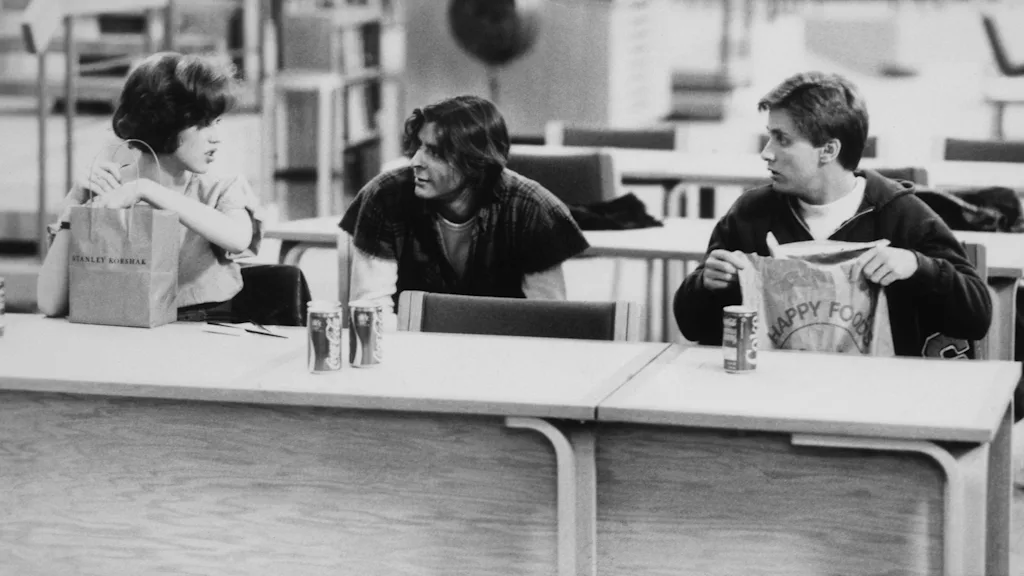
The five teens who make up The Breakfast Club struck a major chord with its Gen X audience, earning the film over $50 million on a $1 million budget when it was released. John Hughes created characters who felt like real teenagers—and he cast five young actors who did a bang-up job portraying these realistic kids with emotion, dignity, and humor. It felt like we were watching real people overcome their prejudices together.
Which raises an interesting question: if these were real people, what might they be up to 40 years after that fateful day in detention?
Let’s imagine what retirement might look like for the former members of the Shermer High School Breakfast Club:
Brian (portrayed by Anthony Michael Hall): Trying to rebuild his nest egg for the third time
After attending Stanford for a degree in Mathematics, Brian has had a successful and lucrative career as a data analyst. Unfortunately, just like when he was a teenager who thought it was a good idea to take shop to boost his GPA, Brian has continued to try to find shortcuts to reach his financial goals.
It started in the late 1990s, when an old college friend who had become a dotcom millionaire invited him to invest in Pets.com, which was guaranteed to take off. Brian talked his wife Alanis into cashing out their retirement accounts, arguing that the 10% penalty they’d pay for accessing money from their IRAs and 401(k) plans would be more than offset by the surefire gains they’d earn. Alanis was not happy when they had to pay the penalty and lost everything.
By 2008, Brian and Alanis had partially regained their financial footing—mostly because Brian was no longer in charge of family investing decisions—but the recession hit just as their kids were starting college. Brian and Alanis took distributions from their IRAs to help pay for their kids’ tuition because they could avoid paying the 10% early withdrawal penalty. The IRS allows you to take a penalty-free withdrawal from your IRA but not from your 401(k) for qualified higher education expenses. Though Brian and Alanis avoided the penalty, their retirement account balances were already diminished because of the recession, so they locked in their losses by taking those distributions.
By 2021, with their retirement accounts finally looking pretty solid again, Brian became enamored with NFTs. Without telling Alanis, Brian liberated a decent chunk of his retirement accounts (and again paid the 10% early withdrawal penalty because he was six years away from the minimum withdrawal age of 59½) and bought himself some bored apes.
He congratulated himself for about a year on making a great financial decision—until the NFT bubble burst. Now Brian is not sure whether he’s more worried about the state of his nest egg or his marriage when he finally comes clean to Alanis.
Andrew (Emilio Estevez): Quietly amassing several million dollars
Andrew settled down back in Shermer after attending the University of Illinois Urbana-Champaign on a partial wrestling scholarship. He took a job selling insurance and he attends every Shermer High School reunion.
What very few people know about Andrew is that his background as an athlete taught him how to be an effective investor. Specifically, he learned that your habits make you who you are. So Andrew maxed out his retirement contributions starting with his very first paycheck. Once sales commissions and bonuses started coming in, Andrew made sure that 50% of each one went toward retirement, too.
But Andrew didn’t just settle for contributing to his retirement accounts. He also wanted to optimize his performance, just like he had as an athlete.
In the mid-1990s, Andrew learned all he could by watching CNBC and trying to read The Wall Street Journal. Eventually, he went to see Larry Lester, his old bullying victim, who had become a financial planner in Chicago. Despite Larry’s understandable wariness, he helped Andrew craft an investment strategy to fit his goals, temperament, risk tolerance, and timeline.
By following Larry’s plan, Andrew has built a portfolio worth nearly $4 million. He has no immediate plans to retire, since he’s only 57, and part of him would love to see if he can get his portfolio up to $5 million.
He buys Larry a beer every time he sees him.
Allison (Ally Sheedy): Worrying about Social Security
After the events of The Breakfast Club, Allison put together a portfolio and received a scholarship for the School of the Art Institute of Chicago. Once she received her BFA, Allison spent a number of years living with friends, making art, and only working sporadically. She and her friends lived hand-to-mouth and worked for cash under the table when they needed to pay rent. Her artwork was relatively successful, and she had several shows in Chicago galleries, but money was never a priority.
When Allison was in her late 30s, her mother became ill. Despite their long estrangement, Allison went back to Shermer to take care of her mother and help her apply for Social Security benefits. Forced to take a retail job while living at home, Allison started thinking about her own future for the first time as she navigated the Social Security system for her mother.
Allison learned that Social Security retirement benefits are based on your 35 highest-earning years in your career and if you have less than 35 years of work history, the calculation uses zeros for the nonearning years to create the average. At the age of 39, Allison realized she didn’t have any work history, at least according to the Social Security Administration. She also hadn’t put any money away for retirement.
At that point, Allison got a steady job as a graphic designer. She contributes to a 401(k) when she remembers, but she’s worried about the fact her work history starts at age 40. She knows she’s going to have a tiny Social Security benefit, but she tries not to think about it too much.
She still paints when she has time. She hopes she might sell a piece for a huge payday someday.
Claire (Molly Ringwald): Taking distributions from an inherited IRA
After finishing college, Claire moved to Chicago and set some firm boundaries with her manipulative parents—but they continued to remind her that they held the purse strings. Eventually, Claire decided to make her own way without her parents’ money or influence.
Her father passed away earlier this year, which is when Claire learned that she was the beneficiary of his IRA, which has a balance of over $2 million. In addition to reigniting her mother’s resentment of her, the inheritance has also been logistically tricky for Claire.
Claire inherited the IRA after the SECURE Act, which means she must empty it within 10 years of her father’s death. She could take the entire balance as a lump sum, but since this is a traditional IRA, it would be considered taxable income.
The other option is to take distributions every year for 10 years—but first Claire would need to determine if her father had already been taking required minimum distributions (RMDs) before he died, in which case she would have to take the RMD her father owed this year if he hadn’t yet satisfied it. No matter what, her taxable income is likely to go up by at least $200,000 per year for the next 10 years.
Claire, who still keeps in touch with John Bender, made the mistake of complaining about this situation the last time she talked to him. He said, “Boo hoo! Queenie has too much money.”
Bender (Judd Nelson): Intending to retire on the proceeds of his dispensary
Despite his determination to prove the malicious Breakfast Club villain Mr. Vernon wrong, John Bender struggled to graduate from Shermer High School. With nowhere to go after graduation, Bender got a job at the local bowling alley. The job stuck—despite his best efforts—because the owner knew what Bender Sr. was like and didn’t hold John’s behavior against him.
Over time, Bender learned marketing, accounting, and inventory from the owner of the bowling alley, and he realized he understood some aspects of running a successful business better than his boss. He just needed a business that he cared about more than bowling.
In the 2010s, Bender paid close attention to the states legalizing marijuana. He started putting together a business plan well in advance of Illinois decriminalizing weed in 2019 and was ready to open a dispensary in Shermer almost as soon as the law passed. It turned a profit its first year and continues to do excellent business. Although it took until he was in his early 50s, Bender finally found work he loves.
Like many other Gen Xers, Bender’s entrepreneurial endeavor will help fund his retirement in Latitude Margaritaville, where he hopes to devote himself full time to pickleball.
Mr. Vernon (Paul Gleason): Retired in 1994 on his teacher’s pension
Nobody hated breakfast club detention more than vice-principal Richard Vernon, who no doubt would have taken early retirement as soon as he was eligible. The Illinois teacher pension system (currently) provides full retirement benefits as of age 67 after at least 10 years of service, but allows educators to retire as early as age 55 with reduced benefits. The full benefit amount is equal to 2.2% of the teacher’s highest average salary during their final 10 years, multiplied by the educator’s total years of service.
We know that Vernon earned $31,000 per year in 1984 (as he brags to Bender). Assuming a 4% pay increase per year, his final salary in 1994 would have been approximately $45,700. From there, we can calculate his highest average salary for his final 10 years of teaching as approximately $40,118. If Vernon started teaching at age 22, his full pension would be equal to:
2.2% of ($40,118 x 33 years) = $29,126 per year
Of course, by taking his pension 12 years early, Mr. Vernon permanently reduced his benefit, so he has to live on significantly less than $29,126 per year.
Somehow, he’s decided it’s Bender’s fault.
Don’t you . . . forget about retirement
Your retirement requires more than seeing things in the simplest terms and the most convenient definitions. When planning for retirement, remember these lessons:
A brain may make terrible financial decisions.
An athlete may understand the importance of habit and incremental improvements.
A basketcase may not always recognize when freedom becomes constricting.
A princess may feel burdened by the rules of wealth.
And a criminal may live long enough to become respected.