
Hello there, and welcome once again to Fast Company’s Plugged In.
For something that continues to suck up so much of the world’s attention, social networking has not exactly been a font of wild innovation in recent years. Its big names are all up there in years and showing their age: Facebook is 21, Twitter is 19. Instagram is 15, Snapchat is 14. Newer entrants, such as BeReal, rarely live up to their early great expectations. Even Bluesky, where many of us have found a home after fleeing the Elon Muskified version of Twitter, isn’t growing at its old clip.
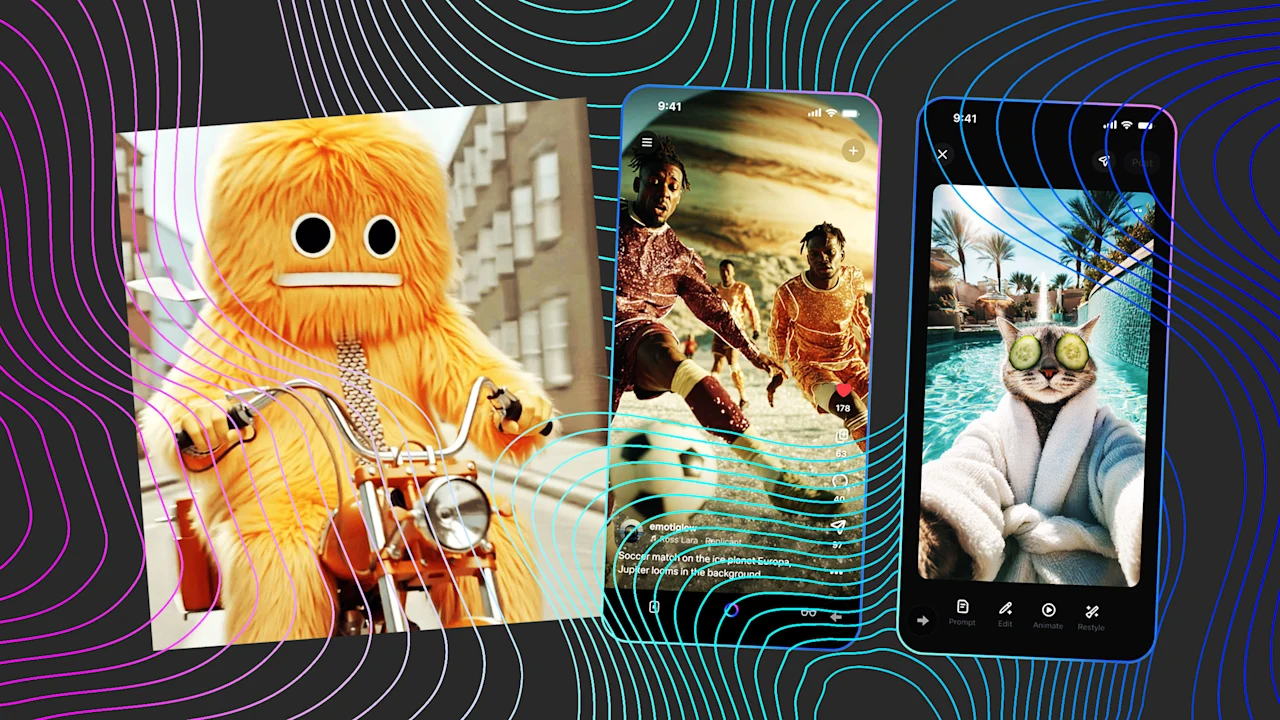
So I was intrigued when two new social networking experiences debuted in rapid succession in late September: Meta’s Vibes and OpenAI’s Sora. Thanks to the fact that both focus on letting people share AI-generated imagery, they compete directly with each other. But their all-AI format also sets them apart from existing social networks, where generative AI is most often a distraction from human contact, not the main attraction.
Personally, I like the idea of AI being cordoned off into its own social app. Most examples of the technology showing up in other social feeds have a dystopian tinge, from Twitter’s Grok bot going full Hitler to the maudlin deepfakes that have recently become an unwelcome element of my Facebook time. (For some reason, Paul McCartney stars in many of the newest ones—in one instance shown dolefully strumming a guitar at Charlie Kirk’s funeral.) Plenty of my friends get downright surly when they encounter AI on their feeds; to avoid making them unhappy, I have gone cold turkey on sharing it.
Isolated in its own apps, however, AI imagery only gets exposed to people who want to see it. And everyone who does see it will understand that it’s synthetic—or so I hope.
While I was waiting to snag an invite code for the Sora app—a requirement to try it at the moment—I dived into Vibes, which is not an app unto itself. Instead, it’s an element of the Meta AI app, which also includes a general-purpose chatbot and serves as a companion for the Meta-powered smart glasses from Ray-Ban and Oakley. Meta is billing Vibes as “an early preview” and says additional personalization and creation tools are in the works.
In its debut incarnation, Vibes doesn’t do all that much. You can enter prompts to create brief AI videos, add music, and then post them to the Vibes feed (or Instagram or Facebook—although I kind of hope you won’t). A Discover feed lets you flip through clips posted by other users, TikTok style, and there’s a remix option that enables you to modify those clips and reshare them.
I cheerfully admit that I found thumbing my way through Vibes mildly entertaining in a hypnotic, untaxing way. Ultimately, though, it felt a little like snacking on Chex Mix—unrelenting sameness, packaged as variety. Little about the videos I saw felt like an expression of individual creativity: I lost track of the number of buttery-smooth tracking shots of obsessively detailed, Pixar-esque orange monsters I saw. The image-generating algorithms—not the humans typing the prompts—are the stars here.
Which brings us back to Sora. Its biggest differentiator from Vibes is that you can create a “cameo” digitized version of yourself and make it the main character of your AI clips. You can also make your cameo available for incorporation into your friends’ videos, or even ones credited by the entire Sora community. Moreover, cameos and other characters in Sora videos talk; in Vibes, audio is limited to music you pick from its library.
Once I got into Sora, it took only a minute or two of exposure to realize that the experience it offers is vastly richer than Vibes. Its clips aren’t just demos of what the technology can do—they’re wacky 10-second mini-movies, sometimes with multiple shots, that occasionally provoked me to literally LOL. Thanks to cameos and OpenAI’s decision to allow depiction of copyrighted property unless its owners explicitly request otherwise, the cast of characters is dazzling: OpenAI CEO Sam Altman, Pikachu, SpongeBob, JFK, Martin Luther King Jr., Betty White, Mister Rogers, and several tech journalists of my acquaintance all made multiple appearances in my feed.
Just in its first few days, Sora seems to have spawned a billion memes, such as a dog being pulled over for speeding, that users riff on by remixing them. In remixes I saw, the driver was a fish, a cow, a giraffe, and Dora the Explorer. No equivalent kindling of community-based humor seemed to be going on over at Vibes.
In other words, Sora feels far more like a killer app with a truly social angle than Vibes. It’s hard to imagine that Meta—which turned imitating (and sometimes improving upon) Snapchat into Instagram’s entire modus operandi—isn’t working furiously on similar functionality. But even if it catches up, OpenAI got there first. Which means that it also has to worry about its app causing problems that the current, more anodyne Vibes probably won’t.
To its credit, OpenAI has clearly done a lot of thinking on that topic. When I signed into Sora for the first time, I got a full-screen disclaimer: “You are about to enter a creative world of AI-generated content. Some videos may depict people you recognize, but the actions and events shown are not real.” I wasn’t able to create videos of living celebrities—I tried Donald Trump, Taylor Swift, and Bad Bunny—except for Altman, who created a cameo of himself and set it to allow open usage. Some baseline of good taste is being imposed: My attempt to create a clip of my own cameo punching out people resulted in an odd effect where the blows didn’t quite land.
The most worrisome misuse of Sora might involve it being used as a tool for deepfake-assisted bullying. OpenAI says it’s putting limits on teenagers’ use of the app, including tighter rules for cameo appearances. You can even see other people’s unpublished draft videos if they depict your cameo, a pretty important measure given that it’s possible to download Sora videos for use elsewhere without ever posting them in the app. (They carry Sora watermarks, indicating their provenance and fictional nature.)
No matter how hard OpenAI works to keep Sora healthy, it’s tough to imagine there won’t be instances of users with bad intent successfully jumping over its guardrails. Sora-generated slop could also overwhelm other social networks where AI is less welcome. Or maybe the app will simply grow tiresome once its novelty has worn off.
For now, Sora is easily the most interesting consumer product that OpenAI has come up with since ChatGPT. More significantly, it’s the rare new social network that feels like it might have legs. I’m @harrymccracken there—and hope it remains a silly ingredient in my social-media diet for the foreseeable future.
You’ve been reading Plugged In, Fast Company’s weekly tech newsletter from me, global technology editor Harry McCracken. If a friend or colleague forwarded this edition to you—or if you’re reading it on FastCompany.com—you can check out previous issues and sign up to get it yourself every Friday morning. I love hearing from you: Ping me at hmccracken@fastcompany.com with your feedback and ideas for future newsletters. I’m also on Bluesky, Mastodon, and Threads, and you can follow Plugged In on Flipboard.
More top tech stories from Fast Company
ChatGPT can now spend your money for you
It’s a huge deal for users, brands, and the future of agentic AI. Read More →
How the White House redesigned its website to blame Democrats for the shutdown
WH.gov transformed into a billboard for a government shutdown publicity moment. Read More →
One in five Americans now regularly get news on TikTok, up sharply from 2020
‘No social media platform we’ve studied has experienced faster growth in news consumption.’ Read More →
Peloton is pivoting to AI. Here’s how it’s using custom-built models to improve your workout
The embattled at-home fitness company is raising its prices and using machine learning to personalize members’ workouts. Read More →
Why Amazon went all-in on balls for its new line of speakers
Three years in the making, Amazon’s new spherical Echo Studio and Echo Dot Max are built to raise the bar of Amazon’s audio quality and usher in the next generation of smart home. Read More →
Who controls the machines that control Artificial Intelligence?
The hidden arms race of AI supercomputers. Read More →