
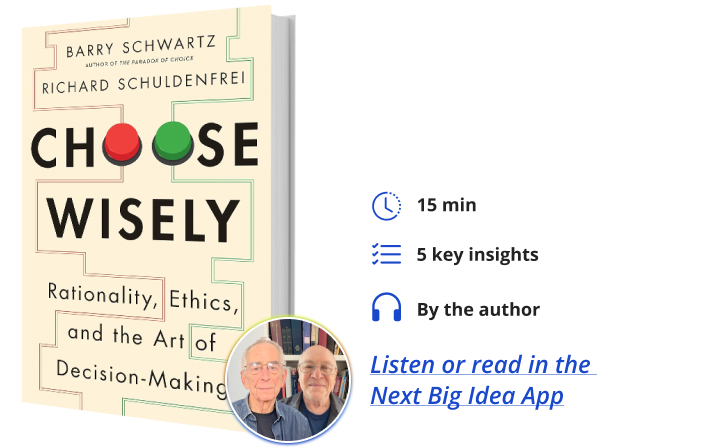
Below, co-authors Barry Schwartz and Richard Schuldenfrei share five key insights from their new book, Choose Wisely: Rationality, Ethics, and the Art of Decision-Making.
Barry spent 45 years teaching psychology at Swarthmore College. Now he holds a visiting position at the Haas School of Business, University of California, Berkeley. Richard held a similarly long tenure at Swarthmore College, 42 years, as a philosophy professor.
What’s the big idea?
There is no such thing as a calculator for life’s decisions. Try as we might to quantify, count, and calculate in search of the “right” choice, that is simply not how wise decision-making happens. Qualitative judgment and consideration of preferences and values are required when identifying the best option before us.
Listen to the audio version of this Book Bite—read by Barry—below, or in the Next Big Idea App.
1. Sorting through the possibilities
Imagine waking up on a beautiful Saturday morning and asking yourself, What should I do today? You consider the possibilities: get some exercise, go for a hike, go to a lovely park with a serious book under your arm, catch up on work, veg out, and watch sports on television. Or maybe, instead of thinking about what you might do, think about what we might do.
What social activities might you engage in? Get in touch with friends, visit your mother at the assisted living facility, or help your adult daughter pack for her apartment move. Lots of possibilities. Is there a right way to think through your options for the day? Is there a right way to choose which of these things to do?
2. Rational choice theory
In economics, according to rational choice theory, there is a rational way to make decisions, which requires thinking about two things:
- How valuable are the options you’re deciding between?
- How likely is it that the option you pick will be as good as you expect?
We live in an uncertain world, and so you assess the value and probability of your options, then multiply them. What you get is expected utility. The rational choice should be the option that provides the greatest amount of expected utility.
This framework analogizes the decisions we make in life to the decisions you might make in a gambling casino. What’s the best strategy in a blackjack hand? What are the odds and payoffs at the roulette table? In situations like this, it only matters how much you could possibly win and how likely you are to win. Rational choice theory suggests that we should think about most of our decisions in these terms.
In figuring out how good it will be if I choose this option, and how likely it is to be that good, you must quantify the relevant information. Create a spreadsheet of all the factors that might matter in making a choice. List how good a particular option is with respect to all these factors, and enter a value for both how good it is and how probable it is. Fill out the spreadsheet with all the options, push a button that does the math, and you’ve made a rational decision.
“This framework analogizes the decisions we make in life to the decisions you might make in a gambling casino.”
Rational decisions are quantitative. You need to attach quantities and magnitudes to both the value of the options and the likelihood that you will achieve that value. Rational choice theory has nothing to tell us about what your preferences among options should be, what your values should be, or what set of options you should consider. In this economic framework, you have whatever values you have, your options are whatever options the world presents, you create the spreadsheet, do the math, and pick the best option. That’s the model of rational decision making.
3. Framing the options
Do we behave as rational decision makers? Definitely not. About 50 years ago, psychologists Daniel Kahneman and Amos Tversky started studying how people make decisions. They did some beautiful and extremely important research, but unfortunately, Tversky died prematurely. Kahneman survived to win the Nobel Prize in Economics and published a book called Thinking Fast and Slow, which has been on the bestseller lists for almost 10 years. His work helped create the field of behavioral economics.
Behavioral economics research has illustrated the ways in which people fail to meet the standards of rational choice theory. People are bad at thinking about probability. People are heavily influenced by the way in which options are framed. People divide their decisions into different accounts and often don’t aggregate the potential consequences of those decisions into one big account. People are highly influenced by anchors. A $500 suit seems inexpensive on a rack full of $1000 suits but seems quite expensive on a rack of $200 suits. These aspects of decision-making get us to more or less the right place, but they can also lead us seriously astray.
The way Kahneman came to regard human decision making is that there are two processes happening:
- Conscious process: Thinking through the pluses and minuses of various options when asking yourself what choice to make. This is effortful, slow, and demanding.
- Automatic process: This system delivers answers to you even before you frame the question. It is fast, efficient, and operating whether you want it to or not.
These two systems interact, and sometimes the automatic system leads the more deliberate, rational system astray. Even if we end up making rational decisions, it’s not through the processes that rational choice theory tells us we should follow.
4. Not everything can—or should—be calculated
Rational choice theory is a terrible model of what it means to be a rational decision maker. Are most of our decisions really like casino gambles? Can everything that matters in a decision be quantified? What’s good about doing strenuous exercise on a hike? And what’s good about helping your daughter pack? What is the common scale of value?
“Can everything that matters in a decision be quantified?”
If you’re choosing a job, you might be interested in knowing the salary, benefits, who your colleagues will be, whether the work will be interesting, the location, opportunities for advancement, and other relevant details. It’s preposterous to attach numbers to all those factors and then use those numbers in a spreadsheet to figure out which job is best for you. Similarly, if you’re deciding where to go to college, you might be interested in quantifiable things like graduation rate and average salary after graduation, but what about the qualitative features of the education, social life, food, and housing? Can these things be arrayed on a spreadsheet using a common scale for assigning value?
When you follow rational choice theory, instead of thinking about decisions, you count. Calculation substitutes judgment. In some areas of life, that could be a good thing, but in many others, shutting down your ability to subjectively reflect will lead to worse, impoverished, pinched decisions.
5. A rational decision requires rational judgment
Rational choice theory is dangerous as a normative standard. It narrows our thinking by encouraging us to invent quantifications of things that can’t be quantified.
During the Vietnam War, the U.S. government was facing pushback from citizens and wondering how to generate popular support for the war. It was concluded that if the public saw that the U.S. was winning, then more people would favor involvement. But it was a guerrilla war, so can someone know who’s winning? It was decided to use body counts and casualties as an indicator. If the enemy had higher numbers of wounded or dead than our side, then we must be winning. This affected our fighting strategy. Instead of seeking strategic advantages, we made decisions designed to maximize casualties because it meant we could tell folks back home that the U.S. was winning the war. As a result, we didn’t win the war, and thousands of people died needlessly.
“Rational deciding requires rational judgment and not just counting.”
You can see the danger of rational choice theory decisions, like where to go to college, too. People are heavily influenced by the ratings of U.S. News & World Report, so universities have learned how to game those ratings by making themselves look good with respect to the dimensions that U.S. News cares about. Does that make them better institutions? Maybe sometimes, but mostly it does not.
Rational choice theory forces us to focus on things that can be easily compared and quantified while leaving out the rest. Rational deciding requires rational judgment and not just counting. We don’t want our ability to think and judge rationally to atrophy because we think that the rational approach to decisions is essentially mechanical and algorithmic.
Enjoy our full library of Book Bites—read by the authors!—in the Next Big Idea App.
This article originally appeared in Next Big Idea Club magazine and is reprinted with permission.