
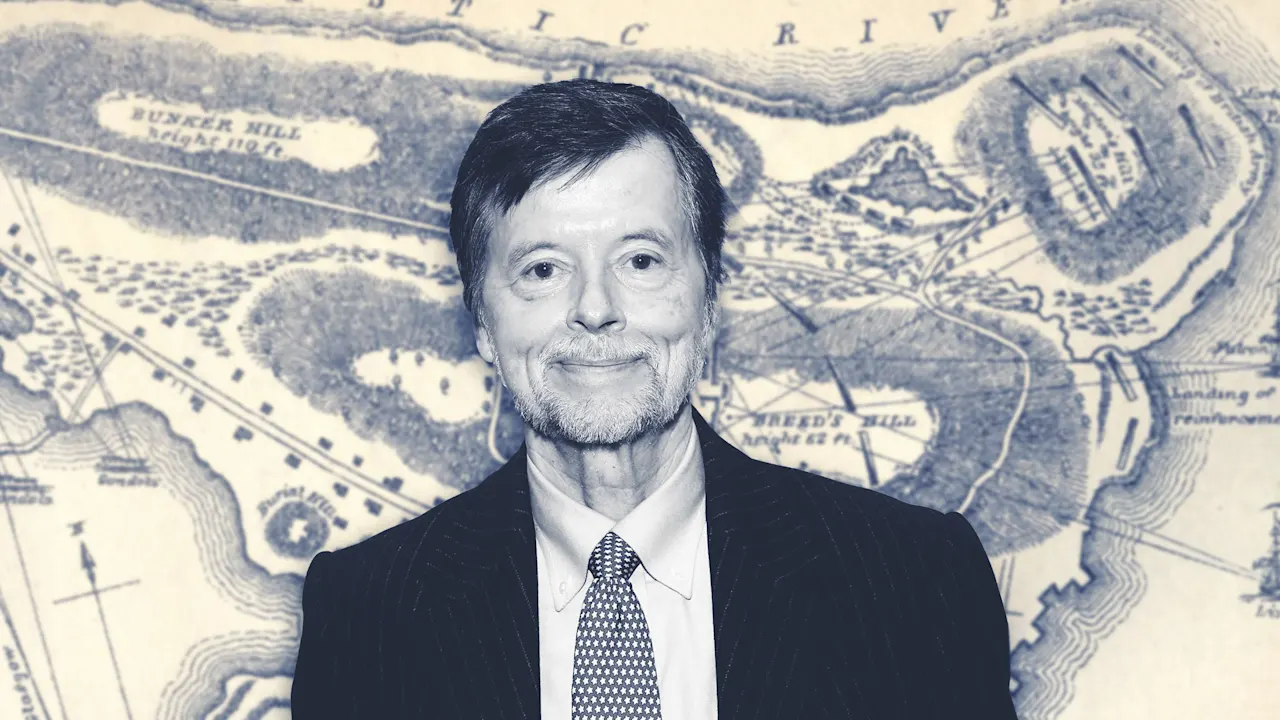
Legendary documentarian Ken Burns is set to release his long-awaited series after a decade in development. In the lead-up to the premiere of The American Revolution, Burns shares key lessons he gleaned from the founding of the United States—and the parallels between the revolutionary era and today. He also reflects on his admiration for Lin-Manuel Miranda’s Hamilton, and the obstacles he himself faces in his ongoing quest for truth.
This is an abridged transcript of an interview from Rapid Response, hosted by former Fast Company editor-in-chief Robert Safian. From the team behind the Masters of Scale podcast, Rapid Response features candid conversations with today’s top business leaders navigating real-time challenges. Subscribe to Rapid Response wherever you get your podcasts to ensure you never miss an episode.
You have a new, six-part series about the American Revolution premiering on November 16. Why were you drawn to this? And why now?
I’ve been working on this for almost 10 years. . . . I said yes to this project in December of 2015. Barack Obama still had 13 months to go in his presidency. What drew me to the Civil War was organic and interior to my choices. I was looking at a map, a kind of 3D map, where I suddenly saw an arrow of British moving west through Long Island towards Brooklyn. This little, tiny town of Brooklyn, which is the largest battle in the entire revolution.
While there are no photographs and newsreels, I felt being a lover of maps and a willingness, I think, to reexamine my usual disdain for reenactments—they’re [the actors] aren’t going to reenact that battle. They’re just being there to make you feel the weather, make you feel the heat, make you feel the cold, make you feel the location, the interiors of all of these actions, and at that point, I realized maybe we can do this. Of course, I went about three years into the project and said, “Wow. If we hit our marks, we’ll be in 2025, which is the 250th anniversary of Lexington and Concord.” Then, all of a sudden people would arrive and say, “Oh, you planned this so well.”
Yes, yes.
We didn’t. I’m glad that a very deep dive into the revolution is going to happen way in advance of the Fourth of July of next year, which is, for many people, the 250th. Of course, it’s been going on for some time, and will go on if you want to follow it through to the end, until 2039, which is 250 years after our government officially got started and George Washington became the first president of the United States of America. There’s lots of things going on. But a lot of it will be focused next July, and there is that risk that it could become superficialized. The war itself is already encrusted with the barnacles of sentimentality and nostalgia. It is not bloodless or gallant. You do not want to die when a cannon takes off your head, or a bayonet guts you, or a musket ball rips through you.
There’s just a remarkable set of characters and remarkable interiors to the war, the details of the battles—a really long, six-and-a-half-year war from Lexington to Yorktown. We need to know about our origin story, particularly in a time when people are sort of ringing their hands. We’re so divided. Well, you just look back there, and we were really divided back then. And that maybe reinvesting with our origin story helps us find out what’s real and what’s artificial in all of the stuff that’s going on right now.
The current cultural story about the American Revolution that maybe is most prominent or most well-known is Hamilton, Lin-Manuel Miranda’s retelling in that. Did that impact the way you told the story at all?
Look, let me give my props to Lin-Manuel. Hamilton is the greatest cultural event of this new millennium, this new century. It is a phenomenal thing. I mean, I’ve got a teenage daughter who’s 15, a 20-year-old daughter, and an almost-15-year-old granddaughter, and they can . . . sing the whole thing, two and a half hours. And so, they know tensions between big and small states. They understand between a strong federal Hamiltonian system and a state’s rights Jefferson model. They know who Hercules Mulligan is. They know all this sort of stuff about the revolution, and they have a kind of great glee about it that must mean that history teachers of this period are just lying down and thanking God for Lin-Manuel Miranda.
I mean, truth and fact are increasingly contested today, and we mentioned Hamilton. I mean, Lin-Manuel, the big picture is certainly there, but there’s a lot of artistic license in what he pulled together. When you look at this as a storyteller—and for our listeners who are business leaders and other leaders—is the responsibility to promote strict accuracy? Or, like, as long as we get the big picture right, it’s okay, the details don’t matter as much?
The people that are listening to this have to do the former, right? Strict accuracy, and so do I. . . . But we’re always finding new and destabilizing information [that’s] true and you need to incorporate [it]. Lin-Manuel can actually take the poetic license necessary to do a big, Broadway musical, and God bless him.
I mean, there’s a guy that we know in our past who would take the histories and conflate characters, change countries, move these characters around: His name is William Shakespeare. And we don’t believe that there are any truths higher in fiction, which are sometimes more true than what’s real. But I can’t do that. I will sacrifice the art for the correct story. That makes it super complicated. But what’s interesting is when you do that, when you try to fit the round peg of the truth into the square hole of art, if you will, and you successfully negotiate it, it’s as good as anything. You’re right, we’re in an age where we’re supposed to be post-truth. No, we’re not. Are you post-truth? I’m not.
Right.
Nor are the business leaders of the country. You’re going to fudge your figures? I don’t think so. We do know that large sections of where we supposedly get information are, themselves, unaccountable. They do not care, one way or the other. Whatever political persuasion, whatever it is, people are manipulating the truth all the time. Always have been.
The problem is just the sheer size of the internet and its ability for a lie to get started before the truth can come back. But one and one is always going to be two. You can’t build an airplane, you can’t run a business, you can’t work the budget of a documentary film without one and one equaling two. You can’t just make it up, right? You cannot make it up.
George Washington rides out on the battlefield at least three times, that I know of, risking his life—at Kips Bay in Manhattan, at Princeton, and at the Battle of Monmouth. And these are significant things. If he’s killed, it’s all over, because he is the only person that held us together, as historian Annette Gordon-Reed says. . . . And I’m interested in him. He’s deeply flawed. He’s rash . . . and he makes terrible battlefield mistakes. He leaves his left flank exposed in the Battle of Long Island, the largest battle of the American Revolution, and loses it and New York for seven years. It’s the British headquarters and the loyalist stronghold for the rest of the war.
He does the same mistake at Brandywine in Pennsylvania, another huge, huge battle, where this time he leaves his right flank. But there’s nobody who knew how to inspire men in the dark of night, in the dead of cold, who could pick subordinate talent that he wasn’t afraid of their skills or talent. Who could defer to Congress and understand how they work. Who could speak to a Georgian and a New Hampshirite and say, “You’re not that. You’re an American, this new thing.” Nobody. Nobody could do that. Does he have undertow? Yes. Does that make him any less heroic? No. Heroism is not perfection. Heroism is a negotiation within yourself between your strengths and your weaknesses.
Has truth always been sort of fungible and selective in U.S. history, kind of a matter of debate and perspective, or is this time we’re in now different?
Human beings have always lied. People have been lying as long as there have been human beings.