
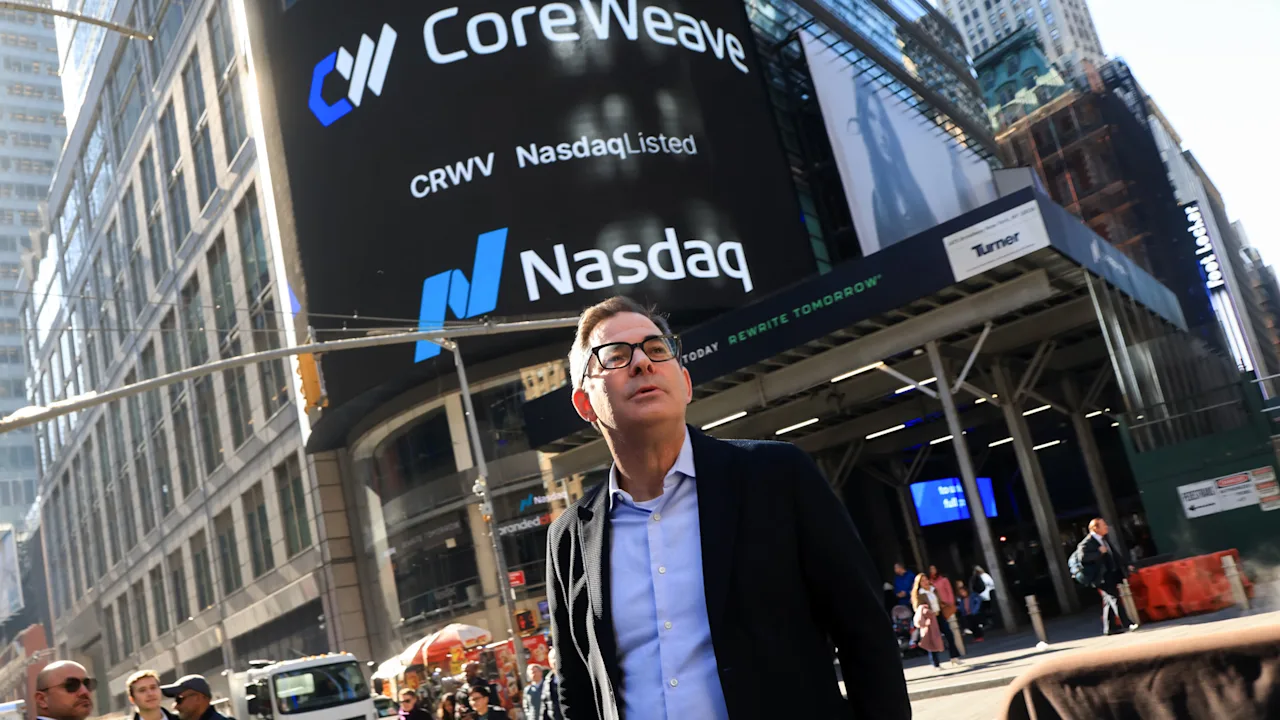
CoreWeave stock dropped 8% Monday after the AI cloud computing company announced plans to raise another $2 billion, this time through convertible debt, to finance its rapid build-out of new data centers. On Tuesday, the company said it would increase the total offering to $2.25 billion. CoreWeave, which sells access to powerful Nvidia graphics processing units (GPUs) to run AI models, may be a bellwether in an industry placing unprecedented bets on an AI boom some believe is just around the corner.
CoreWeave is a “pick-and-shovel” infrastructure company in AI (like Nvidia) whose fortunes may test the narrative that tech companies—and their stock values—are riding the long wave of the next technological transformation. CoreWeave’s stock may be an especially twitchy meter because investors’ rosiest expectations for how that narrative will play out appear to be already priced in. An 8% drop suggests that investor skepticism of the reality and sustainability of the AI boom is growing (the stock closed down only 2.3% on Monday and rose 5.2% on Tuesday, however).
The new convertible notes are targeted at investors willing to loan CoreWeave money at a relatively low interest rate (1.75%), in exchange for the option of converting the notes to equity shares when they mature in 2031. The company also plans to grant initial purchasers an option to buy an additional $300 million in notes ($337.5 million with Tuesday’s add-on). CoreWeave said it raised $1.75 billion through the sale of similar notes during the third quarter.
But the new debt raise comes at a sensitive time. CoreWeave continues to aggressively raise and spend money for its infrastructure expansion, even as its margins fall, making some investors nervous. The company has already raised roughly $14 billion through debt and equity this year alone ($25 billion in total). It reported paying $311 million in interest in Q3 2025—triple the amount it paid in the same quarter a year earlier.
The company already has 41 data centers in its portfolio, CEO Mike Intrator said. The company also buys data center space from third parties. CoreWeave executives believe the company will spend between $12 billion and $14 billion during 2025, and that that amount will double in 2026.
CoreWeave has seen its revenue surge: It rose 134% year over year to $1.36 billion in Q3. But its operating margins have suffered, falling to 4%, compared with 20% in the year-earlier quarter (or 16% from 21% when nonoperational expenses are factored out), as its infrastructure expenses mounted. The company remains unprofitable, posting an adjusted net loss of $41 million in Q3.
Meanwhile, demand for AI computing is high, and the company has been struggling to keep enough GPUs humming to fulfill it. Its shares plunged 45% in November after the company gave full-year revenue guidance below analyst expectations. Company executives said CoreWeave has a backlog of contracted but not yet recognized revenue worth $55.6 billion, nearly double the $30.1 billion reported in Q2. The company says it has major contracts with Meta ($14.2 billion), OpenAI ($22.4 billion across multiple agreements), and Nvidia ($6.3 billion).
But the backlog may not fully translate into revenue, investors worry, especially given CoreWeave’s expansion challenges. And yet the company expects capital expenditures to more than double in 2026 compared with 2025, raising questions about how much more debt it will need to take on.
Investors’ reaction to CoreWeave’s sour full-year revenue guidance may not have been so dramatic if much of the market wasn’t already fearful of a so-called “AI bubble,” or the idea that AI-heavy companies like CoreWeave are way overvalued and overleveraged.
CoreWeave’s decision to issue short-term debt reflects management’s strong belief that the data center capacity the money will fund will quickly translate into increased revenues.
While equity investors reacted negatively to the offer of the convertible notes, the corporate bond market has shown strong demand for them in the past. Initially, the new convertible notes will be offered to institutional investors in private transactions. However, CoreWeave’s past debt offerings have seen strong investor demand—in part because of bullishness about the company’s business prospects and in part because of the relatively high interest rates (9% and 9.25%).
In fact, the tech sector’s biggest players are now placing unprecedented bets on AI. The market caps of these companies, and by extension the wider stock market, seem to rest on the idea that AI models will soon transform business and bring about untold efficiencies and abundance.
The big questions are whether or not said AI transformation will happen fast enough and last long enough to sustain VC-backed AI startups, and the stock prices of larger, publicly traded tech companies. Some longtime investors are reminded of the “irrational exuberance” that propped up the ill-fated dot-com companies of the late 1990s.