
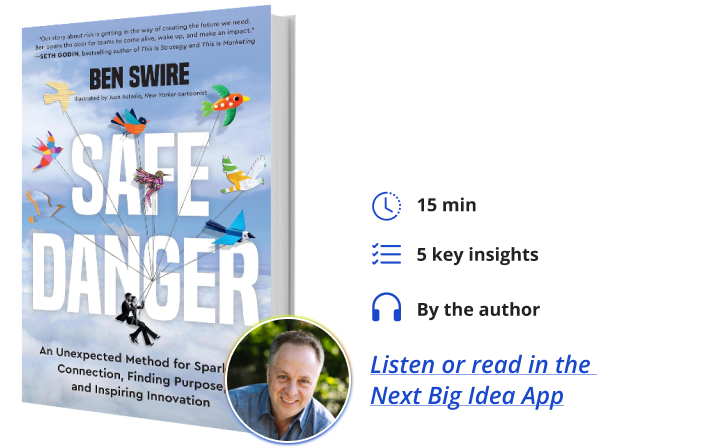
Below, Ben Swire shares five key insights from his new book, Safe Danger: An Unexpected Method for Sparking Connection, Finding Purpose, and Inspiring Innovation.
Ben is a former Design Lead at the innovation firm IDEO and co-founder of Make Believe Works, a team-building company that uses creative activities to accelerate connection, deepen trust, and fuel collaboration. His methods have helped organizations, from Fortune 500 companies to public school districts, build healthy, productive workplace cultures.
What’s the big idea?
Most of us think of risks as a threat to our safety. But what if they’re the best way to create the kind of safety that matters most—trust, creativity, and connection? What if safety itself doesn’t come from avoiding risk, but from taking small, smart risks together?
1. If you’re ready to change but afraid to rock the boat, try a little Safe Danger.
Most people tend to think safety and danger are opposites. But it’s more useful to think of them as dance partners. Safety gives us solid footing; danger gives us movement. The emotional sweet spot between the two—where you feel safe but challenged enough to discover something new—is something I call Safe Danger.
I base entire team-building and community-building workshops around moments of safe danger. In that zone, you can take small, meaningful risks—like sharing a half-baked idea or owning up to an embarrassing shortcoming—in ways that build trust, empathy, and connection.
The trick to making Safe Danger effective is not to ask a lot. This is not about big confessions or life changes, but rather asking enough to make future risks feel less intimidating. For example, I might base an activity around the person who inspired you to become who you are today. Or about a hard-earned life lesson. These ask you to risk sharing some personal details of your story, but are not so private as to be intrusive or uncomfortable. These are manageable risks.
“The trick to making Safe Danger effective is not to ask a lot.”
Every time you take a small risk and it goes well, your nervous system updates its prediction: It’s safe to be a little braver here. That’s why Safe Danger works. It rewires fear into trust, step by step. And trust is contagious. When one person shares a personal story or asks an uncomfortable question, others feel permission to follow.
This isn’t about bullet points. It’s not about telling. It’s about showing. It’s about the feeling. Safe Danger works because you feel the risk, you feel it pay off, and your brain starts to build an appetite for more.
2. Build Safe Danger by leveling the playing field.
Most workplaces celebrate what people do, not who they are. That’s efficient, but brittle. If your value depends on flawless output, everyone’s going to hide their messier truths—the exact truths teams need to share to collaborate and innovate and grow.
If you want to practice building a space that celebrates people for who they are, there are three principles I use in my workshops to create the safe danger that makes people feel able to lower their guard.
These three principles help level the playing field so that no one has to worry about embarrassment, and everyone is set up for success:
- Intention over execution. When I have people make something in response to a prompt, I don’t focus on what people make; I focus on why they made it. Whether someone has labeled themselves as creative or uncreative doesn’t matter. Talent is out of people’s control. I reward the choices within their control: generosity, effort, and thoughtfulness. We don’t grade the drawing; we use it to focus on the ideas it’s meant to express.
- Curiosity over comparison. Instead of saying, “That’s beautiful,” which immediately builds a hierarchy and starts everyone else wondering if theirs is as good, I’ll say, “I see you used all blue—what made you choose that?” That neutral curiosity says, “This is valuable, and I want to know more about how your mind works.”
- Journey over destination. The goal of having people make things is the story behind it: what mattered to you, what you noticed, what you felt. Safe Danger is not about the creation, it’s about what you learn in the making and what you reveal about yourself and others in the process.
When someone feels seen for how they show up, not what they produce, they feel safe to be more themselves. Suddenly, even the most resistant introvert or battle-worn cynic starts participating more fully. This is how you build psychological safety in minutes, not months: make it safe to be seen, and worth it to share.
3. Fun isn’t enough for connection.
My specialty is helping people connect quickly and meaningfully. That falls under the heading of team building. Even though there can be lots of fun in the process, most traditional team-building activities don’t actually build the team.
There are three pitfalls in a lot of team-building ideas:
- Competition. Lots of team-building leans into competition because it’s a quick, easy way to get people fired up. But competition inherently divides people, pits them against each other, people start showing off, and most people lose. Not a great mindset for authentic connection.
- Passivity. Guest speakers or cooking classes can be easy and pleasant, but people don’t really contribute any value to the experience themselves. You never want someone to walk away thinking no one would have noticed if they had skipped that. Everyone needs to feel that they matter.
- Old news. This simply means you carried old dynamics into a new room: fun stuff, like happy hours and escape rooms, where the loud people get loud, the quiet get quiet, and cliques stick together. People leave as they arrived, with no new insight or feeling.
Fun matters. It just isn’t enough on its own. If nothing new was revealed about who we are, we didn’t build a team—we filled a calendar.
That’s why I like to use play and creativity to help create safe danger. Creativity is like an oven mitt. It lets you handle dangerous material without getting burned. People believe they’re talking about what they made, but they’re actually sharing their values, priorities, and perspectives on life. They get to be vulnerable without feeling threatened, to feel seen without being judged.
One of my favorite examples of this is an activity called “Orchestra of Optimism.” I ask people to think about how it feels for them to go from being stuck to being inspired. Then I have them sketch that out on a piece of paper—a tornado? An EKG? A plate of spaghetti? Next, I ask them to compose a 30-second “soundtrack” of that journey, using whatever’s at hand—staplers, coffee mugs, plants, carpet, it’s all fair game. The performances are short, wordless, and totally unique.
Everyone’s inner process is different, yet that individuality can get lost when we all use the same words to describe ourselves. But translating feelings into sound forces us out of our usual shortcuts. It’s a little playful, a little vulnerable, and surprisingly revealing. In 15 minutes, you’ve learned something real about how each person navigates challenge—insight that transfers to work. With a little safe danger, fun stops being a diversion and becomes a delivery mechanism for understanding.
4. Soft stuff gets solid results.
Leaders often ask, “Does this soft stuff, like trust and connection, actually move the numbers?” Yes, because the soft stuff enables the hard stuff.
Psychological safety is the top predictor of team effectiveness. Amy Edmondson’s research shows that teams in which people can speak up without fear learn faster and perform better. Gallup’s Engagement data consistently links high-trust cultures with better retention, productivity, and profitability. A major productivity study by the University of Warwick suggests that when people genuinely enjoy their work, output skyrockets. Building cultures around the soft stuff is not about being “nice.” It’s about reducing the hidden tax of fear and loneliness so brains can do their best work.
“Psychological safety is the top predictor of team effectiveness.”
I’ve seen this translate in rooms that care deeply about results—like competitive sales teams. One leader told me after a Safe Danger activity, “We still love to push each other, but this showed us the difference between competing against each other and competing with each other.” That shift can unlock more pipeline suggestions, more honest post-mortems, and faster iteration.
If you want speed, use Safe Danger to build trust. If you want better ideas, use it to lower the social cost of being wrong. If you want accountability, use it to normalize admitting reality. Safe Danger activities aren’t a detour from performance; they’re a secret shortcut.
5. Small risks can yield big returns, no matter who you are.
I’m a deep introvert with a healthy cynical streak. For years, I would have rather run for the hills than do a team building skit. But Safe Danger creates the space for everyone—even skeptical introverts like me—to engage. It works for anyone who wants to grow, connect, or stop feeling so alone at work or home.
Safe Danger can even adapt from the everyday to the extreme. Recently, I worked with a team ten days after a colleague was murdered in a workplace shooting. They’d had time off and counseling, but this was their first time back in the office. At lunch, the mood was light but careful—polite armor. Chit chat. But during the Safe Danger session, that all shifted with a simple prompt: “How do you want to grow as a person this year?” The first person held up a small, funny gift a colleague had made for him: “I want to live differently after this.” Shoulders dropped. People leaned in. The room became deep but not heavy, meaningful but not morose. It wasn’t therapy; it was permission. After that, one by one, they all spoke about the changes they hoped to make and how they were going to help each other get there.
But you don’t need a crisis. The principle is the same whether you’re an introvert during a Tuesday stand-up or a team carrying unspoken weight: create a container where a small, honest risk is obviously worth it. Do that repeatedly, and you get compounding returns in trust, candor, and creativity.
“Taking small, brave risks can make a real difference at work, home, or anywhere.”
Anyone can practice Safe danger in daily life by taking one small risk that reassures your brain that honesty is worth it here. Taking small, brave risks can make a real difference at work, home, or anywhere. Pay attention to the moments that you hold back, like the joke you almost made or an honest thought you edited out. Those are opportunities to change course.
Most of us are living someone else’s life. We’re following expectations we inherited instead of choices we made ourselves. We learn early on to hide or diminish the qualities that make us unique in order to fit in. Safe Danger allows us to risk showing up as our real selves instead of someone else’s version of us. It’s a chance to rekindle our dimmed light, so we can rediscover and express the parts of ourselves that may have been scared into silence.
If you’re not speaking with your own unique voice, the world is missing out. The people who mean the most to you, look up to you, and people you may never even meet, are all missing out if you’re not standing out. The risk you take is never as big as the reward it returns.
Enjoy our full library of Book Bites—read by the authors!—in the Next Big Idea App.
This article originally appeared in Next Big Idea Club magazine and is reprinted with permission.