

Protein is everywhere these days. The cultural obsession with the macronutrient has become unavoidable; from constant protein-adjacent Instagram ads to protein-focused recipes and protein-filled Chipotle bowls, Starbucks drinks, and Pepsi products. All of these products are starting to sound like part of some big, loud, fitness influencer chorus. But there’s one brand that’s managed to break through the noise—often, by saying nothing at all.
Early this month, the protein bar company David debuted a print campaign in the New York City subway system featuring plain images of its bars, with no text or embellishments, surrounded by a sea of blank white space. It’s the encapsulation of a marketing strategy that’s catapulted the brand into the cultural zeitgeist and the protein bar big leagues.
Where other protein bars sport colorful, energetic packaging with bold fonts and crisp product imagery, David bars come in sleek gold packages with a serif wordmark and a few simple macronutrient descriptors. Instead of vying for consumer attention with eye-catching graphics and silly ads, David shows up online and in the real world with a distinctly minimalist aesthetic and serious, no-frills brand voice. It’s an approach that founder Peter Rahal describes as “anti-marketing”—but, counterintuitively, is actually a highly effective marketing tactic.
Rion Harmon, executive creative director of the creative agency behind the David brand, Day Job, says an atypical ethos has guided the creative from the start: “[The brand] should not be your best friend.”
“Every brand was trying so hard to win you over, to be just like you,” Harmon says. “David didn’t care. David was here to be effective. To design solutions. To create a superior product, with a superior brand.”
How David built a protein-obsessed following
Since it debuted last September, David has amassed an almost cult-like following of customers who patiently await its next protein innovation.
David was founded by Rahal, a serial entrepreneur who also cofounded the brand RXbar; and Zach Ranen, who previously founded the better-for-you cookie brand Raize. After launching, the company managed to sell more than $1 million worth of bars in a week. By the following May, it had raised $75 million in Series A funding, at a $725 valuation—and, according to a report from The New York Times in September, it was on track to hit $180 million in retail sales this year. (David declined to share updated financial information with Fast Company.) This month, David announced that it would appear on shelves at Walmart and Target.
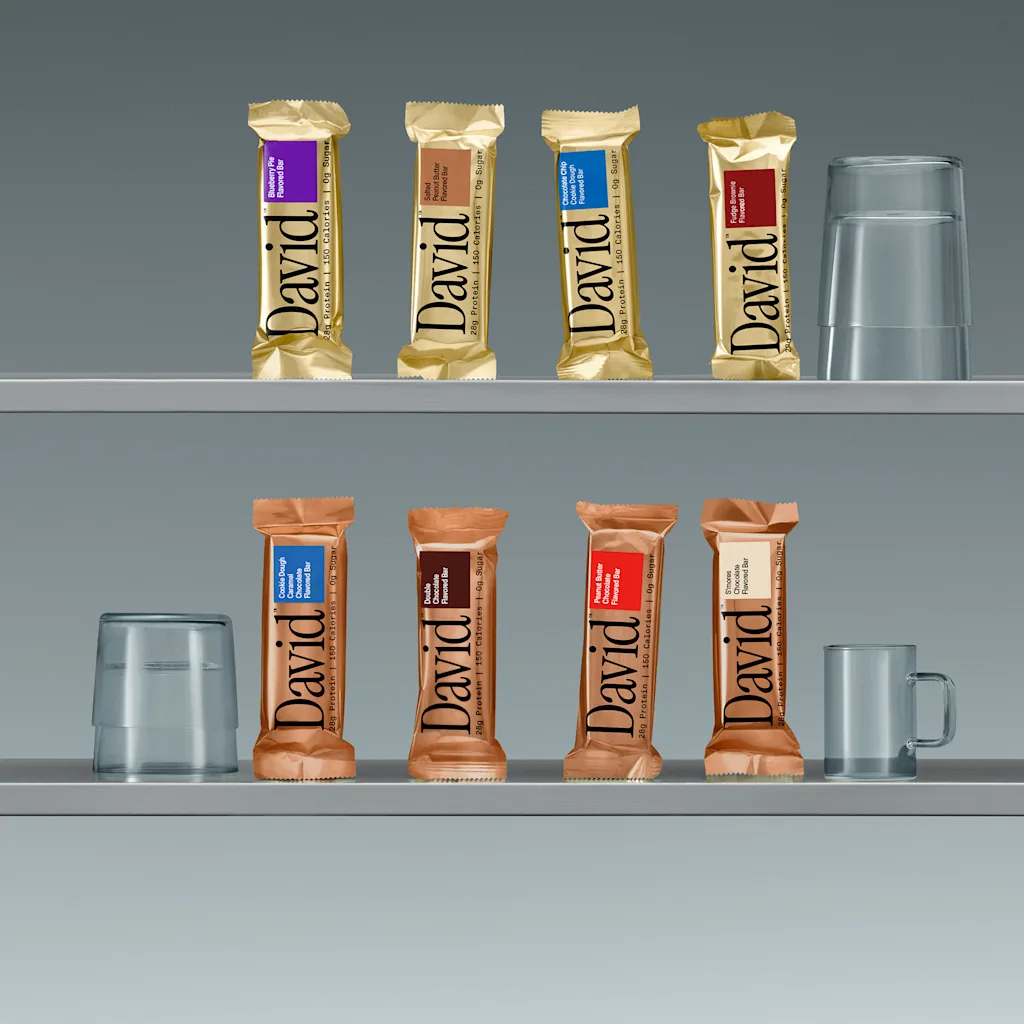
Fitness gurus and casual protein-seekers alike are attracted to the David bar by its impressive macros (28 grams of protein for 150 calories and zero grams of sugar; a ratio that’s almost unbeatable in the bar category). But a large part of David’s meteoric success is also owed to its branding and marketing strategies.
As a “student of the protein bar category,” Rahal says, he’s noticed that natural food players like Lärabar and his own RXBar kicked off a trend from around 2000 to 2015, wherein protein bar companies stopped using their packaging to signal a certain brand, but to instead convey flavor.
“What happened is when you would look at the category, you would see confusion,” Rahal says. “Rather than identifying brands, it was organized by flavor. So you’d see purple, blue, green, red, yellow.” That was innovative in the 2010s, he adds, but it quickly turned the protein aisle into a colorful kaleidoscope of sameness.
David returned to an earlier era of branding—think ’80s and ’90s candy bars, for example—when the primary goal of the packaging was to communicate brand, and the secondary goal was to communicate flavor. “One thing we did is make gold the primary focus,” Rahal says. “This is ironic because it’s actually really differentiated. I find it interesting how history repeats.”
David’s brand guidelines are fairly straightforward: It stands out by embracing simplicity. Instead of adding more product descriptors or colors on its packaging, it subtracts them. “It’s loud by being quiet,” Harmon says.
‘Restraint can cut through when chaos is the norm’
Nowhere is that “less is more” philosophy more clear than in David’s latest print campaign in the NYC subway.
The campaign comes directly on the heels of several other headline-grabbing subway brand stunts. Those include a controversial September campaign from the AI companion company Friend, which inspired intense vandalism, and, just over a month later, a campaign from the embryo screening company Nucleus Genomics that incited widespread backlash online. Both of these campaigns were intentionally designed with provocative copy and imagery to spark conversation. Compare that to David’s design—which is quite literally just a David bar on a blank canvas, with zero copy in sight—and the difference is almost visceral.

“When everyone is doing one thing, there’s often an advantage in doing the opposite,” Harmon says. “A lot of shock-driven work depends on escalation. It has to keep pushing harder to stay visible. Restraint can cut through when chaos is the norm. This campaign isn’t trying to provoke a reaction so much as invite your own.”
Rahal says he “doesn’t like marketing,” and prefers a non-traditional, “anti-marketing” approach whenever possible. It would be wrong to characterize David as a buttoned-up brand, though—in fact, it’s pulled several audacious marketing stunts in the last few months. Earlier this year, the brand introduced a real line of frozen boiled cod to its portfolio as a nod to its protein bars’ similar macronutrient profile (David declined to share sales data on the cod, though Rahal says it was “not that convenient and expensive.” You can still buy it online for $69.)
And, this month, David sent out PR packages that included both a protein bar and a vibrator, alongside copy like, “Finish twice,” and “Pick your pleasure”; seemingly insinuating that its bars are orgasmic. Harmon and Rahal argue it’s still ultimately in line with the brand’s anti-marketing ethos.
“David usually keeps things pretty straightforward,” he says. “This one seems like an outlier, but honestly it still fits the same principle. No fluff, no over-explaining, just the product in a context that feels true to the brand. If anything, it’s just a different take on the same idea.” Rahal adds, “The thinking is still ‘anti-marketing’: one clear message rooted in the product truth, delivered in a novel way.”