
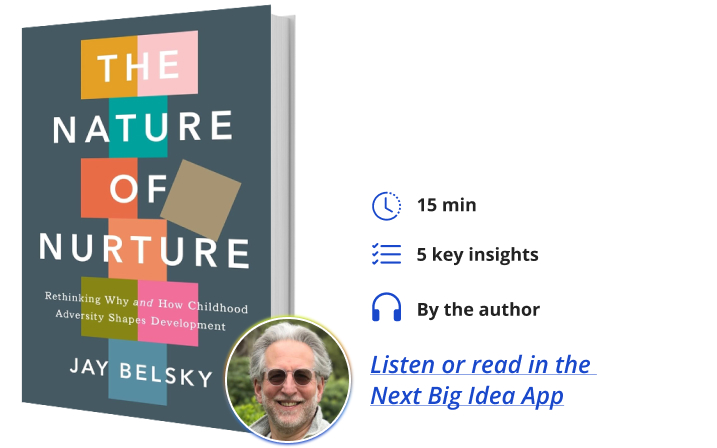
Below, Jay Belsky shares five key insights from his new book, The Nature of Nurture: Rethinking Why and How Childhood Adversity Shapes Development.
Belsky is emeritus professor of human development at the University of California, Davis.
What’s the big idea?
Seen through an evolutionary lens, early adversity can shape development in adaptive ways. And because children differ in their sensitivity to their environments, early experiences may matter a lot for some and much less for others.
Listen to the audio version of this Book Bite—read by Belsky himself—in the Next Big Idea app.
1. A radically transformed understanding of development
It is beyond dispute that the Hubble Telescope, launched in 1990 (to say nothing of the James Webb Space Telescope launched 11 years later), radically transformed our understanding of the universe. To virtually everyone involved in the life sciences, Charles Darwin’s theory of adaptation by natural selection in the mid-19th century and William Hamilton’s insights on kin selection and inclusive fitness in the mid-20th century have functioned much like these recent telescopic wonders in understanding life on planet Earth.
This is true not simply with respect to human nature, as long highlighted by many evolutionary-minded scholars, but specifically with respect to why, how, and for whom early-life conditions shape, or fail to shape, child, adolescent, and even adult development.
2. Childhood adversity looks different when cast in evolutionary perspective
What stimulated the radical shift in my thinking some three decades ago was the realization that the prevailing, mainstream view of development I cut my teeth on reflected an idealized, romanticized view of the human condition: Good experiences foster well-being, whereas bad things lead to disorder, dysregulation, and dysfunction.
Putting on evolutionary lenses made me realize that because childhood adversity—in the form, for example, of threat and deprivation—was not uncommon over the course of human history, the ways children develop in response to it likely evolved and reflect adaptation rather than problematic functioning, as so long presumed. Critically, adaptations evolve because they increase, directly or indirectly, the chances of an individual reproducing, that is, passing on genes to future generations, the ultimate goal of all living things.
Thirty years after first coming to view life on Earth through an evolutionary-developmental, or evo-devo, perspective, I find it astonishing that the discoveries this perspective led to remain extremely underappreciated—by developmental scholars, clinicians, parents, and policymakers alike. While genetics has been how “nature” has been conceptualized for decades in nature and nurture thinking and research, evolution itself has been more or less ignored, especially with regard to the effects of early life on later development.
3. Early-life adversity accelerates development
Early-life adversity should accelerate development, resulting in earlier pubertal maturation than would otherwise be expected. Because adversity can result not just in compromised functioning, but early death, accelerating sexual maturity, I theorized that adversity would have increased the chances of our ancestors successfully passing on genes—despite the fact that early puberty carries health and longevity risks. The perhaps sad truth is that evolution privileges reproduction more than health, wealth, and happiness, though these can serve as means to that end under some conditions.
4. Children differ in their susceptibility to environmental effects
The future is, and always has been, uncertain, making it somewhat unpredictable. This means that developing in a manner consistent with the nurture a child experiences, whether adverse or supportive, could undermine the passing on of genes if and when the future environment proves substantially different from the one the child was prepared for. This realization led me to predict that children would vary in their developmental plasticity, that is, susceptibility to environmental influences—what I labeled the differential-susceptibility hypothesis. Whereas some would be strongly shaped by their early-life conditions—for better and for worse—as those emphasizing nurture have long argued, others would be far less so, as those emphasizing genetic nature have long asserted.
By implication, then, those most vulnerable or susceptible to the negative effects of adversity would, at the same time, prove most susceptible to the beneficial effects of support and nurturance. Conversely, those who prove resilient in the face of adversity, so as not to succumb to its pernicious effects, would also prove less susceptible to the developmental benefits of support and nurturance.
Clearly, then, the benefits and costs of being more or less developmentally plastic depend on the quality of the development context to which the child is exposed early in life. Being resilient is a benefit, for example, in the face of adversity, but a cost in the face of support and nurturance.
5. Implications of evo-devo thinking
One implication of evolutionary thinking aligns with mainstream developmental thought: If we don’t like the effects of adversity on development, given prevailing values, we can intervene to reduce these anticipated risks, and probably the earlier, the better. At the same time, we need to appreciate the second implication that even the most successful such efforts will fail to benefit, or benefit modestly, many children—because they are less developmentally plastic. Factors that shape susceptibility to environmental influences include genetics, early temperament, and physiology.
The Nature of Nurture challenges long-standing ways of thinking about human development, the role of the environment, as well as genetics, while advancing a 21st-century way of thinking about why and how early life conditions do—and do not—shape later life by underscoring evolution and thus natural selection, adaptation, and reproduction.
Enjoy our full library of Book Bites—read by the authors!—in the Next Big Idea app.
This article originally appeared in Next Big Idea Club magazine and is reprinted with permission.