Close Menu
    Facebook X (Twitter) Instagram
    TRENDING :
    • This common travel habit is now banned on American Airlines flights
    • Market Talk – April 29, 2026
    • Uber just expanded into hotels, AI, and ‘room service’ and it’s moving fast
    • Social media’s big tobacco moment is just a first step
    • Ghirardelli Chocolate products recalled over Salmonella fears. Avoid this list of 13 beverage mixes
    • Google, TikTok and Meta could be taxed by Australia to fund its newsrooms
    • MacKenzie Scott says we underestimate the impact of small acts of kindness. Science agrees
    • Trump says Iran ‘better get smart soon’ as economies deal with skyrocketing energy prices
    Compatriot Chronicle
    • Home
    • US Politics
    • World Politics
    • Economy
    • Business
    • Headline News
    Compatriot Chronicle
    Home»Business»Housing market squeeze: The income needed to purchase a typical U.S. home is up 79% since 2020
    Business

    Housing market squeeze: The income needed to purchase a typical U.S. home is up 79% since 2020

    March 14, 20263 Mins Read
    Share Facebook Twitter Pinterest LinkedIn Tumblr Telegram Email Copy Link
    Follow Us
    Google News Flipboard
    Share
    Facebook Twitter LinkedIn Pinterest Email


    Want more housing market stories from Lance Lambert’s ResiClub in your inbox? Subscribe to the ResiClub newsletter.

    Here’s the annual U.S. household income needed to purchase the typical valued U.S. home:

    • January 2020: $52,041
    • January 2021: $52,087
    • January 2022: $63,111
    • January 2023: $87,092
    • January 2024: $93,227
    • January 2025: $98,900
    • January 2026: $93,061

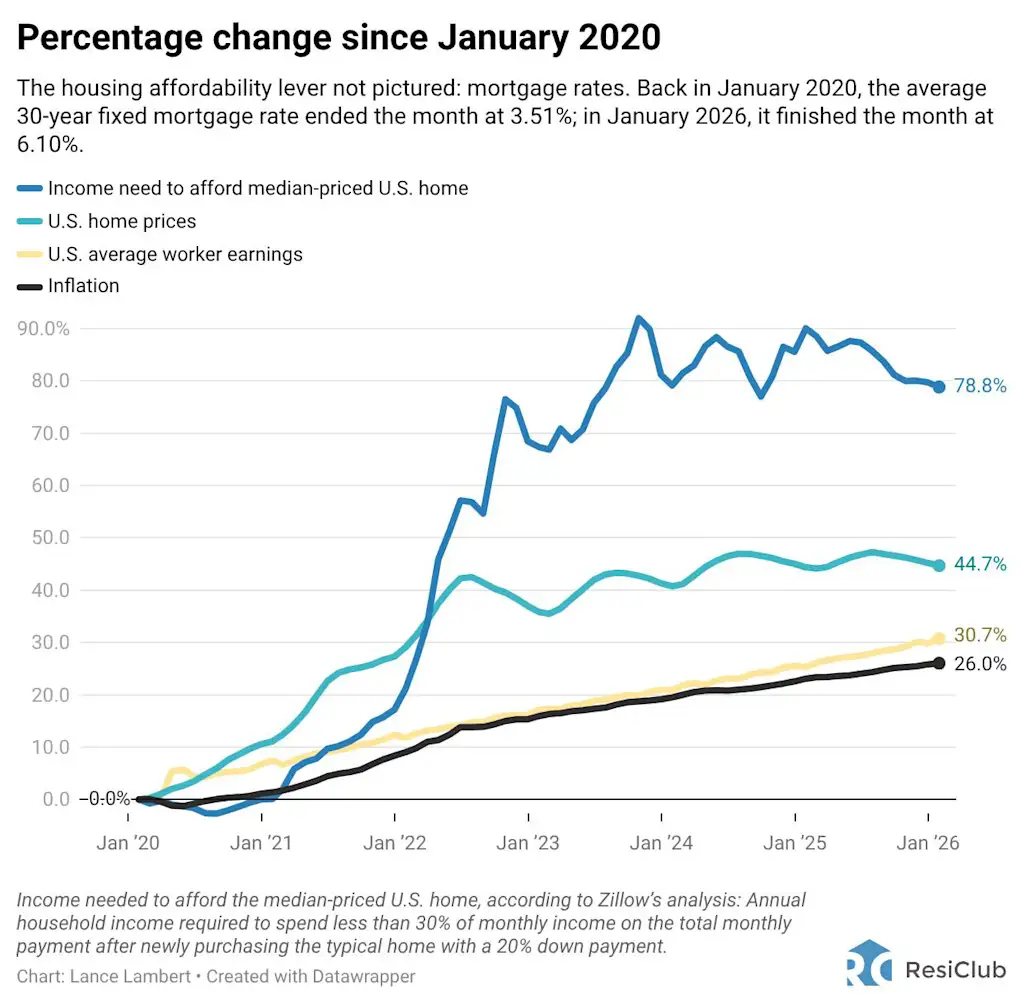
    While the income needed to buy the median-priced U.S. home is +78.8% higher than it was in January 2020, it’s down -5.9% year over year.

    Methodology: This Zillow calculation is conservative and assumes a 20% down payment and that the homebuyer spends less than 30% of their monthly income on the total monthly payment. This is a financed purchase, of course. For typical home value, Zillow economists used the latest Zillow Home Value Index reading.

    window.addEventListener(“message”,function(a){if(void 0!==a.data[“datawrapper-height”]){var e=document.querySelectorAll(“iframe”);for(var t in a.data[“datawrapper-height”])for(var r,i=0;r=e[i];i++)if(r.contentWindow===a.source){var d=a.data[“datawrapper-height”][t]+”px”;r.style.height=d}}});

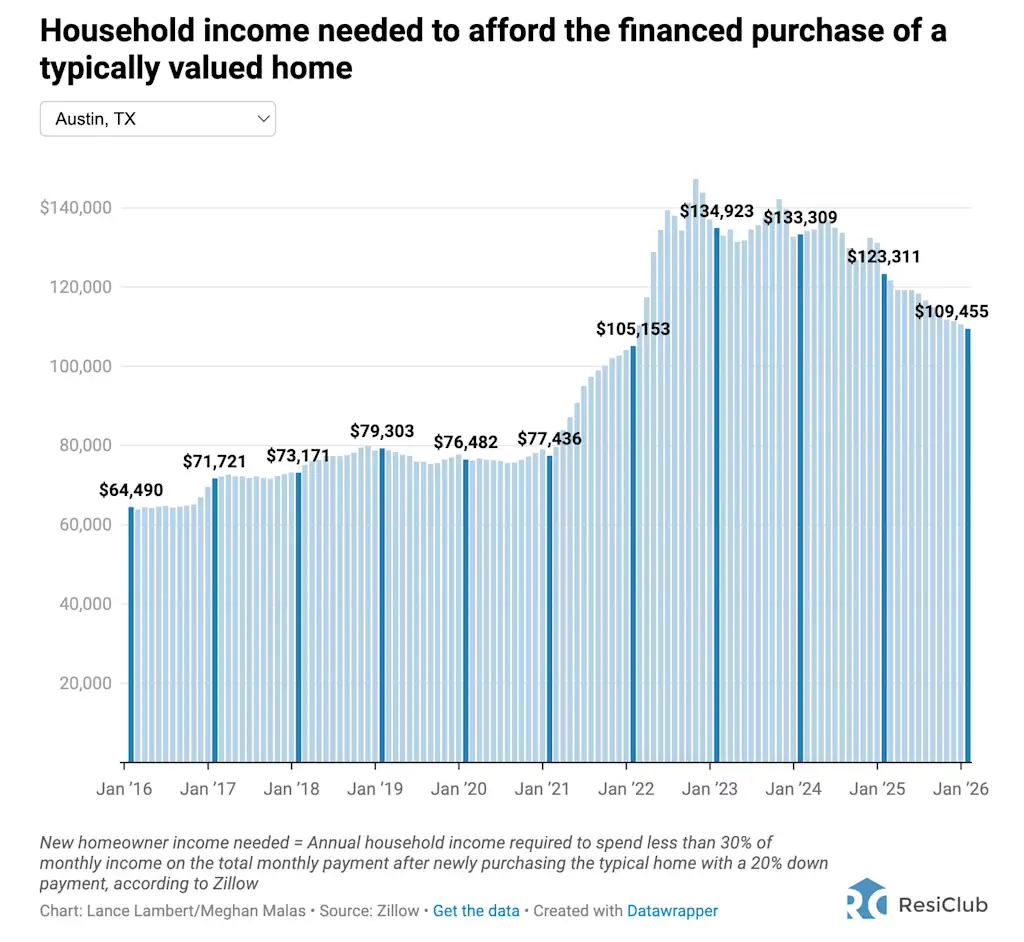
    Regional housing markets that have experienced outright home price corrections since the end of the pandemic housing boom have seen faster affordability improvements. That said, many of those places—like the Austin, Texas, metro area—also experienced greater home price overheating during the pandemic housing boom.

    How did we get here?

    During the pandemic housing boom, housing demand surged rapidly amid ultralow interest rates, stimulus, and the remote work boom. Federal Reserve researchers estimate that “new construction would have had to increase by roughly 300% to absorb the pandemic-era surge in demand.”

    Unlike housing demand, housing supply isn’t as elastic and can’t quickly ramp up like that. As a result, the heightened pandemic-era demand drained the market of active inventory and sent national home prices soaring. The typical U.S. home value measured by the Zillow Home Value Index in January 2026 is still a staggering +44.7% greater than in January 2020.

    That overheated home price growth, coupled with the ensuing mortgage rate shock, with the average 30-year fixed mortgage rate jumping up from under 3% to over 7%, created the fastest-ever deterioration in housing affordability in 2022. Over the past two years, housing affordability has improved some; however, it still remains challenged.

    While the exact hit has varied, this decade’s affordability squeeze has spread across much of the country—just look at the two maps below.

    window.addEventListener(“message”,function(a){if(void 0!==a.data[“datawrapper-height”]){var e=document.querySelectorAll(“iframe”);for(var t in a.data[“datawrapper-height”])for(var r,i=0;r=e[i];i++)if(r.contentWindow===a.source){var d=a.data[“datawrapper-height”][t]+”px”;r.style.height=d}}});

    window.addEventListener(“message”,function(a){if(void 0!==a.data[“datawrapper-height”]){var e=document.querySelectorAll(“iframe”);for(var t in a.data[“datawrapper-height”])for(var r,i=0;r=e[i];i++)if(r.contentWindow===a.source){var d=a.data[“datawrapper-height”][t]+”px”;r.style.height=d}}});

    The challenge, of course, is that incomes haven’t kept up. The gap has narrowed since the end of 2022; however, it’s still wide.

    While the annual U.S. household income needed to purchase a typical U.S. home increased by +78.8% between January 2020 and January 2026, average weekly earnings of U.S. workers have risen by +30.7%, and overall U.S. consumer inflation has grown by +26% during the same period.


    Source link

    Share. Facebook Twitter Pinterest LinkedIn Tumblr Email

    Related Posts

    This common travel habit is now banned on American Airlines flights

    April 29, 2026

    Uber just expanded into hotels, AI, and ‘room service’ and it’s moving fast

    April 29, 2026

    Social media’s big tobacco moment is just a first step

    April 29, 2026
    Top News

    CNN Continues to Beclown Themselves in Their Ongoing Quest to ‘Get’ Trump (VIDEO) | The Gateway Pundit

    By Staff WriterAugust 24, 2025

    Screencap of Twitter/X video. For a decade now, individuals in media have been making an…

    Market Talk – March 11, 2026

    March 11, 2026

    Venezuela attack: Trump says U.S. has captured leader Nicolás Maduro

    January 3, 2026

    High-Crime Blue Neighborhoods To Become Police-Free Zones

    October 22, 2025
    Top Trending

    This common travel habit is now banned on American Airlines flights

    By Staff WriterApril 29, 2026

    Passengers flying with low battery on their phones might be out of…

    Market Talk – April 29, 2026

    By Staff WriterApril 29, 2026

    ASIA: The major Asian stock markets had a mixed day today: •…

    Uber just expanded into hotels, AI, and ‘room service’ and it’s moving fast

    By Staff WriterApril 29, 2026

    Uber Technologies is doing everything it can to save its customers’ time,…

    Categories
    • Business
    • Economy
    • Headline News
    • Top News
    • US Politics
    • World Politics
    About us

    The Populist Bulletin serves as a beacon for the populist movement, which champions the interests of ordinary citizens over the agendas of the powerful and entrenched elitists. Rooted in the belief that the voices of everyday workers, families, and communities are often drowned out by powerful people and institutions, it delivers straightforward, unfiltered, compelling, relatable stories that resonate with the values of the American public.

    The Populist Bulletin was founded with a fervent commitment to inform, inspire, empower and spark meaningful conversations about the economy, business, politics, inequality, government accountability and overreach, globalization, and the preservation of American cultural heritage.

    The site offers a dynamic mix of investigative journalism, opinion editorials, and viral content that amplify populist sentiments and deliver stories that echo the concerns of everyday Americans while boldly challenging mainstream narratives that serve the privileged few.

    Top Picks

    This common travel habit is now banned on American Airlines flights

    April 29, 2026

    Market Talk – April 29, 2026

    April 29, 2026

    Uber just expanded into hotels, AI, and ‘room service’ and it’s moving fast

    April 29, 2026
    Categories
    • Business
    • Economy
    • Headline News
    • Top News
    • US Politics
    • World Politics
    Copyright © 2025 Populist Bulletin. All Rights Reserved.

    Type above and press Enter to search. Press Esc to cancel.