
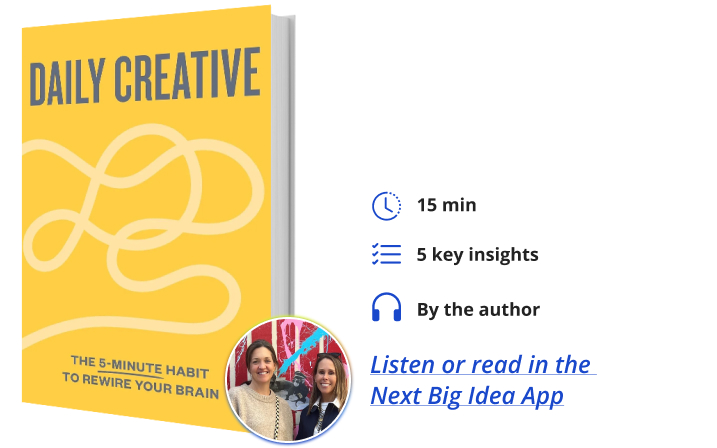
Below, coauthors Blythe Harris and Mallory May share five key insights from their new book, Daily Creative: The 5-Minute Habit to Rewire Your Brain.
Harris is an artist and entrepreneur, and for many years was the cofounder and chief creative officer of Stella & Dot. Today, she runs Daily Creative with her partner, May, where they focus on creativity as a daily wellness practice—not an artistic achievement.
What’s the big idea?
Creativity is a natural human capacity that grows stronger with use. When we treat creativity as a small daily practice rather than a high-stakes performance, it becomes a powerful tool for well-being, flexibility, and feeling more alive.
Listen to the audio version of this Book Bite—read by Harris—in the Next Big Idea app, or buy the book.
1. Creativity isn’t a talent—it’s a practice.
One of the most persistent myths about creativity is that you either have it or you don’t. But creativity works much more like a muscle than a trait. Just as your body needs movement to stay strong, creativity needs regular use to stay alive. Creativity is innate, but it requires nourishment and practice. When we don’t use it, it doesn’t disappear; it simply goes dormant.
Many people who say, “I’m not creative,” didn’t lose creativity. They adopted a fixed mindset after an early experience of judgment or shame. Maybe a teacher frowned at your poem. Or maybe your horse looked like a hamburger in drawing class, and you decided to never try again. Over time, creativity stopped feeling safe, so you opted out.
What we’ve seen is that when creativity is reintroduced as a practice—something small, playful, and low-pressure—people reconnect quickly. Confidence doesn’t come from being good at creativity. It comes from using it regularly, without fear.
2. Small creative acts create meaningful shifts.
We often assume that meaningful change requires large amounts of time or effort. But the brain frequently responds more to consistency and novelty than to duration.
Brief creative engagement—especially when it’s playful and nonjudgmental—can interrupt habitual thinking and invite new perspectives. The goal isn’t to do more or to do it perfectly. It’s simply to engage often enough to stay mentally flexible.
We hear people say things like, “I didn’t make anything good, but I felt different afterward.” That feeling—slightly more open, more awake—is the shift that matters. Creativity doesn’t have to be impressive to be effective.
3. Creativity supports well-being.
Creativity is often framed as self-expression, but it also plays a powerful role in mental and emotional health. Engaging in creative activity has been shown to increase brain plasticity, reduce stress and anxiety, and support cognitive flexibility and open-mindedness. Over time, creative engagement is also associated with improved memory and may even play a role in protecting against cognitive decline.
What’s especially interesting is that many of the benefits of creativity mirror those of meditation—greater calm, presence, and emotional regulation—but creativity often feels more playful and accessible. You don’t have to quiet your mind. You just have to engage it differently.
Many people feel calmer, clearer, or more grounded after creative engagement, even when nothing particularly successful comes out of it. Creativity allows us to process experience indirectly, without needing to explain, analyze, or fix everything. In that way, creativity becomes less about output and more about care.
4. Perfectionism blocks creativity.
Perfectionism narrows attention and increases self-monitoring, both of which make creative thinking harder.
One of the most effective ways to restore creativity is to lower the stakes. Simple constraints, repetition, or clear starting points shift the focus from outcome to process. Instead of asking, “Is this good?” the brain starts asking, “What happens if I try this?”
We’ve seen this again and again: When people are given a simple rule—like drawing with their nondominant hand or working within a grid—the pressure drops immediately. They begin experimenting, laughing, and surprising themselves.
Letting go of perfection isn’t a personality change. It’s a skill you can practice.
5. Creativity is about aliveness, not output.
At its core, creativity isn’t about what you produce—it’s about how you engage with the world.
People often describe feeling more alive after creative moments: more present, more connected, more themselves. That sense of aliveness doesn’t require talent or training. It comes from allowing curiosity and attention back into daily life.
Creativity, in this sense, isn’t something you earn. It’s something you allow.
Enjoy our full library of Book Bites—read by the authors!—in the Next Big Idea app.
This article originally appeared in Next Big Idea Club magazine and is reprinted with permission.