
As brand obsessions go, our collective love/hate relationship with airlines may be one of the most passionate and unique. It’s a perfect storm of time pressure, cost, emotional stakes, and a complete lack of control as a customer.
An airline’s product is the experience, and that experience has a laundry list of potential pain points—check-in, lost luggage, boarding, seat comfort—that can ruin the entire thing. Now, the U.S. government is throwing a shutdown-size wrench into the mix.
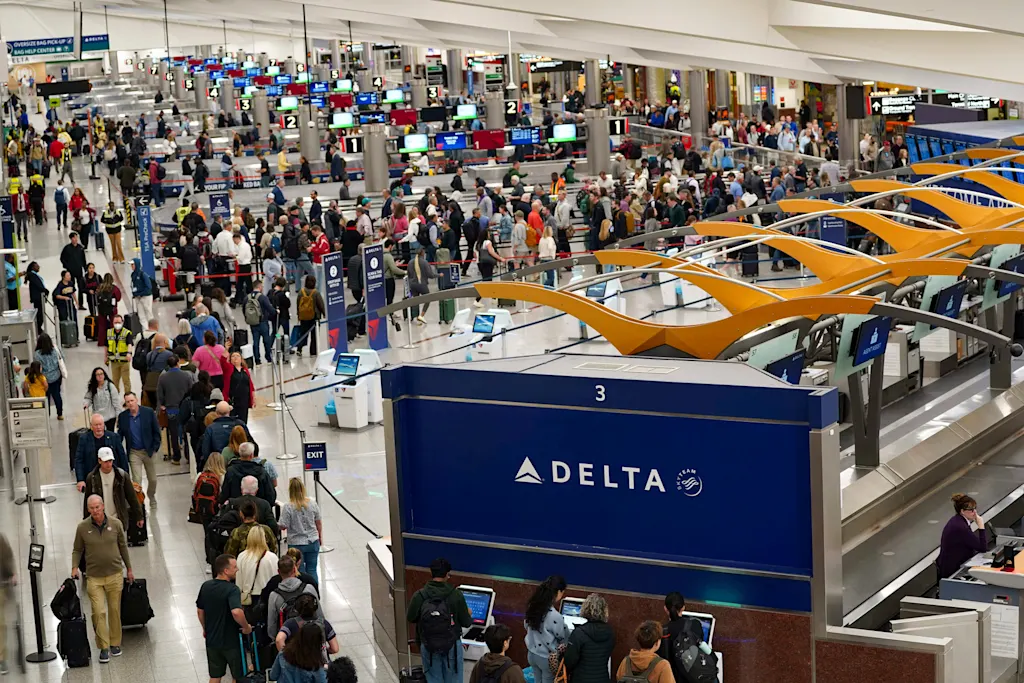
Due to a partial government shutdown, funding for the Transportation Security Administration has been paused. TSA workers have not been paid for more than a month, leading to staffing shortages at some airports. As both sides of the aisle point fingers and try to find a compromise, line-ups at airports are snaking so long that many airports have stopped even trying to post estimated wait times for travelers. On March 25, acting TSA head Ha Nguyen McNeill told Congress that air travelers are experiencing the highest wait times ever under the TSA.
What do you call the opposite of a brand halo? A brand anchor? That’s what this entire situation is for airlines, since their customer experience is tied directly to this shutdown funding fallout.
One airline, however, decided to step up to distinguish itself in a way we haven’t seen a brand do in a long time. On March 24, Delta announced that it was suspending its “specialty services” perk for U.S. Senators and Representatives, which gave those government employees high-touch service like escorting them past lengthy security lines and a dedicated check-in experience.
“Due to the impact on resources from the longstanding government shutdown, Delta will temporarily suspend specialty services to members of Congress flying Delta,” the airline said in a statement to Fast Company. “Next to safety, Delta’s no. 1 priority is taking care of our people and customers, which has become increasingly difficult in the current environment.”
The move follows what an “outraged” Delta CEO Ed Bastian told CNBC last week. “It’s inexcusable that our security agents, our frontline agents, that are essential to what we do, are not being paid, and it’s ridiculous to see them being used as political chips,” Bastian said.
It’s a great example of a brand picking a perfect moment to speak out. But if you’re hoping this signals a return to corporate leadership having a backbone when it comes to issues that impact their customers and employees, you’re going to be like folks at the airport: waiting a long time.
Purpose popularity
There was a time in the not-so-distant past that brands were lining up to say something about an issue—any issue, really. It was all black Instagram squares this, and Stop Hate for Profit that. In 2017, tech execs like Meta CEO Mark Zuckerberg and Google CEO Sundar Pichai spoke out against President Trump’s proposed “Muslim ban,” which limited travel and immigration from predominantly Muslim countries.
Around that time, it was often seen as a brand risk not to speak out on certain issues. When Disney’s then-CEO Bob Chapek stayed silent about Florida’s Parental Rights in Education bill (better known as the Don’t Say Gay bill) in 2022, he was widely criticized by employees until he apologized and the company announced it was formally opposing the bill.
But leading up to the 2024 election, maybe even starting with the Bud Light/Dylan Mulvaney controversy in April 2023, brands and corporate leaders have avoided taking a stand or speaking out on any issue even remotely considered political for fear of landing in MAGA crosshairs. This coincided with a broader shift in sentiment that saw the majority of these corporate stances as largely performative marketing moves, as opposed to real values.
The last couple of years, corporations have remained mostly silent, save for a few recent examples. (In January, a collection of more than 60 CEOs of Minnesota-based companies wrote an open letter that called for “an immediate de-escalation of tensions,” during ICE’s occupation in the city.)
Pick a moment
According to recent Ipsos Consumer Tracker data, 56% of Americans say brands should remain neutral on political issues today, down from 63% last year. And 57% believe that, if a brand takes a stance, they should stick by their decision, regardless of consumer backlash.
Of course some issues are less political than others. Delta coming out against the shutdown to help spur a solution is about as neutral as possible. No one likes long lines. Taking away the special perks afforded members of Congress and the Senate is just this side of performative, and should be paired with giving something back to its everyday customers. Even if it’s just a free drink. The advantage here as a brand is to be agile and open enough to pick your moment to stand out.
We’ve seen it work in the past. Back in early 2009, Hyundai did just that amid the 2008 financial crisis. The carmaker’s “Assurance” Super Bowl ad promoted its program that allowed buyers to return vehicles if they lost their income. It drove a 59% jump in brand consideration and helped boost Hyundai’s market share from 3.1% to 4.3% in early 2009. Despite a 22% industry-wide sales drop in September 2009, Hyundai’s sales rose 27%.
Hyundai took advantage of a consensus issue—the financial crisis—that was out of its control, by finding a way to help customers that it could control.
Right now, Delta has the first mover advantage on this issue, if it chooses to take off.