Close Menu
    Facebook X (Twitter) Instagram
    TRENDING :
    • Why we still hate HR—and 100 business leaders on how to fix it
    • Only The Tip Of The COVID Conspiracy Has Surfaced
    • This Breakthrough Technology Is Poised to Accelerate Your Company’s Growth
    • The Fed Holds While Inflation Refuses To Die
    • This 83-Year-Old Entrepreneur Is Rejecting a $400 Million Payday
    • Europe’s Wealthiest Households Are Drowning In Debt
    • Why My Times Square Billboard Didn’t Drive Sales
    • Can India Become The Next Factory Of The World?
    Compatriot Chronicle
    • Home
    • US Politics
    • World Politics
    • Economy
    • Business
    • Headline News
    Compatriot Chronicle
    Home»Business»This $3B builder moves from California to Arizona—signaling something about the housing market’s next decade
    Business

    This $3B builder moves from California to Arizona—signaling something about the housing market’s next decade

    April 11, 20263 Mins Read
    Share Facebook Twitter Pinterest LinkedIn Tumblr Telegram Email Copy Link
    Follow Us
    Google News Flipboard
    Share
    Facebook Twitter LinkedIn Pinterest Email


    Want more housing market stories from Lance Lambert’s ResiClub in your inbox? Subscribe to the ResiClub newsletter.

    KB Home announced on April 9 that it will relocate its corporate headquarters from Los Angeles to Tempe, Arizona, beginning in spring 2027. The builder, which has a $3 billion market capitalization, said the new headquarters in the Phoenix metro area will bring executive leadership and key corporate functions into a more centralized, lower-cost operating environment.

    While the giant homebuilder, ranked No. 526 on the Fortune 1000, emphasized that it will maintain a significant presence in California (in particular in San Bernardino County)—a state where it currently operates six divisions and more than 100 active communities—the move reflects a broader shift in where large homebuilders are increasingly doing business.

    On the one hand, the cost-saving move reflects how homebuilders are tightening operations after several years of margin compression during this softer post-boom period. On the other hand, it underscores how the geographic center of U.S. homebuilding has shifted over the past decade—and where it may continue to shift in the years ahead.

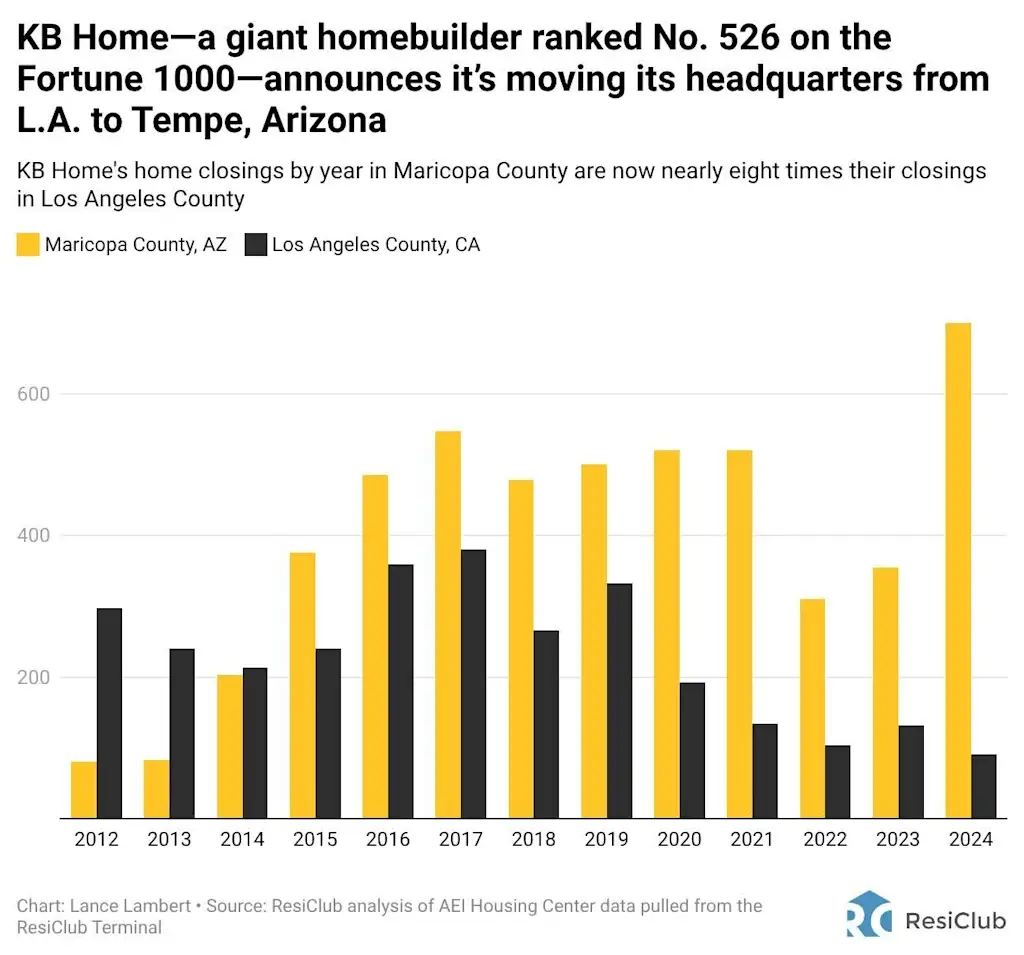
    KB Home’s own construction footprint illustrates the trend. Back in 2012, KB Home built nearly four times as many homes in Los Angeles County as it did in Maricopa County, Arizona. Today, that dynamic has flipped dramatically: KB Home’s annual home closings in Maricopa County are now nearly eight times higher than its closings in Los Angeles County, according to data pulled from the ResiClub Terminal. 

    “This move brings our teams together in a more collaborative environment, and Phoenix is the right place to do it. . . . It positions KB Home to operate more effectively and supports the next phase of our growth,” wrote Robert McGibney, CEO of KB Home, in a press release published on April 9.
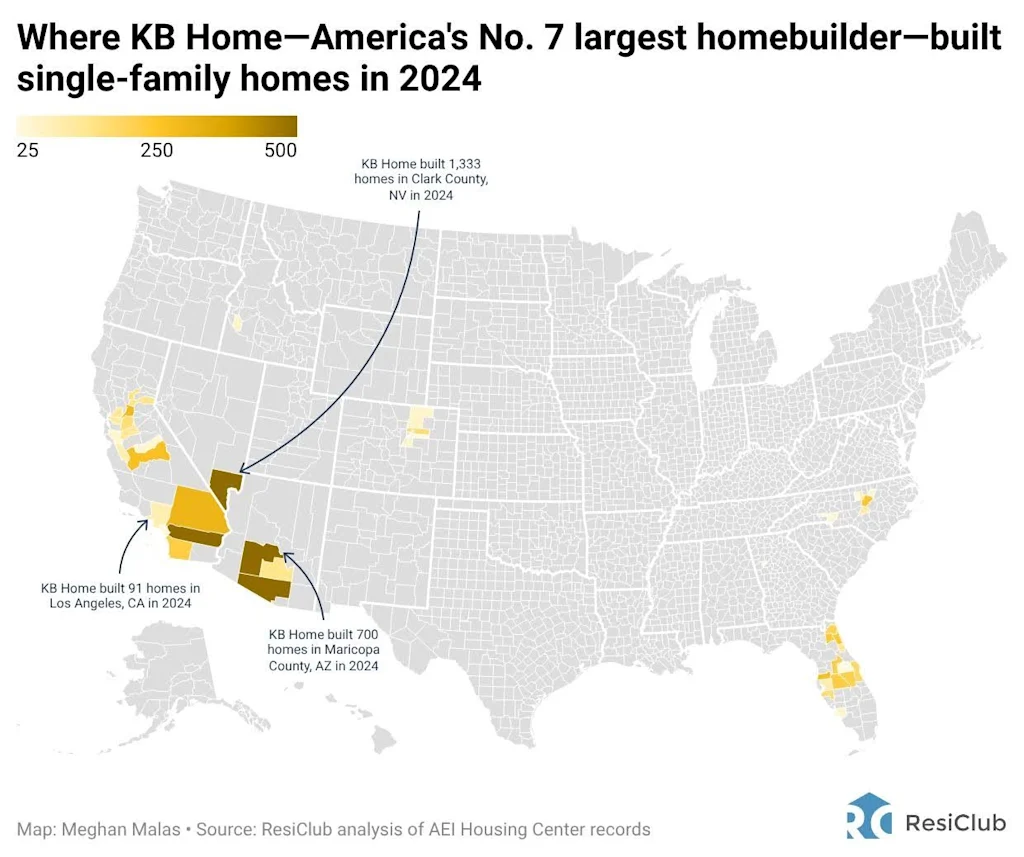
    KB Home’s steady shift in production from a market like L.A. to Phoenix also reflects the broader migration of homebuilding activity toward high-population growth areas in Arizona, Alabama, Florida, Idaho, Texas, South Carolina, North Carolina, Utah, and Tennessee. Metro areas like Phoenix have seen stronger population growth, more available land, and fewer regulatory constraints compared to coastal California markets where land costs, permitting timelines, and development regulations are often far more restrictive. For national homebuilders, those structural differences increasingly influence where capital gets deployed.

    To see where America’s core homebuilding markets are concentrated, look at the ResiClub map below.
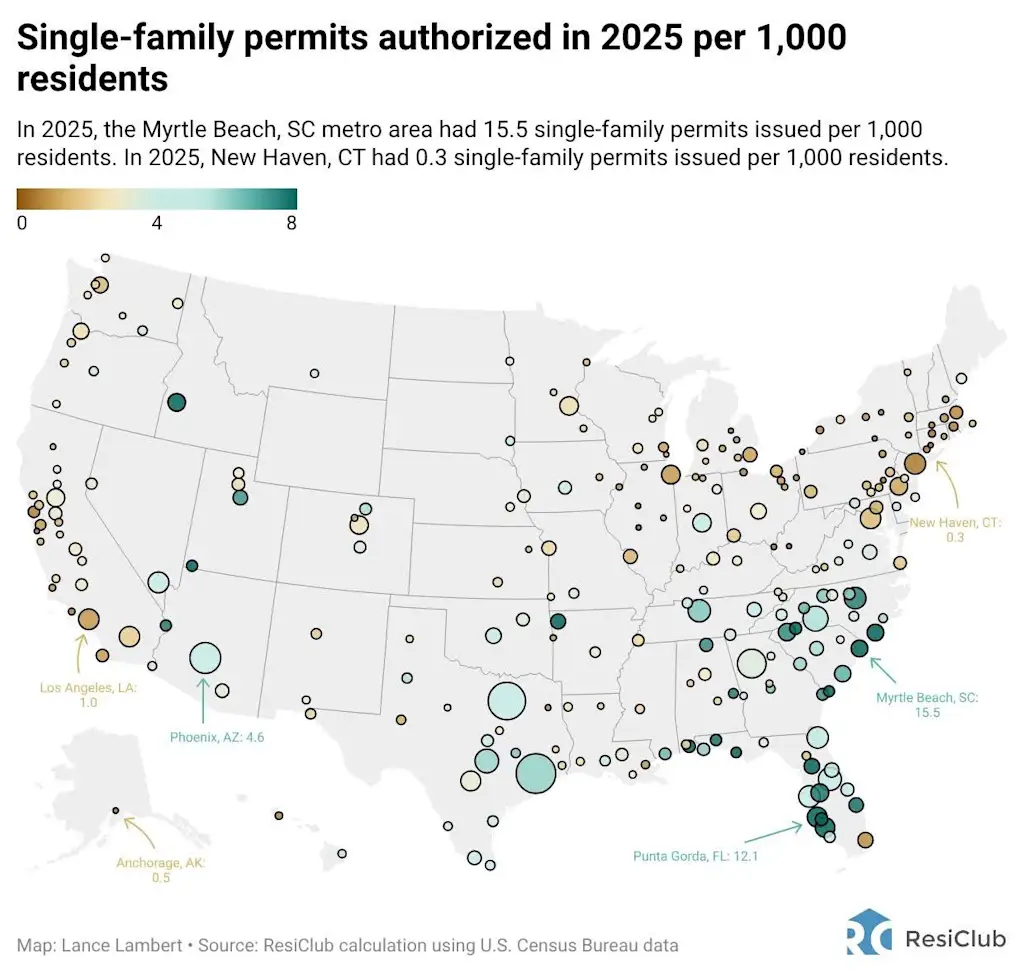
    When you look at the map above, you might notice the similarity it has with the map we share frequently showing how active inventory across the nation compares to pre-pandemic 2019 levels.

    In ResiClub’s view, during this post-pandemic housing boom period—where there’s some downward pressure on home prices—markets with an abundance of new home supply have experienced additional softening pressures. When they have the margins to do so, builders are often willing to offer larger affordability incentives (sometimes even lowering net effective prices) to maintain sales in a shifted market.

    That’s exactly what we’ve seen in many pockets of the country during this period, and when it happens, it puts additional cooling pressure on the resale market. Some buyers who would have previously considered existing homes are now opting for new homes with more favorable deals, adding further upward pressure on resale inventory.

    That alone doesn’t fully explain the current housing market bifurcation, but it’s a piece of the puzzle. According to ResiClub statistical analysis in July 2025, there’s a modest or moderate correlation (R² = 0.31) between recent single-family permitting levels and active inventory climbing above pre-pandemic 2019 levels.


    Source link

    Share. Facebook Twitter Pinterest LinkedIn Tumblr Email

    Related Posts

    Why we still hate HR—and 100 business leaders on how to fix it

    July 30, 2026

    This Breakthrough Technology Is Poised to Accelerate Your Company’s Growth

    July 30, 2026

    This 83-Year-Old Entrepreneur Is Rejecting a $400 Million Payday

    July 30, 2026
    Top News

    These 3 Perplexity power-user techniques make AI search more useful

    By Staff WriterJuly 20, 2026

    If you’ve been using Perplexity for a while, you’ve probably figured out the basics. You…

    After the Shein shock, Everlane’s founder launches his next act

    May 26, 2026

    How to Calculate Business Tax – A Step-by-Step Guide

    May 25, 2026

    Industrial Production Falls 1.4% In Euro Area

    February 18, 2026
    Top Trending

    Why we still hate HR—and 100 business leaders on how to fix it

    By Staff WriterJuly 30, 2026

    Earlier this month, a senior executive at a global company shared a…

    Only The Tip Of The COVID Conspiracy Has Surfaced

    By Staff WriterJuly 30, 2026

        Dr. Anthony Fauci, now 85 who led the National Institutes…

    This Breakthrough Technology Is Poised to Accelerate Your Company’s Growth

    By Staff WriterJuly 30, 2026

    Opinions expressed by Entrepreneur contributors are their own. Imagine if your business…

    Categories
    • Business
    • Economy
    • Headline News
    • Top News
    • US Politics
    • World Politics
    About us

    The Populist Bulletin serves as a beacon for the populist movement, which champions the interests of ordinary citizens over the agendas of the powerful and entrenched elitists. Rooted in the belief that the voices of everyday workers, families, and communities are often drowned out by powerful people and institutions, it delivers straightforward, unfiltered, compelling, relatable stories that resonate with the values of the American public.

    The Populist Bulletin was founded with a fervent commitment to inform, inspire, empower and spark meaningful conversations about the economy, business, politics, inequality, government accountability and overreach, globalization, and the preservation of American cultural heritage.

    The site offers a dynamic mix of investigative journalism, opinion editorials, and viral content that amplify populist sentiments and deliver stories that echo the concerns of everyday Americans while boldly challenging mainstream narratives that serve the privileged few.

    Top Picks

    Why we still hate HR—and 100 business leaders on how to fix it

    July 30, 2026

    Only The Tip Of The COVID Conspiracy Has Surfaced

    July 30, 2026

    This Breakthrough Technology Is Poised to Accelerate Your Company’s Growth

    July 30, 2026
    Categories
    • Business
    • Economy
    • Headline News
    • Top News
    • US Politics
    • World Politics
    Copyright © 2025 Populist Bulletin. All Rights Reserved.

    Type above and press Enter to search. Press Esc to cancel.