
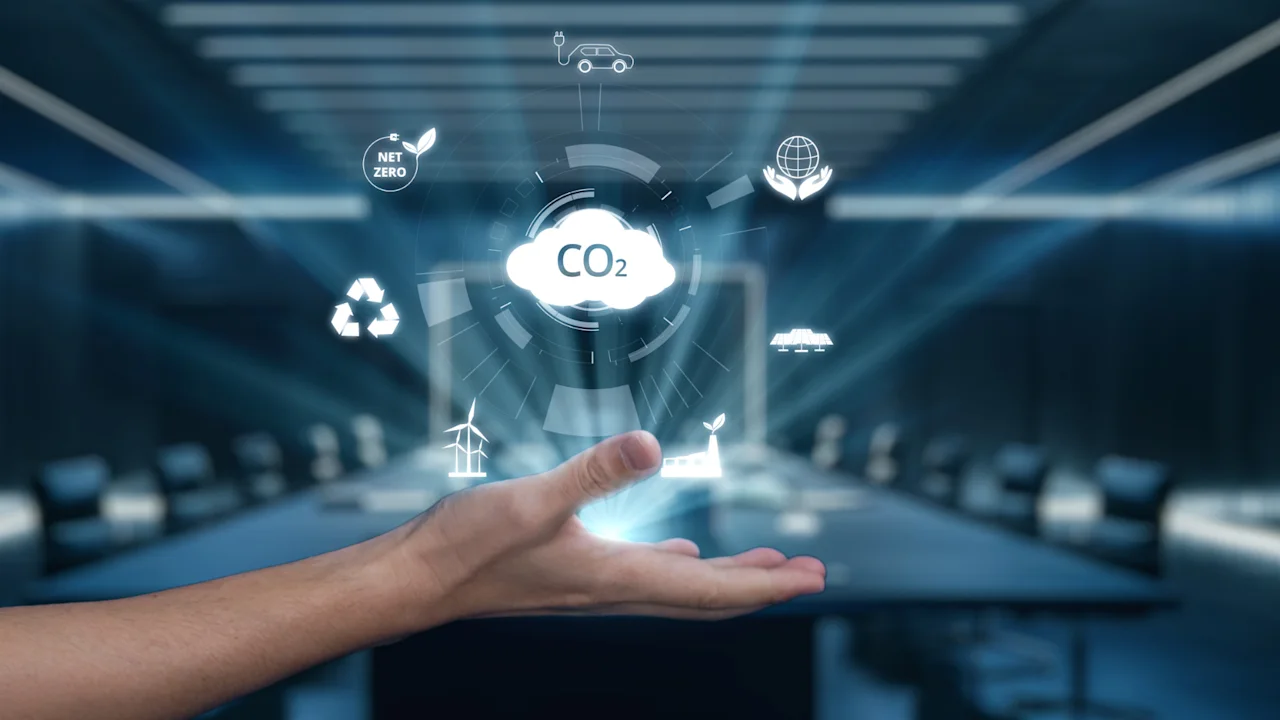
Last year at SXSW, I got on stage with a colleague from Tangent, a London-based digital design agency, to ask a simple question: What if every time you checked your phone, a visible puff of smoke rose into the air? While we can’t immediately see the environmental impact of our digital lives, it is very real.
Over the past two decades, the digital ecosystem has become society’s invisible infrastructure. More than 60% of the global population is now online. Each user generates 229 kilograms of carbon dioxide, amounting to almost 4% of average per capita greenhouse gas emissions. Most of us don’t know or even consider the hidden cost of our increasingly digitized world.
The internet may feel intangible, but it runs on physical infrastructure. Every email, text, post, video, website, and AI response is processed in a physical data center and stored in the “cloud,” which is in fact another physical data center.
The negative impacts of transportation, fashion, agriculture, and packaging are often discussed, but we rarely talk about the environmental cost of our hours online. Every time we scroll through Instagram, shop online, ask ChatGPT a question, or file away another week of emails we are expanding our digital footprints and generating shocking amounts of carbon.
THE ENERGY OF EXPERIENCE
Today, we expect immersive digital experiences featuring bold visuals, autoplay video, and seamless motion. My colleague from Tangent mentioned how nearly every client brief references the flashiest brands to emulate. She showed how highly animated, media-heavy websites require more data transfer, directly correlating to energy use and carbon emissions. On sites with high monthly traffic, the carbon output multiplies.
Yet few users or even designers consider the environmental impact of unnecessary animation, bloated imagery, or autoplay videos. Every choice about file size, motion, or media embeds adds to the web’s collective energy demand. Thoughtful digital design can reduce the load without sacrificing creativity or user experience.
AI RUNS ON ENERGY AND WATER
A single generative AI query uses nearly 10 times the electricity of a standard web search. The demand for the growing tech industry is so large that Constellation Energy announced it will reopen Three Mile Island to power Microsoft’s data centers.
Data centers consume unbelievable amounts of energy. Worldwide, data centers are responsible for roughly 1.5% of total greenhouse gas emissions, on par with the airline industry. Compounding this, these facilities—often placed in deserts and other remote locations where large format real estate is easy to develop—require enormous volumes of potable drinking water to cool servers. In 2022 alone, Google data centers consumed roughly 4.3 billion gallons of water, roughly equivalent to four days of water supplied to the 8.5 million people in New York City.
GROWTH WITHOUT GUARDRAILS
The environmental impact of our digital lives is amplified by the breakneck speed of investment. Microsoft announced plans to spend $80 billion on AI-focused data centers. Meta was close behind, with $60–65 billion earmarked to expand and build new data center capacity. These commitments are not incremental upgrades; they represent a rapid buildout of energy-intensive infrastructure designed to support the next era of AI and emerging technologies. As capability accelerates, so too does the electricity required to power it.
Worse, efficiency improvements alone will not solve the problem. When technologies become more efficient, overall consumption often rises, a dynamic known as the rebound effect. As digital tools become faster, cheaper, and more embedded in daily life, usage will only expand. Without intentional limits or systemic guardrails, this growth will reap climate disaster.
The time for designers and technology companies to act is now. The digital economy is scaling faster than our conversation about its environmental consequences can even scratch. This is not a slowing trend or a temporary spike in demand; it is a structural shift. The infrastructure being financed and constructed today will determine energy use, water demand, and emissions for decades to come—for our technology, as well as for our human and planetary health.
A DIGITAL REDESIGN: CIRCULARITY AND RESPONSIBILITY
Technology is not going away. If we won’t reduce usage, we must reduce impact—circularity offers a path forward.
Often framed around physical products, circular principles apply equally to digital systems. For designers, this means building modular, reusable systems, modernizing legacy architecture, and planning for content archiving and deletion.
Sustainability must also address water use, critical materials, and e-waste. Extending hardware lifespans, enabling repair, improving recycling, and increasing water reuse are essential. Today, most technology providers and data centers recover only a fraction of their infrastructure, leaving significant room for improvement.
While circular strategies may not reduce emissions as dramatically as operational efficiency gains, they can at least reduce the extraction of finite resources, lower waste, and support long-term environmental resilience.
Responsibility does not rest with designers alone. Organizations must allocate meaningful budgets toward sustainable design practices, invest in training, and report emissions transparently. Consumers also play a role by choosing lower-impact products, extending the lifespans of their devices, and being more mindful of the digital services and AI tools they use.
The cost of our clicks can be measured in electricity drawn from strained grids, in the potable water used to cool servers in water-stressed areas, and in total carbon emissions that exacerbate climate change. The physical footprint of our online lives may be largely invisible to us, but it is both measurable and cumulative.