
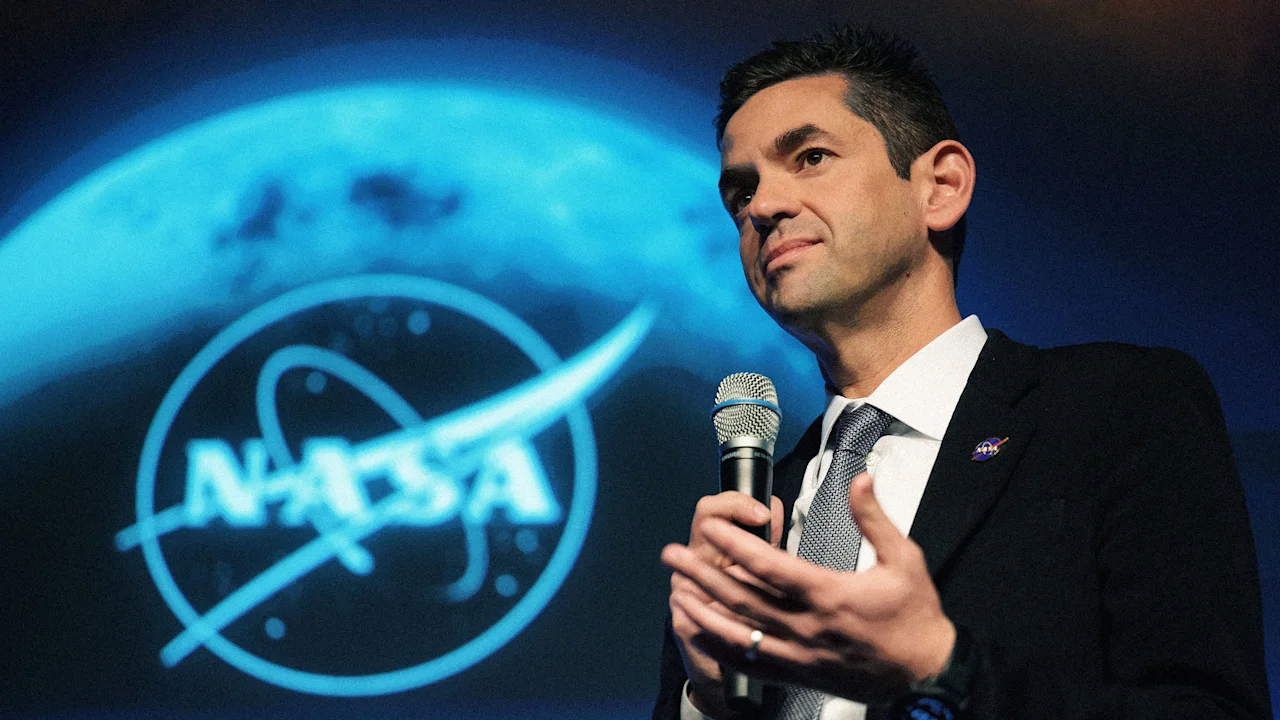
Just days after the record-breaking Artemis II crew aboard the Orion capsule splashed down in the Pacific, NASA Administrator Jared Isaacman is ready to talk about what comes next. An entrepreneur turned space chief, Isaacman gets frank about the agency’s ambitions to build a permanent lunar base, put boots on Mars, and push the search for extraterrestrial life further than ever before. Plus, he shares why he sees the accelerating space race with China as one of the most consequential competitions of our time.
This is an abridged transcript of an interview from Rapid Response, hosted by former Fast Company editor-in-chief Robert Safian. From the team behind the Masters of Scale podcast, Rapid Response features candid conversations with today’s top business leaders navigating real-time challenges. Subscribe to Rapid Response wherever you get your podcasts to ensure you never miss an episode.
I wanted to start by congratulating you on the successful Artemis II flight, a 10-day voyage farther than any humans had gone before, a stepping stone for returning to the moon. You’re still new to NASA, only a few months in. Do you still bask in the euphoria, or for you personally, is it just, all right, onto the next thing?
We’ve been incredibly busy for four months, so I don’t feel very new. We’re all running really hard right now, so there are a lot of 18- and 20-hour days because Artemis II, for as much of a great success as it was as a mission, was just the opening act in America’s return to the moon. We are in another race right now, so our goal is to get American astronauts back to the surface of the moon and build the moon base so they can stay.
To answer your question, yes, I was completely in awe at launch and captivated throughout the entirety of the mission itself and the recovery operation on the boat because we haven’t done this in 53 years. So we’re doing a lot of new things, a lot of skills we haven’t exercised in a while, not to mention just the overwhelming cool factor of sending humans farther into space than ever before.
I had a conversation with the CEO of Intuitive Machines after their private landing of Odysseus on the moon, and he talked about how so many things on the mission didn’t go as planned at every stage, which they had sort of planned for. During Artemis II, are you clued in if it’s time to go to plan B? How much does that happen?
Of course. I am in every one of the meetings. I would say I’m a very in-the-weeds and active administrator here. So throughout the entire flight readiness review and preflight readiness review process leading up to the mission, we were tracking the issues we actually had when we put Artemis and the SLS [Space Launch System] rocket out to the pad. We had some hydrogen leak issues. We had helium flow issues in the upper stage. We actually had to bring the rocket back into the Vehicle Assembly Building and fix those problems. So I was very aware of the issues before launch.
Are there any particularly meaningful moments for you—particular lessons gleaned or unexpected things that were revealed?
I would say the biggest takeaway from my perspective is this: There absolutely were things that did not perform as expected, and that’s good. We want to learn them and get them out of the way before you’re actually landing on the moon. I will say that if we all could have sat around a table before launch and said, “What do you think we’re going to be discussing in terms of issues before we commit to the translunar injection burn?”—that’s when the astronauts are not hours away from being in the water, but days away. That’s an incredibly important decision.
I will say probably the highest-blood-pressure moment of any human spaceflight mission is reentry. That’s where there are no plan B’s. The heat shield has to work. The parachutes have to come out and help decelerate the vehicle before it gets into the water. So you’ve got a lot of off-ramps on ascent when you’re sending the rocket into space. You have a launch escape system. When you’re in orbit, you have lots of time to talk about issues like water valves or wastewater lines. But once Orion is committed to the translunar injection, we send it out there. It was on a free-return trajectory, meaning that the spacecraft and those four astronauts were coming right back around the moon, and they were going to slam into Earth’s atmosphere to decelerate the vehicle, take all its energy out, and that has to work. There’s no plan B there.
This past week, I know you were on Capitol Hill getting grilled about NASA’s budget. What part of that is your mission? Is that your personal version of a mission, where you’re, like, “I’m on reentry. I don’t know what’s going to happen”?
I would just say that this is absolutely part of the job. And if it’s, “Are my responsibilities dynamic, am I going from the launch control center to the recovery ship to talking on Capitol Hill?” Absolutely. I enjoy it, to be very honest. Part of what I love doing in life, not just here at NASA, is being able to bring together a lot of people with differing views and get aligned so we can achieve incredibly challenging things—which is what we do here at NASA. Big, bold endeavors, ambitious objectives, the near impossible, as I like to say many times—and getting Capitol Hill aligned on how to do it. And of course, it’s a conversation about the budget.
But what I wanted to point out is, we are in a great race right now. This is not like the 1960s. Success and failure are going to be measured in months, not years. And if you perpetuate the status quo, if you ask us to keep doing things the way we have for decades, when we did not have a geopolitical competitor capable of rivaling us in the high ground of space, then we are going to lose. Or we can acknowledge our shortcomings, that we’ve spread ourselves very thin over the years and now it’s time to reconcentrate our resources back on the mission that taxpayers have entrusted us to do—which is get back to the moon, build the base, realize its potential, and master the skills so you can get to Mars in the near future.
And this race you’re talking about, just so we’re clear. You’re talking about competing with China, right? You’ve said nuclear power propulsion is essential for America to dominate the future space race. All of that is sort of around staying ahead of China.
In a way, competition is a good thing because it constantly forces us to think about what comes next. In that respect, programs like nuclear power and propulsion are very important because there is a race on right now to return to the moon and build a base. I want to point out that if you think of the surface area of the moon, it’s essentially the size of Africa. But where the United States and our international partners, and where the Chinese want to be, is in a portion of the moon, the South Pole, that’s essentially the size of Washington, D.C., maybe a little bit bigger. And that’s because there is water ice there that we need to interact with for in situ resource manufacturing, to master the skills to make propellant. And you want to do this on the moon before you are required to do it on the surface of Mars. So it’s got the water ice, but it also has the crater ridgelines where you have access to essentially what we call the eternal light, where you can get some solar power.
Where nuclear power and propulsion comes in: President Trump’s national space policy is don’t just return to the moon for the footsteps and the flag. Build the base, build the enduring presence, master those skills, and make investments in the next giant leap capabilities. That’s where nuclear power and propulsion come in, because it is a very efficient way to move mass. Think train locomotives, not airplanes. It’s a very efficient way to move mass, whether it’s to the moon or Mars. But also, the components and capability, the reactor design, are going to be very similar to what you will use for surface power on the moon, as well as on Mars. And you’re going to need that power to make propellant on the surface.
And then the last piece I’d say is simply this: If you want to explore the outer solar system, the farther away you get from the sun, the less effective it is as a source of solar power. That’s where you’re going to need nuclear power and propulsion to explore the outer solar system.