
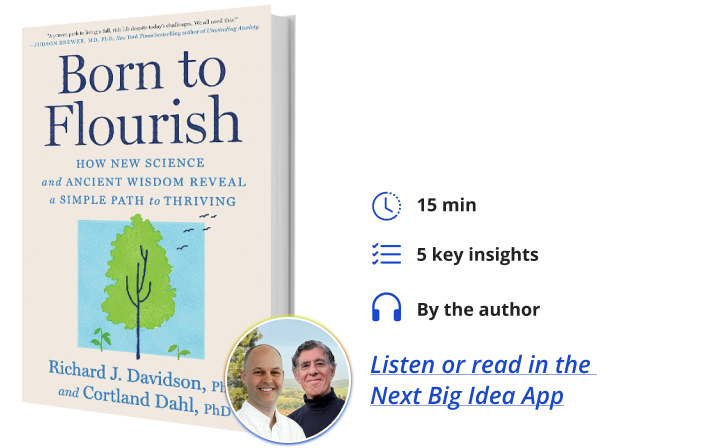
Below, Richard Davidson and Cortland Dahl share five key insights from their new book, Born to Flourish: How New Science and Ancient Wisdom Reveal a Simple Path to Thriving.
Davidson is a professor of psychology and psychiatry at the University of Wisconsin-Madison, as well as the founder and director of its Center for Healthy Minds. He also founded a nonprofit, Humin, which translates science into tools that cultivate and measure well-being.
Dahl serves as a contemplative scientist at the University of Wisconsin-Madison’s Center for Healthy Minds and as chief contemplative officer at the center’s affiliated nonprofit, Humin.
What’s the big idea?
Feeling happier, more connected, and more purposeful isn’t luck—it’s a set of skills you can practice and get better at. The wild part? Just a few minutes a day can start to change not only your quality of life, but that of the people around you too.
Listen to the audio version of this Book Bite—read by Davidson—in the Next Big Idea app, or buy the book.
1. We are born to flourish.
Flourishing is a learnable skill. Some people believe that their general well-being is fixed and there’s not much they can do to improve it, but research shows that this is not true.
The qualities that underlie flourishing are rooted in brain networks that exhibit neuroplasticity. These networks can be shaped by experience and training. With very simple exercises, our minds can actually be nourished and changed.
2. Flourishing is comprised of four basic skills.
The four basic, trainable skills of flourishing are awareness, connection, insight, and purpose.
Awareness refers to our capacity to be mindful and voluntarily deploy our attention. It also relates to our capacity for self-awareness, meaning to be aware of our own bodies, minds, feelings, and thoughts. Another component of awareness is a process that psychologists and neuroscientists call meta-awareness, which is awareness of our own minds—knowing what our minds are doing. This may sound a little bit strange, but have you ever been reading a book, set it aside after a few pages and then realized that you have no idea what you just read? That is an example of not knowing what your mind is doing. But that moment of recognition is a moment of awakening, and that is meta-awareness.
Connection includes qualities that are important for healthy social relationships, like appreciation, gratitude, kindness, and compassion. This is the antithesis of loneliness. These qualities are vital for human flourishing.
Insight is the deep appreciation and understanding of how our thoughts, beliefs, and expectations shape our experience of the world. Each of us has thoughts, beliefs, and expectations of ourselves. This constitutes our narrative self—the self that we tell ourselves exists. Knowing that we filter our experience of the world through our own personal lens helps us keep in perspective that other people in the same situation may have a very different experience. Insight is vital to developing empathy.
Purpose is not so much about finding something especially significant to do with our lives, but about finding meaning in even the most pedestrian activities of daily life. Can taking out the garbage connect with our sense of purpose? Of course it can be. It simply requires a little reframing.
3. Cultivating flourishing is easier than you think.
Research shows that it only takes a few minutes of daily practice to nurture each of these four qualities of flourishing. We don’t have to sit and meditate for hours, days, months, or years. It’s something that can change rather quickly, although regularity of practice is important.
I like to remind people that when humans first evolved, none of us were brushing our teeth. And yet, a very large segment of the world now brushes their teeth daily because we recognize its importance for physical hygiene. The data shows that if we dedicated as much time to nourishing our mind as we do brushing our teeth, then this world would really be a different place.
According to our research, five minutes a day for 28 days can produce measurable change in well-being, levels of stress and anxiety, and it even can change aspects of our biology. It doesn’t take much to get these circuits in the mind going because we are innately predisposed to cultivate these qualities.
Another important element to mention is that you can cultivate these qualities while engaged in other daily activities. It doesn’t require that we formally sit and meditate. You can do it as you’re commuting. You can do it as you’re washing the dishes. You can even do it while you’re brushing your teeth. The data shows that, at least in the early stages, the benefits are comparable when done paired with other activities as they are if done as stand-alone practices.
4. Flourishing is contagious.
When you are around people who are flourishing, you also feel good. Flourishing changes the social landscape by benefiting all the people in its presence.
One of our amazing research findings comes from public school teachers in the U.S. They were randomly assigned to cultivate their well-being using our Healthy Minds program. When teachers did this for 28 days, for approximately five minutes a day, their well-being improved. This part was expected.
But we also had access to the academic performance of the students who were taught by these teachers. We found that, on standardized math tests, students taught by teachers assigned to flourishing training performed significantly better than students in classrooms taught by teachers in our control group. The students had no idea that there was research going on.
This is an example of the downstream effects of having a teacher in the classroom who is fully present, really connected to their students, has insight into how their own thoughts and expectations may be shaping their experience of situations, and comes into the classroom with a strong sense of purpose. That teacher will be more effective at teaching than a teacher who has not nurtured these qualities. This is empirical evidence for the conjecture that flourishing is indeed contagious.
5. Conscious habits.
We can use daily activities as reminders to do little practices that cultivate flourishing. For example, we eat every day. If we paused for a minute or two before eating in order to reflect on how many people it took for this food to end up on our plate, then we would cultivate a sense of appreciation for the network that made this meal happen. It would heighten our sense of interdependence.
We are not isolated but rather exist in a connected and dependent web of humanity. Something like nurturing our sense of appreciation every time we eat is a little element we can add to a daily habit that, in turn, cultivates overall human flourishing. We need flourishing now, possibly more than ever.
Enjoy our full library of Book Bites—read by the authors!—in the Next Big Idea app.
This article originally appeared in Next Big Idea Club magazine and is reprinted with permission.