
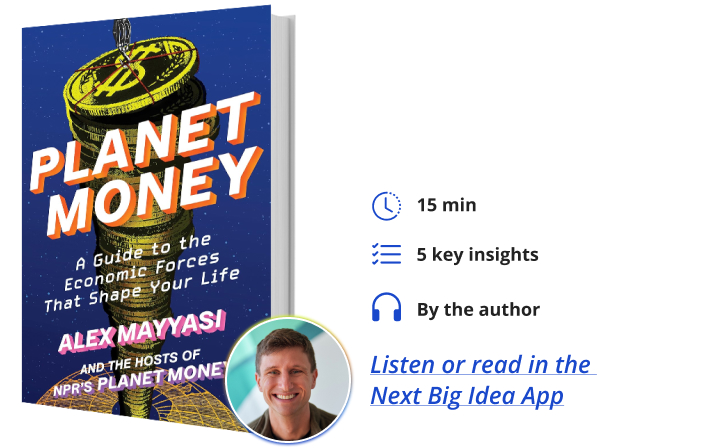
Below, Alex Mayyasi shares five key insights from his new book, Planet Money: A Guide to the Economic Forces That Shape Your Life.
Mayyasi is a journalist who writes about business, economics, and food. He hosts the new podcast Gastronomics and is a longtime contributor to NPR’s Planet Money. A former editor of Priceonomics, he launched Gastro Obscura, which won two James Beard Awards, and published the New York Times best-selling book Gastro Obscura.
What’s the big idea?
The economy isn’t static or centrally controlled. It’s an evolving system where information, technology, and human behavior interact to continuously reorganize opportunity.
Listen to the audio version of this Book Bite—read by Mayyasi himself—in the Next Big Idea app, or buy the book.
1. A price tag is a tiny newspaper.
If you drive by a gas station and see that the price of gas is up, that’s like reading a front-page headline. Maybe war in the Middle East is disrupting oil exports. Maybe everyone is getting gas for summer road trips. Maybe it’s both.
You don’t need to know the exact reason because the price tag on gas synthesized all that information—every single thing influencing the supply and demand for gas—into one number. The price is like a tiny newspaper about the state of the world.
Prices contain information. They are also incentives. If the price of gas is high, it incentivizes people to cut down on driving while gas is scarce or in high demand. And it incentivizes businesses to refine and sell more oil to increase the supply.
The information and incentives of price tags are what make the invisible hand work. They allow us to have an amazingly complicated global economy where no one person or organization is in charge.
2. Technology does not automate jobs; it automates tasks.
In the 1970s, banks started installing ATMs, or automatic teller machines. They were literally machines that did the job of bank tellers. But bank tellers did not disappear. For decades, the number of bank tellers in the U.S. kept increasing!
Why? Well, ATMs only replaced some of the tasks that bank tellers did each day. So, tellers used the extra time to do the things ATMs couldn’t, like pitching customers on getting a credit card or hiring a financial adviser. Plus, since ATMs reduced the cost of running a bank branch, banks opened more locations and hired more tellers.
When technology automates people’s work, it is rare that their jobs vanish overnight. Instead, it changes their work. The transition can be painful. But it creates new opportunities, too.
3. Goods get cheaper, but services get more expensive.
When mystery writer Agatha Christie became a new parent in the 1910s, she and her husband hired a live-in servant and a nanny, but she noted that a car seemed like an unimaginable luxury. Today we experience the reverse: Plenty of people own cars, but a live-in servant is an unimaginable luxury.
This is an example of a powerful economic phenomenon. Over time, technology and innovation have made cars, TVs, and other goods cheaper. But as countries grow and become wealthier, the cost of labor rises. So, services like haircuts, daycare, and concerts get more expensive.
This is a big reason why so many artists struggle to make a living. And why parents in the U.S. now pay around $11,000 per year for childcare. The high cost of childcare is the cost of living in a dynamic and growing economy.
4. The winner-take-all economy.
Before the invention of Spotify and CDs, the only way to hear someone sing was hiring someone to sing. The best singers made the most money, but not that much more than good singers.
Today, everyone in the world can stream Taylor Swift’s albums and listen to Bad Bunny’s Super Bowl halftime show, so good singers compete directly with the world’s greatest entertainers. Swift and Bad Bunny make millions. Singers who are merely very good need day jobs.
In many industries, technology has created this winner-take-all dynamic. If you want to work long hours to be the very best at what you do, this works in your favor. But if you want work-life balance, you should avoid winner-take-all professions in favor of careers like nursing or sales, where the average worker makes a solid salary.
5. The power of place.
One of the biggest recent findings in economics is that the American Dream is not dead. It’s just not evenly distributed. When economists looked at poor families that went on to become middle class, they found they were clustered in certain cities and regions. There’s something special happening in those places.
The special sauce seems to be social capital. The American Dream is still alive in these places where people form lots of friendships and connections—especially across class lines. Researchers are still figuring out why this matters so much, but it’s already influencing projects such as replacing public housing that’s only for poor people with mixed-income neighborhoods.
We also see the power of place in how tech companies cluster in Silicon Valley, ad agencies in New York, and TV and film in Hollywood. This is called agglomeration. When workers and companies are in close proximity, it’s easier for them to hire workers, network, and exchange ideas. The pandemic forced millions of people to experiment with remote work. I think many people were surprised by how well it worked. But the power of place is so strong that the majority returned to in-person work and local hiring.
Enjoy our full library of Book Bites—read by the authors!—in the Next Big Idea app.
This article originally appeared in Next Big Idea Club magazine and is reprinted with permission.