
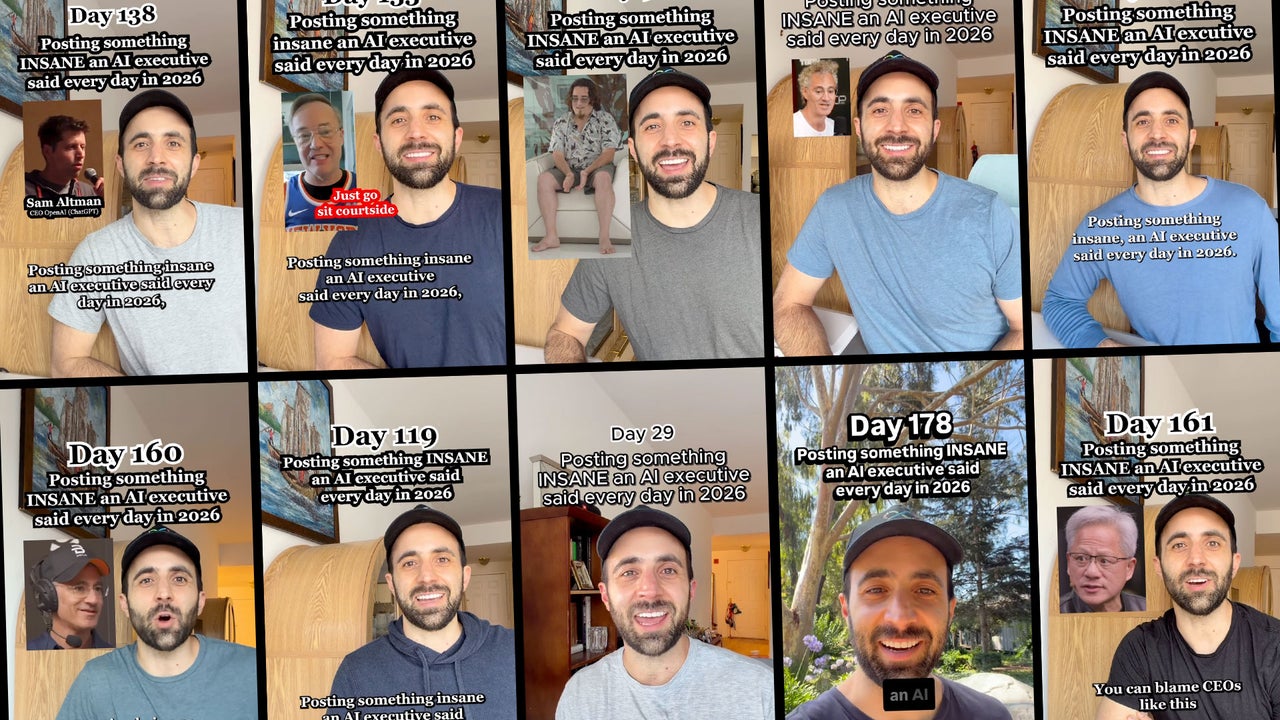
When Brian Patrick wakes up each day, he logs on to his computer and starts combing through social media, news articles, and YouTube videos to find the craziest things prominent AI executives have ever said. He always finds something.
There’s the clip of Oracle founder Larry Ellison admitting to building body cameras that record users while they’re in the bathroom. A sound bite of SpaceX CEO Elon Musk advocating for merging humans with AI. Even an interview with Friend CEO Avi Schiffmann, in which he compares his relationship with AI wearables to peoples’ relationships with God.
Once he’s pulled one of these clips, Patrick breaks down its claims in a video for his AI Executive Insanity Series, a social media project that’s chronicling one wild AI executive statement every day throughout 2026.
The series—currently at 181 installments and counting—has notched tens of millions of views and thousands of comments since the start of the year, and continues to gain steam with each new installment.
The series is part of a broader effort, spearheaded by Patrick, to convene a community of like-minded people interested in taking “democratic control” of AI.
Through his self-founded organization, Panodime, he’s building a website and an app (expected to debut within the next several weeks) aimed at helping educate people about developments in the AI tech space and connecting those individuals to potential opportunities for collective action.
He believes the public should be allowed to stop, pause, or direct AI development through a democratic process, rather than allowing the technology’s power to rest in the hands of a select few technocrats—and he’s bringing more attention to that choice, one video at a time.
“[AI] just reached a point where it was clear to me that it was going to go off the rails in ways that are going to be irreversible if we don’t do anything about it in the near future,” Patrick says, adding, “There’s a small group of unaccountable people primarily in Silicon Valley who are deciding the future of humanity in really profound ways. That’s what motivated me.”
Taking AI execs at face value
Hunting down AI executives’ latest hot takes is Patrick’s full-time job.
Before running Panodime, Patrick studied political theory at Georgetown, attended Harvard Law School, and worked as a software developer. He says his research into AI executives accelerated about a year ago—and he began uncovering interviews and statements that shocked and unnerved him.
At that point, he decided to quit his day job and put all of his energy into educating the public on the small group of technologists at the forefront of the AI revolution.
“I think just more and more the way I heard them speak, it was so disturbing to me,” Patrick says. “The more I listened to it, the more I realized that I didn’t know the depth of it—and I felt like most people weren’t aware of the depth of it. Most people just aren’t aware of how many standard deviations these people are away from the mean, and how their views of the world are so warped in very disturbing ways.”
“I am convinced that the job destruction in the next couple of decades is going to be massive”
Every day, Patrick searches different AI executives across social media platforms, on YouTube, and on search engines to uncover new nuggets for his videos. Often, he says, his process includes diving into comment sections and replies to find the most startling topics, or watching the context around viral clips to find other interesting details.
Sometimes his finds are more recent, like one clip from early June of Palantir CEO Alex Karp claiming his company has “100 million fans.” Others are pulled from much older sources.
Some of the most alarming content, Patrick says, traces back to an era before AI executives “buttoned up” their talking points around their technology. One such example is a 2009 article in which venture capitalist and AI enthusiast Peter Thiel laid out his ultimate objective of “escaping world politics” by settling three frontiers: cyberspace, outer space, and the sea.
Another is a 2015 panel, hosted at Stanford, wherein OpenAI CEO Sam Altman stated, verbatim, “I am convinced that the job destruction in the next couple of decades is going to be massive. I don’t actually think this is a new thing. I think technology has always created and concentrated wealth but destroyed jobs, but, honestly, one of the things that I struggle with getting out of bed every morning is that my job is to help people destroy jobs.” More recently, Altman has walked back the idea that AI will lead to a “jobs apocalypse.”
Patrick sees these clips as examples of the kinds of conversations AI executives are having behind closed doors—and he believes that once people are educated on them, there will be enough collective dissent to start a movement against the unchecked development of more powerful AI tools.
“I think there’s a lot of energy and a lot of collective will to change this, and one of the most encouraging things is that it’s not coming from one region, one political persuasion, or background,” Patrick says. “It’s just a very diverse group of people who are concerned. It’s fundamentally a human problem, and I think a lot of people recognize that.”