
Opinions expressed by Entrepreneur contributors are their own.
For years, the rule in text-to-speech has been simple. If you wanted the best-sounding voice for your product, you paid enterprise pricing. If you wanted cheap, you accepted robotic. If you wanted fast, you gave up something on both. That rule just broke.
The trade-off every product team has been forced to make
If you have ever built a voice agent, a phone system, or a real-time reader, you know the drill. You audition four or five models. One sounds incredible and costs more than your infrastructure. One is affordable and sounds like a GPS from 2009. One is fast, but only in three languages. You pick the least bad option and ship.
Then the invoice arrives.
And every quarter, your CFO asks the same question: why is voice the single most expensive line item in the stack?
What just changed on the leaderboards
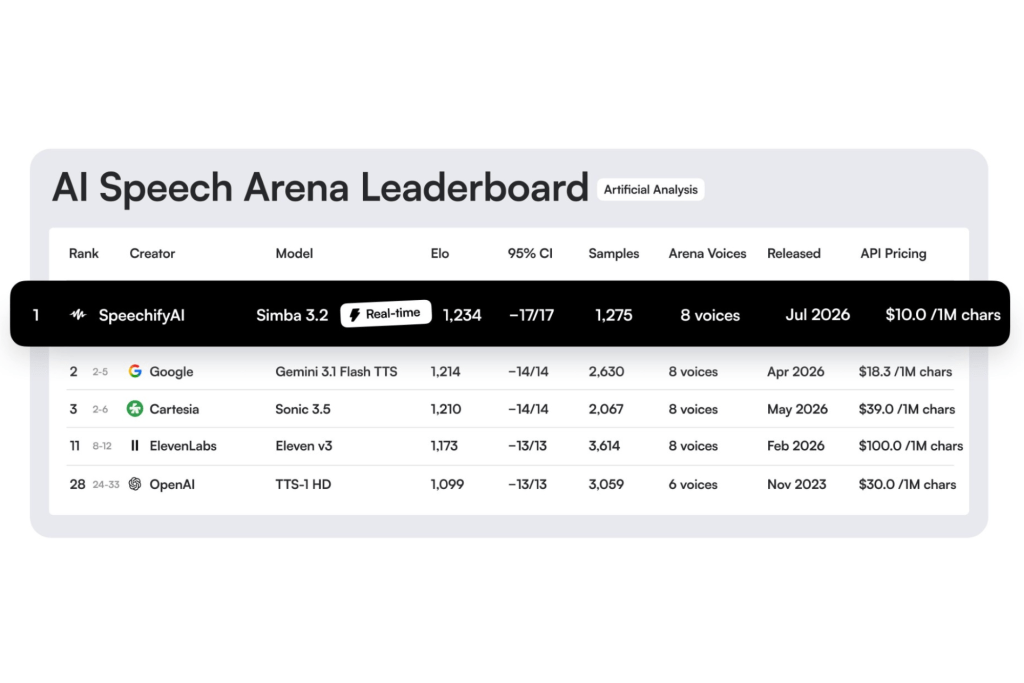
This week, Speechify’s Simba 3.2 moved to first place on the Artificial Analysis text-to-speech leaderboard, ranking above ElevenLabs, Cartesia, OpenAI, and Google DeepMind. On Voice Arena, the blind-listener benchmark modeled on Chatbot Arena, it sits at the top for real-time models at its price point.
Neither leaderboard is run by Speechify. Neither uses self-reported scores. Native speakers hear two clips without knowing which model made which, and they vote for whichever sounds more natural.
Simba 3.2 is now the highest-rated real-time voice model a team can put in production today.
Here is where it gets uncomfortable for the incumbents.
The three numbers that matter
For anyone building with voice, only three things ever really mattered: quality, latency, and cost. Every model release has forced a compromise on at least one of them.
1. Quality. Simba 3.2 is ranked number one on Artificial Analysis and on top for quality and price on Voice Arena. Both benchmarks are independent. Both are blind.
2. Latency. It is a streaming-native model with lower time-to-first-byte than its predecessors, built for voice agents that respond in real time rather than after a pause that ruins the conversation. All sub-100ms.
3. Cost. It is listed at $10 per one million characters, dropping to $6 per one million characters on the Scale tier. That makes it the cheapest model in the Artificial Analysis top ten, over fifteen times more affordable than ElevenLabs and roughly six times more affordable than Cartesia, according to the company.
Best-sounding, fastest, and cheapest have almost never described the same model. Now they do.
Credit: Speechify
Why this happened
The usual story with AI models is that the lab optimizes for the benchmark, prices for enterprise buyers, and lets the developer platform inherit whatever margin is left over. Speechify built it in the opposite order.
The same voice technology has been running inside a consumer product used by more than sixty million people for years. That audience does not tolerate a robotic voice, a two-second delay before the first word, or the kind of unit economics that only work at enterprise pricing. Every A/B test in that product fed back into the model.
“We made the architecture decisions at the beginning that most labs put off until later,” explained Raheel Kazi, an engineering leader at Speechify. “We never wanted to sacrifice on cost to chase quality, or sacrifice on quality to chase latency. We took the harder route on purpose. Hitting SOTA on all three at once is what that decision was always for.”
“This is the underdog story for API providers,” Luke Oliff, Head of Developer Relations at Speechify, said in a press release. “We spent years making our models run efficiently because our consumer business demanded it, tens of millions of listeners, with some of the best voices on the planet. That work is why we can now put the best-rated model in the world on our API at about as cheap as it comes. Most labs are built for the benchmark and priced for the enterprise. We built for listeners and priced for production.”
What Artificial Analysis and Voice Arena actually test
Neither leaderboard is the kind of benchmark a vendor can game.
Artificial Analysis runs on live serverless API endpoints, four times a day at random times, using a randomly selected voice, a unique 500-character prompt, and a standardized audio sample rate. Latency is measured end-to-end, all the way to when the audio file lands locally.
Voice Arena uses the same blind pair-comparison principle across six languages, with a balanced voice slate per model rather than each vendor’s best-sounding default. The methodology was developed with input from Prof. Shinji Watanabe of Carnegie Mellon University.
On both boards, quality is scored the same way. Pairs of clips generated from identical text are played to native speakers in blind comparisons. Listeners choose which sounds more natural. Votes get aggregated into an Elo rating. No self-reported score, no vendor-selected clip, no internal panel, and no provider pays for inclusion or ranking.
For a model to sit near the top of both, it has to satisfy an objective performance evaluation and a blind human preference vote across multiple languages. Simba 3.2 does.
SpeechifyAI Agents and Speechify’s Developer Platform
Alongside the leaderboard result, Speechify is launching Voice Agents for businesses and a developer platform, both at speechify.ai. The model powering both is the same one running its consumer apps.
Simba 3.2 is a streaming-native model with low time-to-first-byte, fine-grained emotional control, and SSML prosody, engineered to sound natural in real-time voice applications. According to the company, more voices, additional languages, and an even lower-cost tier are already on the roadmap.
“Simba 3.2 is our best model yet, now available on Speechify.ai,” Cliff Weitzman, CEO and Founder of Speechify, shared in a public post. “It’s built to power voice agents at scale and perfected from millions of A/B tests we run in our consumer platform. In TTS APIs, three things matter: cost, quality, and latency. Simba 3.2 has achieved SOTA on this trifecta. Beyond excited for you to experience it firsthand to power your experiences.”
So is this the end of paying enterprise prices for voice?
For the teams that have already spent six figures on a voice bill this year, the answer is starting to look obvious.
For the teams that haven’t yet, the question is how long they are willing to keep paying for a trade-off that no longer exists.
Voice AI used to make you choose. It doesn’t anymore.
For years, the rule in text-to-speech has been simple. If you wanted the best-sounding voice for your product, you paid enterprise pricing. If you wanted cheap, you accepted robotic. If you wanted fast, you gave up something on both. That rule just broke.
The trade-off every product team has been forced to make
If you have ever built a voice agent, a phone system, or a real-time reader, you know the drill. You audition four or five models. One sounds incredible and costs more than your infrastructure. One is affordable and sounds like a GPS from 2009. One is fast, but only in three languages. You pick the least bad option and ship.
Then the invoice arrives.