
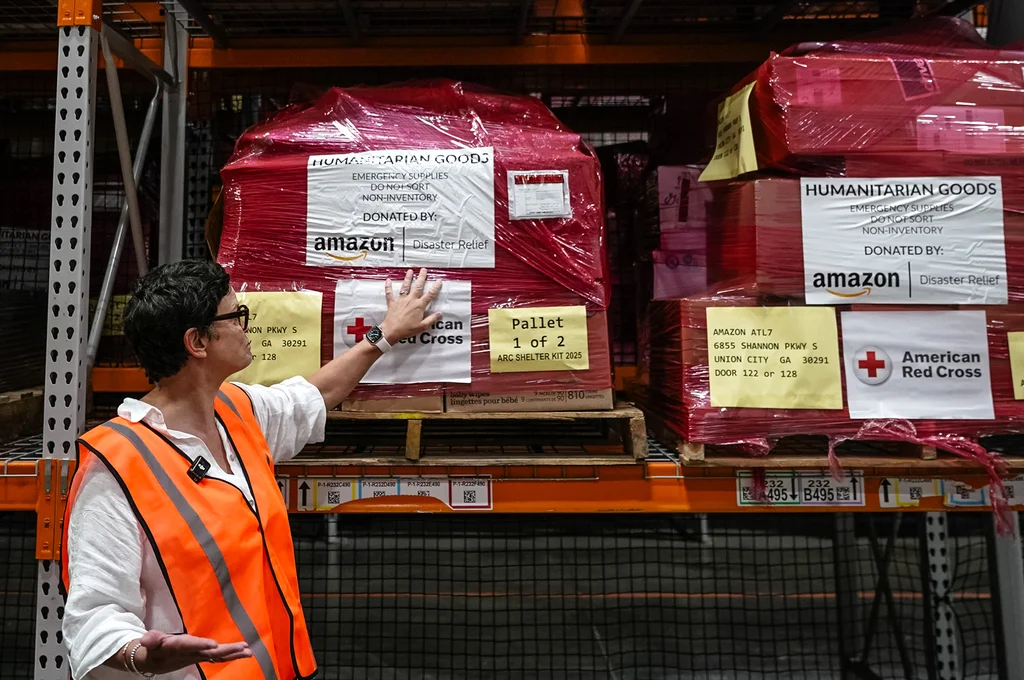
Tens of thousands of Venezuelans remain missing after two deadly earthquakes. Bettina Stix, global director for community impact at Amazon, takes us inside the disaster relief operation she built from scratch, deployed across more than 200 global crises from the L.A. wildfires to the Caribbean. She explains what Amazon Prime’s obsession with speed and logistics has to do with getting aid to people who need it most, and why delivering what hasn’t been asked for can make a disaster worse.
This is an abridged transcript of an interview from Rapid Response, hosted by the former editor-in-chief of Fast Company, Bob Safian. From the team behind the Masters of Scale podcast, Rapid Response features candid conversations with today’s top business leaders navigating real-time challenges. Subscribe to Rapid Response wherever you get your podcasts to ensure you never miss an episode.
The recent earthquake in Venezuela has been devastating: more than 2,000 confirmed dead, 43,000 missing, towns reduced to rubble. Amazon has partnered with more than a dozen nonprofits, from the Red Cross to World Central Kitchen, to provide help. How do things look on the ground right now, and how did you first hear about it?
I learned about it from the news, and I immediately texted the team and said, “This is going to need our help.” When you hear there’s an earthquake in the middle of the capital of a country that’s already structurally weak, you know immediately this is not going to end well.
A couple of weeks ago, Venezuela was still an embargoed country by the United States. So we can only, as a company, help in places where there isn’t an embargo. But luckily, in situations like that, the community comes together, the world comes together, and sanctions like these are lifted. We could start having conversations with partners about how we help provide response and relief really fast. We also do this for connectivity, for example. One of the biggest problems is that the infrastructure for connectivity is mainly down. Power lines are down. It’s hard to connect with people. So one of the first things we did was send connectivity kits. That means batteries, routers, and satellite equipment so hospitals could be powered and relief operations could be powered.
It could sound like, well, this is standard Amazon activity. We are getting supplies together and logistically getting them from one place to the other. But it does have to be different when you’re dealing with a disaster like this.
It is and it isn’t. Our commitment is to speed. Our commitment is to be able to deliver whatever is needed, very similar to the promise we try to make to our customers. When they need something the next day, they go to the website, they order it. In this case, we have pre-positioned relief items. We have 16 of those around the world. We have one in Atlanta, especially for the Caribbean, Latin America, and the U.S. area, to be ready to fly relief goods. Think tarps, think equipment to clean up, think first-day emergency items like diapers, medical items, and what have you. Our flight actually went out on July 3, and we delivered 663,000 items on one of our Amazon Air cargo planes as soon as the runways were clear.
We have helped in 200 disasters. We’ve delivered 26 million relief items since 2017, since we started doing this. And we’ve built a lot of trust in this community. We’re going to be part of an air bridge that will bring help to Venezuela on a weekly basis. The State Department has brought together a coalition of partners. Amazon Air Cargo is the provider of airlift. The World Food Program will distribute everything on the ground. And Airlink, which is a nonprofit known for distributing and helping coordinate, will do the operations.
In Venezuela, and in the 200-plus other disasters that you’ve worked on, you focus on the most acute phase of disaster recovery rather than the long tail of recovery, because recovery, there are things that are needed all the way through.
The long-term recovery starts with the relief phase. You may have seen that search and rescue is ongoing. It’s horrible. The death toll changes hourly because more and more people are being pulled from the rubble. Meanwhile, there are children displaced. There are people without a roof to live under. They’re completely traumatized.
There is need that needs to be taken care of immediately. If you don’t meet that immediate need, all recovery is going to be slower. There are studies that say if relief is delayed, recovery is delayed four times that much. So it is important that a partner like [ourselves] can help in that phase with what we’re uniquely good at: the supply chain, the speed, the transportation capabilities, and the way we treat this really as a customer problem for our nonprofits. They’re our customers.
I had worked in our store retail business and Prime before I posed this question to the company: There’s got to be a better way to help in disasters. I thought, what if this was like Prime? What if we could bring what Amazon is good at directly to the people who need it most when a disaster strikes?
For companies and businesspeople who want to do relief work well rather than just for the press release, are there things you’ve learned? Is there a mindset shift?
My best advice to anybody is: Do not deliver any help that has not been asked for. There’s a phenomenon called a second disaster. It’s when people, with the best intentions, send what they think is needed, and that may actually not be what’s needed. Sometimes we need to wait to hear what’s needed. That just leads to more work on every end where that aid needs to go. Don’t send anything that has not been requested.