
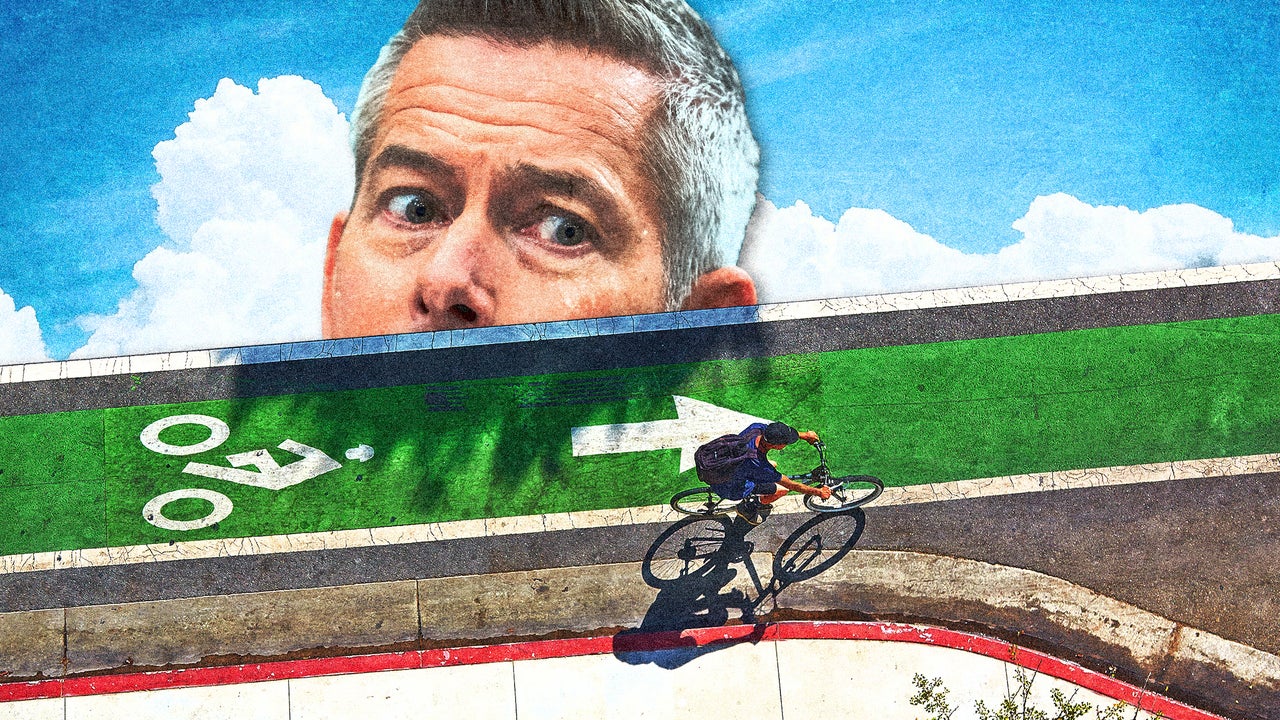
The Trump administration could soon reduce public transportation choices in the U.S. and make it more difficult to get around town on your own.
A series of recent moves by the Department of Transportation deprioritizes mass transportation and bike lanes by removing information previously available online and proposing funding cuts, describing these strategic mainstays of good urban design as “DEI” (diversity, equity, and inclusion) efforts.
In a letter sent to lawmakers this month, Transportation Secretary Sean Duffy asks Congress to authorize the Trump administration’s new transportation priorities, which he positions through a lens of partisan politics. The proposal would also scale back funding for bike lanes.
Whether or not the rhetoric scores Duffy political points, in practical terms it could make American roadways less safe. “Secretary Duffy is asking Congress to ignore the facts about bike lanes: They improve safety, don’t cause congestion, and aren’t a partisan issue,” says Laura Jenkins, communications director for the League of American Bicyclists, a nonprofit association. Improvements like green “bike boxes” painted on the road or physical barriers have been shown to reduce collisions with motorists.
Duffy’s proposal also includes cutting funding for public transportation and EV infrastructure. It calls for eliminating the Highway Trust Fund, which includes a Reagan-era mass transit account that funds public transportation; prioritizes motor vehicle traffic over bike lanes; and ends a requirement that projects paid for through the Complete Streets program to increase pedestrian and cyclist safety also include sidewalks and bikeways.
In his letter, Duffy says bike lanes increase congestion and waste fuel, and he asks Congress to restrict federal grants for bike lanes and to remove bike lanes “that contribute to congestion,” though he offers no specifics on how that would be determined. It’s worth noting that recent research from cities across the globe has found that bike lanes can reduce traffic congestion.
Duffy puts bikes in the political lane
The Trump administration has worked to remove information about bike lanes from government web pages, including from the Federal Highway Administration website just this month. According to an internal email seen by NPR, DOT staff were told to remove pages that included language about bike safety from the site two days after a social media post from Duffy called bike lanes “DEI.”
Duffy previewed his proposal to Senate lawmakers with a post on social media that cast transportation as a culture war. “Remember when Biden and Boot-edge-edge used YOUR MONEY for DEI bike lanes and climate change? THAT’S OVER,” he wrote.
The “DEI” reference seems to be a dig at Biden administration projects funded by the former president’s bipartisan infrastructure legislation, which includes money for pedestrian and bike infrastructure, recreational trails, and safe routes to school in communities of color that are disproportionately impacted by roadway fatalities.
There’s a difference in Americans’ primary modes of transportation that fall along the urban-rural divide, which today has become highly correlated with party affiliation. Democrats, who are more likely to live in cities, are thus more likely to ride bikes and take the train around town than Republicans, who are more likely to live in rural areas and need to drive everywhere. (The suburbs are more or less split evenly.)
Rather than presenting the Trump administration’s transportation priorities as being for Americans no matter where they live, though, Duffy frames the issue as an us versus them proposition, as if riding a bike is somehow “woke.”
Additionally, Duffy’s letter calls for more federal oversight of local public transportation systems by tying government funding to crime and safety, changing regulations related to autonomous vehicles, providing new grants for interstate funding, further privatizing air travel, mandating vehicles be capable of wireless data transmission or automated driving, requiring all knowledge and skills tests for commercial driver’s licenses be administered in English, adopting permanent daylight saving time, and providing an additional $1 billion for renovating New York’s Penn Station, which would be renamed.
Authorization of DOT surface transportation funding ends on September 30, so between now and then, lobbyists and lawmakers will hash out a funding bill that could include some of these proposals. Senate Minority Leader Chuck Schumer said Monday he would block any proposal that renames Penn Station for Trump.
“Politics ahead of safety”
At least when it comes to the Trump administration’s views on bike lanes, the League of American Bicyclists, which advocates for cycling infrastructure and safety, is not on board. The group says DOT “needs to explain why it is putting politics ahead of safety.”
“DOT’s own data shows bike lanes reduce crashes up to 49% and don’t increase congestion, and polling consistently shows Americans want safer roads and more bikeable communities,” Jenkins says. “They don’t have the facts, they don’t have the law, they don’t even have the American public on this, so they’re taking cheap shots at people who bike.”
According to government research that Duffy’s DOT has removed from its website, adding bike lanes reduces all crashes—not only bike crashes but also vehicle crashes—by 53%, as well as reduces crashes on both four- and two-lane undivided and local roads.