
Everyone has a statistic about enterprise AI. Depending on the survey you come across, 70% to 90% of projects never make it past the pilot stage. For the last two years, “pilot purgatory” has been enterprise AI’s defining narrative.
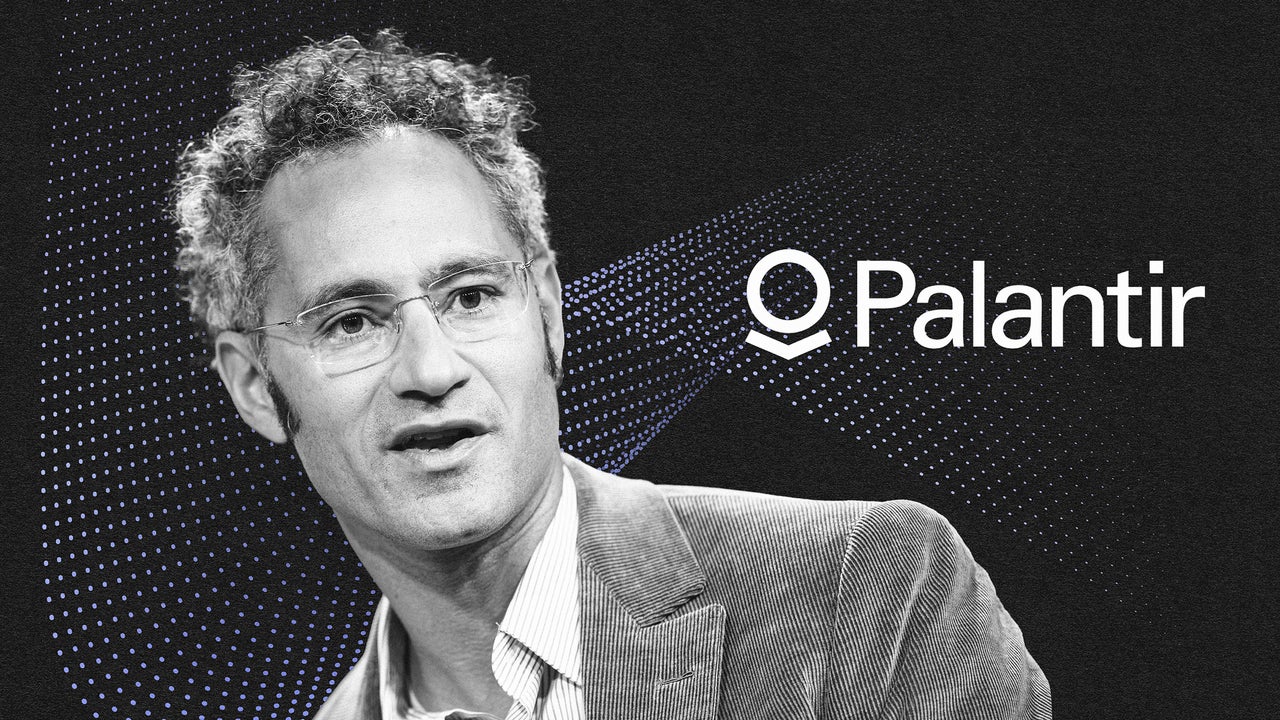
Then came Palantir. If Wall Street wants proof that enterprise artificial intelligence has escaped the lab, few companies make a stronger case. Palantir has posted growth rates that would be extraordinary for a startup, let alone a company expected to top $7.6 billion in revenue this year. CEO Alex Karp told shareholders that the company’s results for the first quarter of 2026 demonstrate strength “that dwarfs the performance of essentially every software company in history at this scale,” while positioning its Artificial Intelligence Platform as the operating layer for how enterprises reorganize work.
The tech giant recently joined Nvidia, Microsoft, Meta, and more than 20 other companies in urging U.S. policymakers not to restrict open-weight AI models, which enterprises can run and tune on their own infrastructure. It also published a corporate blog post claiming that companies risk handing their competitive edge to leading AI providers. According to Palantir, those providers could absorb an organization’s institutional knowledge—its “alpha”—and eventually monetize it. The solution, it suggests, is AI sovereignty.
Taken together, the moves read like a doctrine. One targets Washington, arguing against regulation of the open-weight models enterprises need. The other targets CIOs, urging them not to surrender institutional knowledge to someone else’s infrastructure. Palantir is trying to shape the rules around who controls enterprise AI.
Ahead of its earnings report on August 3, the market is focused on whether Palantir can justify one of software’s richest valuations. But the more revealing insights sit beneath the headline numbers.
Palantir’s Biggest Growth Engine
Last quarter, Palantir delivered one of the strongest performances in enterprise software history. Revenue climbed roughly 85% year over year to $1.63 billion, while U.S. commercial revenue surged 133% to $595 million. It raised its full-year guidance by nearly half a billion dollars in a single quarter and closed 206 deals worth at least $1 million.
But of its $377 million commercial revenue increase over the past year, $352 million came from existing customers. Average annual revenue from its 20 largest customers jumped from $64.6 million to $93.9 million in a year, and by the March quarter had reached $108 million on a trailing-12-month basis. Net dollar retention hit 150%, far beyond normal software benchmarks.
“Palantir’s 20 biggest customers grew about 45% last year. Everyone else grew 65%. Most of the growth comes from existing customers buying more. But it’s getting less top heavy, not more,” says Mike Leone, VP and principal analyst at Moor Insights & Strategy.
That helps explain Karp’s most revealing comment from the last earnings call: “Only seven of our salespeople actually even really sell.” Instead, Palantir relies on AI bootcamps and forward-deployed engineers, or FDEs, embedded with customers. Software companies typically scale by reducing human involvement. Palantir scales by placing engineers inside customer organizations until AI stops being an experiment and becomes operational infrastructure.
But if enterprise AI succeeds because vendors embed deeply inside their customers, where does software end and consulting begin?
The consulting-in-disguise argument “has been the standard knock on Palantir for years, and the margins just don’t support it,” Leone says. “True consulting firms like Accenture or Cognizant run operating margins in the mid-teens. Palantir ran 46% in the quarter ending in March.”
If anything, the industry is drifting toward Palantir. Amazon Web Services and Microsoft are building their own FDE groups; Microsoft’s runs about 6,000 people. “Palantir built the company around FDEs from the start, and everyone else is finding out enterprise AI needs them to get off the ground,” Leone says. Karp made the same case in his shareholder letter with a single figure: annualized revenue per employee of $1.5 million.
But Liz Miller, vice president and principal analyst at Constellation Research, is less convinced. “Right now, many FDEs are nothing more than better-trained and more sophisticated inside sales reps—now rebranded,” she says. Her challenge to Karp is to demonstrate why the shift matters.
Nowhere is the tension between software and embedded services more visible than in Britain.
The Sovereignty Paradox
While Palantir tells enterprises to reduce their dependence on frontier-model providers, one of its biggest customers is wrestling with the opposite question: How dependent should it become on Palantir itself?
Its Federated Data Platform, a contract awarded in late 2023 and reportedly worth up to £330 million ($444 million at current exchange rates), was meant to serve as the digital backbone for data across England’s National Health Service, one of the four national health services in the U.K. Palantir positioned it as governed AI in action. Instead, it became one of the world’s most politically scrutinized enterprise AI projects.
Parliamentary committees have urged ministers to consider a break clause, more than 100 NHS data and technology professionals want the platform replaced, and the CEO of NHS England, Sir Jim Mackey, has questioned whether its claimed benefits were objectively assessed, calling for an independent review. (Palantir did not respond to Fast Company’s request for comment.)
“Governance was never built to prevent a trust crisis,” says Leone at Moor Insights. “You’re buying lineage and access control. That’s forensics.” But “governance can’t prove the system worked or get the people affected to agree, and those are the two things that blow up trust,” he says.
Likewise, Miller at Constellation Research believes “enterprises aren’t buying trusted AI. CEOs are not buying trusted AI. They are buying indemnified AI.” CIOs want the governance kill switch, she says, “but Palantir is proving time and again that selling the promise to CEOs is the path to profit.”
The U.K. government hasn’t moved to terminate the contract. But the episode exposes an irony in Palantir’s doctrine. The company warns that hosted providers may lock customers in and accumulate knowledge they can’t reclaim, while U.K. lawmakers are asking structurally similar questions about the NHS’s dependence on a single foreign supplier woven into public infrastructure.
Sovereignty operates differently at each layer of the stack. An enterprise can swap one model for another. Replacing the workflows, ontologies, security policies, and operational logic built over years is another matter. That’s why Palantir’s largest customers keep spending more. The company is not just expanding revenue but dependency—while warning customers against depending on anyone else.
To Miller, that dependency isn’t a side effect. “What Palantir is doing is selling to CEOs better than anyone on the promise of AI in a way that CEOs understand—but completely befuddles every CIO,” she says. “They are effective, but the organization will be super dependent. That is the business model. And so far, it is working, as proven by that revenue fine print.”
The sovereignty campaign’s timing isn’t accidental. Investors worry that OpenAI, Anthropic, and Google will move up the stack and become enterprise software companies. Palantir’s counterargument: Models are becoming commodities. In his May letter, Karp described model companies locked in a race where token costs have fallen a thousandfold and “winners and losers swap places every six months,” while Palantir sits “in a category of our own.”
If intelligence becomes abundant, control becomes the scarce asset instead.
The Pre-Earnings Question That Matters Most
The more durable question is whether Palantir represents the future of enterprise AI, or an exception proving how hard it still is. Current numbers point in both directions. The fact that Palantir has more than 1,000 commercial customers—including Airbus, Bain, GE Aerospace, and Stellantis—suggests industrial companies are embracing AI faster than skeptics predicted. Yet the growth remains concentrated, high-touch, and, in Britain, politically contested.
“Companies this size almost always slow down,” Leone says—and Palantir sped up instead. Beyond next quarter, he says, the real metric would be geography. “U.S. revenue more than doubled in the March quarter and nothing outside the U.S. grew half that fast. That gap isn’t a technology problem. Regulated buyers outside America are deciding whether they want a U.S. company running their operations.”
Perhaps enterprise AI has arrived, just not in the form many expected. “Enterprise AI is not mainstream,” Miller notes. Token counts measure cultural readiness, “but it simply does not measure the success of what was built, generated or delivered with AI. The adults need to enter this chat and assign real business value and metrics to AI application.”
That’s why Palantir’s upcoming earnings matter beyond Wall Street’s expectations. They may offer the clearest signal yet of what enterprise AI is becoming: software that companies deploy or infrastructure they can’t easily replace. That distinction could determine not only who wins the enterprise AI race, but what winning ultimately means.