
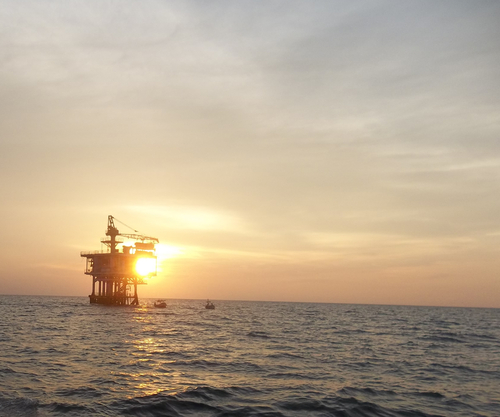
Iran’s oil industry has been brought to a standstill, and the economic consequences are becoming impossible to ignore. Iran’s seaborne crude oil exports collapsed from a 14-day average of 230,000 barrels per day at the beginning of September to ZERO, remaining there into October. This is an extraordinary development for a country that depends upon petroleum revenues to finance its government, support its currency, and obtain the foreign exchange necessary to purchase imports. Washington has spent decades attempting to cripple Iran’s economy through sanctions, but the naval blockade has accomplished something far more devastating in a matter of weeks.
Claire Jungman, Vortexa’s director of maritime risk and intelligence, stated, “The blockade is doing what years of sanctions never managed.” There are now an estimated 83 million barrels of Iranian crude sitting aboard tankers, including 43 million barrels trapped west of the Strait of Hormuz. Iran has the oil, it has potential buyers, and it has enormous financial obligations, but it cannot freely deliver its product and collect the revenue. Liquefied petroleum gas exports have also collapsed by 48% from the previous month, reaching their lowest level since at least January 2023. The government is being deprived of its principal source of hard currency while the costs of maintaining the state and its military continue.
This is precisely what I have explained regarding the sovereign debt crisis throughout the Middle East. These governments built their budgets around petroleum revenues, and when that income disappears, the financial structure begins to unravel. They cannot simply replace billions in lost export earnings by increasing taxes on a population that is already struggling. Government employees still expect to be paid, military expenditures continue, imports must be financed, and outstanding obligations do not disappear because the oil tankers cannot leave port. The longer this blockade continues, the more difficult it becomes for Tehran to maintain the financial machinery upon which the government depends.
Iran’s currency has already been devastated. The rial has lost approximately 35% of its value against the dollar since July, while annual inflation reached 73.6% in September. Imagine living under a government where the purchasing power of your savings is being destroyed at that pace while the country loses access to its most important source of foreign exchange. Imported goods become more expensive, businesses struggle to obtain necessary supplies, and the average family pays the price for decisions made by politicians who never seem to suffer the same consequences as the people they govern.
The economic contraction is equally alarming. The International Monetary Fund now projects Iran’s economy will shrink 7.6% in 2026, while Iranian government figures show GDP contracted approximately 10% during the spring compared with a year earlier. Industrial production, trade, and household consumption are all suffering. A country cannot lose its export revenue, experience a currency collapse, and maintain normal economic activity simply because its leaders insist they remain financially secure. The government may be able to survive politically for some time, but the private economy is being systematically deprived of the capital necessary to function.
China’s position is particularly important because Beijing has been one of the principal destinations for Iranian petroleum. Vortexa reports that China’s demand for Iranian crude has weakened as Russian oil has filled part of the gap. This illustrates how international capital and trade flows adjust regardless of the political arrangements governments believe they have established. Russia benefits from replacing Iranian supplies, while Tehran loses both revenue and bargaining power. Russia now accounts for 80% of the high-risk petroleum exports tracked by Vortexa among Iran, Russia, and Venezuela. Moscow may be politically aligned with Tehran, but that does not mean Russian producers will voluntarily surrender their own market share to rescue Iran’s finances.
Washington may believe that eliminating Iran’s oil revenue will force Tehran to negotiate, but economic warfare carries consequences well beyond the intended target. Iran still possesses the ability to threaten shipping through the Strait of Hormuz, one of the most strategically important energy corridors in the world. The more desperate its financial position becomes, the greater the incentive for its leadership to use whatever leverage remains. A blockade intended to weaken one country can therefore create disruptions throughout the region, raising transportation costs, insurance premiums, and energy prices for nations that have nothing to do with the original dispute.
We are already witnessing the inflationary consequences of this conflict. American gasoline prices surged 9.1% in September, and the energy component of the Consumer Price Index increased 5.2% in a single month. The same government attempting to deprive Iran of petroleum revenue must now confront the consequences of higher energy costs at home. Energy enters virtually every stage of production and distribution, so the disruption does not end at the gasoline pump. It works its way into transportation, agriculture, manufacturing, and ultimately the cost of living for ordinary households.
The global economy is interconnected, whether politicians wish to acknowledge it or not. Iran loses its oil revenue, Russia captures additional market share, China adjusts its purchases, and Western consumers confront higher energy costs. Every government involved believes it can manipulate the outcome through sanctions, blockades, or military pressure. But international commerce does not operate according to political wishes, and the economic damage rarely remains confined to the country originally targeted.