
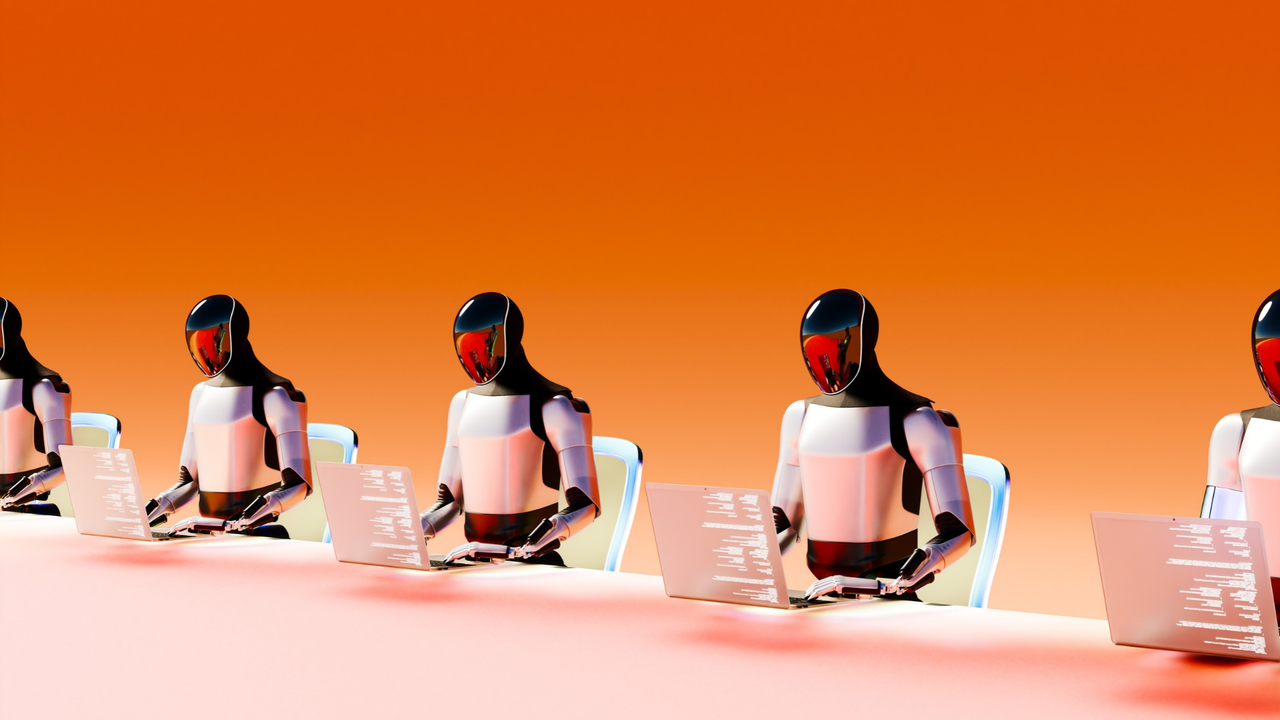
Every executive team I talk to asks me some version of the same two questions: How fast can we deploy AI? Which AI tools should my team have? But they are asking the wrong questions.
A person or organization can purchase a license to an AI solution in moments, but how fast can people adapt? The answer to this question will decide who succeeds in the AI era.
TECHNOLOGY IS MOVING QUICKLY
AI tools are changing weekly. A workflow can change overnight. A new model can suddenly perform a task that belonged entirely to a person six months ago.
People do not update like software. They need to understand what changed. They need to practice. They need to develop new judgment. They need guidance on when to trust the technology and when to challenge it. They need clarity on where AI’s autonomy ends and their responsibility begins. Eventually, organizations need to know whether people are actually ready. I do not know of a single organization, large or small, that has infrastructure for that.
As the rate of technology innovation accelerates, so does something I refer to as “readiness debt.”
READINESS DEBT IS THE NEW TECHNICAL DEBT
Anyone who has built software understands technical debt. You move quickly. You take shortcuts. You defer important but non-essential work. You need to build features that weren’t envisioned at the outset.
The product keeps moving forward, but the tech stack starts becoming shaky. Advancements slow and bugs become trickier to fix. The liabilities accumulate and eventually, you must pay them back. In software development this is often referred to as refactoring and, if managed poorly, it can kill an organization.
Now, the same thing is happening to the workforce.
Every time an organization changes a workflow without adequately preparing the people performing it, it adds readiness debt.
Every time AI assumes part of a job but nobody redefines what good human performance now looks like, it adds readiness debt.
Every time a company rolls out a new policy or tool, sends employees a new training, checks the completion box and assumes they are ready, it adds readiness debt.
Individually, these gaps seem small, but collectively they compound and emerge as inconsistent execution, workarounds, declining sales, mistakes your customers see, or poor customer satisfaction. People trust AI when they should challenge it. Others refuse to trust it when they should use it. Managers cannot tell who understands the new workflow and who is struggling.
AI IS CONSTANTLY REDRAWING JOBS
For most of modern corporate history, jobs were relatively stable. A role changed. The organization updated the training. Employees learned the new process. Eventually the next change came along. AI breaks that model.
The boundary between human work and machine work can now move continuously. One task remains human-led. Another becomes human plus AI. Another is mostly performed by AI with human oversight. Another disappears entirely. And six months later, those boundaries may move again.
In every industry, AI removes some capabilities from the job. It makes others dramatically more important.
That is why AI training is too small a way to think about the problem. We are not teaching people how to use a tool. We are continually redefining what it means to be good at the job. And we are continually redefining what the employee is responsible for and what they are accountable for.
Most organizations are remarkably sophisticated at measuring technology and remarkably unsophisticated at measuring human capability. With technology, we measure uptime, latency, adoption, engagement, effectiveness, and ROI. With employees, we measure readiness checking—whether they completed a training course.
If you are introducing a new AI-assisted workflow in a front-line environment such as a sales team, hospital, airline, or financial institution, the most important question is whether they can perform.
THE AI PARADOX
There is an irony here I need to point out. AI is helping create the readiness problem, but it may also give us the ability to solve it.
Historically, high-quality applied learning has been difficult to scale. It is easy to distribute a PDF or PowerPoint presentation to 50,000 employees. It is much harder to give 50,000 employees realistic opportunities to practice judgment, make decisions, communicate with another person, make mistakes, get feedback, and try again.
That is changing.
AI can turn policies, procedures, job requirements, and real-world scenarios into interactive practice. It can create dynamic customers, patients, employees, managers, or teammates. It can change the difficulty of a scenario. It can observe decisions and behaviors. It can identify patterns across individuals and teams.
This creates an opportunity to move from training intelligence to something much more consequential.
Organizations should begin asking what they can actually do. That is a very different relationship between organizations and their workforces.
THE LARGEST CONSTRAINT ON AI ADOPTION
There is enormous pressure to move quickly on AI. Some of that pressure is justified.
But speed without readiness creates fragility and risk. The organizations that pull ahead will be the organizations that can adapt their workforces as close to the rate of technology change as possible and maintain the low readiness debt.
This requires organizations to maintain workforce readiness as infrastructure, not periodic professional development. When a new AI capability is deployed, leaders should immediately ask what changed about the work. That question belongs alongside cybersecurity, governance, architecture, and ROI in every serious AI implementation plan.
Ryan Schmaltz is CEO and cofounder of ReadyAI (formerly Patient Ready).