
Key Takeaways
- Allison and Stephen Ellsworth are launching Jetty, a new “everyday hydration” brand.
- Hydration is a declining category, but they see a major unmet need in the space.
- When debuting a product, it’s important to build an emotional connection with consumers. Your packaging can do a lot of that work.
After selling a company for $1.95 billion, what do you do next?
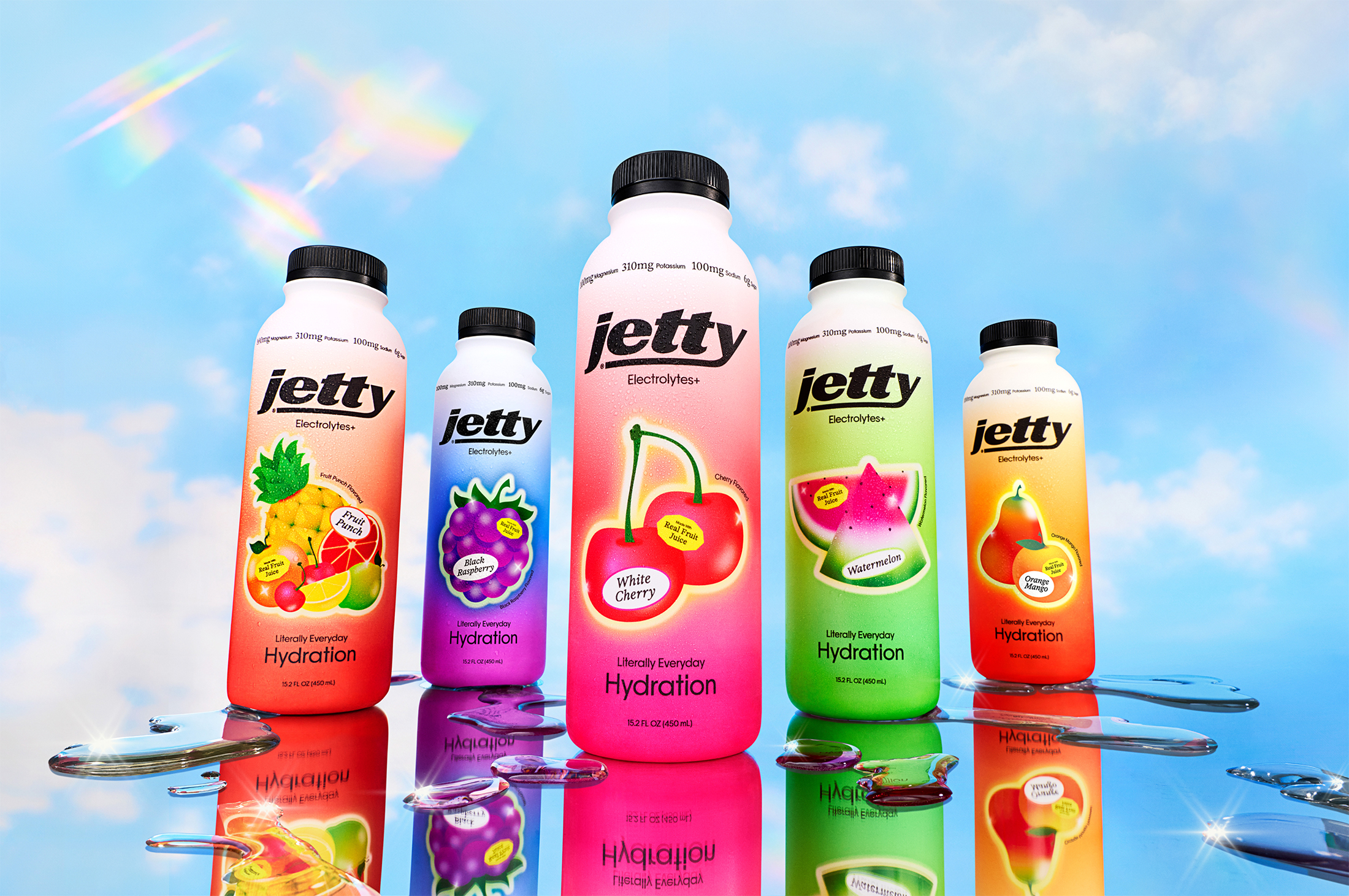
Here’s Allison Ellsworth’s answer: One year after selling Poppi to PepsiCo, she’s now back with a new brand — called Jetty. It calls itself a “literally everyday hydration” brand, which sells hydration powders and liquid beverages.
She and her husband Stephen, who she built Poppi with, are self-funding Jetty with a $2.5 million investment.
“My kids asked me, ‘Mom, why are you doing this again?’” says Ellsworth. “And I was like, ‘Because I want to. I’m really excited to build again.’ And I also think there’s something really important about showing my kids the work ethic of it all. We don’t want them to grow up and think, ‘Oh, we don’t have to work hard.’”
The Ellsworths will have their hard work cut out for them: They’re entering a crowded and declining category, and going up directly against juggernauts like Liquid I.V. and Gatorade.
So, how do they plan to make Jetty a success?
Here are five things they learned from building Poppi, which Ellsworth says will help along their journey:
1. Opportunities hide in crowded categories
This may sound like counterintuitive advice: If you want to find a huge business opportunity, look where the market is most crowded.
Ellsworth learned that from building Poppi.
Poppi originally began as a brand called Mother, and the Ellsworths pitched it as a health tonic that contained apple cider vinegar. This left them chasing a niche consumer in a small market. Then they scored a major investment on Shark Tank, rebranded as Poppi, and started competing inside the much larger and noisier soda category — just as sales of mainstream sodas were declining.
The play worked, because Poppi targeted an underserved consumer with a better-for-you offering. Poppi was just different enough to be special, but familiar enough for soda lovers to embrace it.
This taught Ellsworth something important: If a category is struggling, that doesn’t always mean declining demand. It could just mean that the existing products have stopped meeting people’s needs.
That’s what she now sees in the hydration space. She says the major players are marketing towards men, and positioning themselves as athletic solutions. But that leaves a large, untapped market of women who just want to stay hydrated and enjoy something flavorful. “The data shows when people are hydrating — say, drinking a Gatorade, a BODYARMOR, a Vitaminwater — it’s morning, lunch, and afternoon. It’s not even at time of sweat,” she says. “Seventy percent of consumers are doing it not while working out.”
To take advantage of that, Ellsworth is positioning Jetty around the daily ritual of “everyday hydration” — something people reach for the way they’d reach for a coffee or a Diet Coke, regardless of whether they’ve broken a sweat.
2. Lead with personality, not just benefits
When most early-stage brands hit the market, their packaging is full of benefit statements: They’ll call out unique ingredients, specific health benefits, or anything else that makes the brand special.
Ellsworth decided not to do that with Jetty.
“People get really caught up on, benefit, benefit, benefit,” she says, “but they wouldn’t think to make the largest callout just fun.”
Jetty has benefit statements, but they’re smaller and more secondary. For example, the bottle notes that it contains electrolytes, real fruit juice, and a variety of nutrients. But the packaging is primarily about vibe: It is colorful, flavor-forward, and full of quirky messages. One of them reads, “Hydrating just became your new personality.”
Ellsworth wants Jetty to feel like an identity, not a list of reasons to drink it. Her reasoning is rooted in consumer psychology: Data and health claims may inform a purchase, but lasting brands are built on emotional connection.
“Most of the time when you’re marketing, and you want to build a long-term sustainable brand that community connects with, you have to find ways to emotionally connect with your consumers,” she says.
3. Companies are built on org charts
When they first built Mother, the Ellsworths focused heavily on product. As the company grew, they scrambled to build an organization to support it.
Now they’re doing things in reverse.
“When we decided to do this, our first exercise was to sit down and make an org chart,” Ellsworth says. From there, the couple modeled out costs, funding needs, and staffing projections years into the future… long before their product even existed.
Why? Because most entrepreneurs build a business reactively, she says. They grow by trial and error, instead of deliberately planning from the start.
“If we’re really going to do this at scale, how do we skip the first two years of business where you’re doing everything yourself and trying to figure it out?” she says, “Why not surround ourselves with the most incredible team and do it right from the beginning?”
4. Think of Amazon as a trust signal
For early-stage consumer brands, Amazon can be a double-edged sword: It’s a powerful way to reach consumers, but it comes with extra costs that can feel hard to afford.
But it has a benefit you cannot overlook, Ellsworth says: “Prime is in 90% of households in America,” she says. “We look at Amazon for the first two to three years as a marketing channel for trial.”
She lays out a scenario: A shopper encounters the product in Whole Foods, pulls out their phone, and checks the reviews. That validation — four and a half stars, dozens of comments — becomes the final nudge toward purchase, regardless of where the actual transaction happens.
And here’s another thing she’s learned about Amazon and other DTC business: To do it right, you may need to redesign your packaging to be mailed. In retail, for example, Jetty’s powders come in a box. That helps it stand out on shelves. But on Amazon, they’ll be sold in a bag. Why? It’s simple, she says: “If you ship a box, it’ll get dented and you’ll get a bad review.” And the reviews are everything.
5. Always make it personal
Building Poppi was stressful, she says. Because like almost all entrepreneurs, the stakes were extremely high. “It was like my life was on the line,” she says. “It was about generational legacy and wealth, and all of these things.”
Now, she says, the pressure is off. The Ellsworths don’t need to build a company for the money, which means they can focus on the joy of the building.
But, she says, it’s important not to get complacent — because you must always have something that motivates you, beyond just wanting to build a good product. The stakes must feel personal in some way.
For her, Jetty is all about pride and self-reliance. When building Mother and Poppi, the Ellsworths received a $400,000 investment on Shark Tank from Rohan Oza. He has extensive beverage experience, and was able to help guide their growth. But now the Ellsworths are self-funding, and relying on their own know-how. “It’s truly 100% percent on our own. It feels almost riskier,” she says. “We’re doing it truly alone, to prove that we can do it alone too.”