
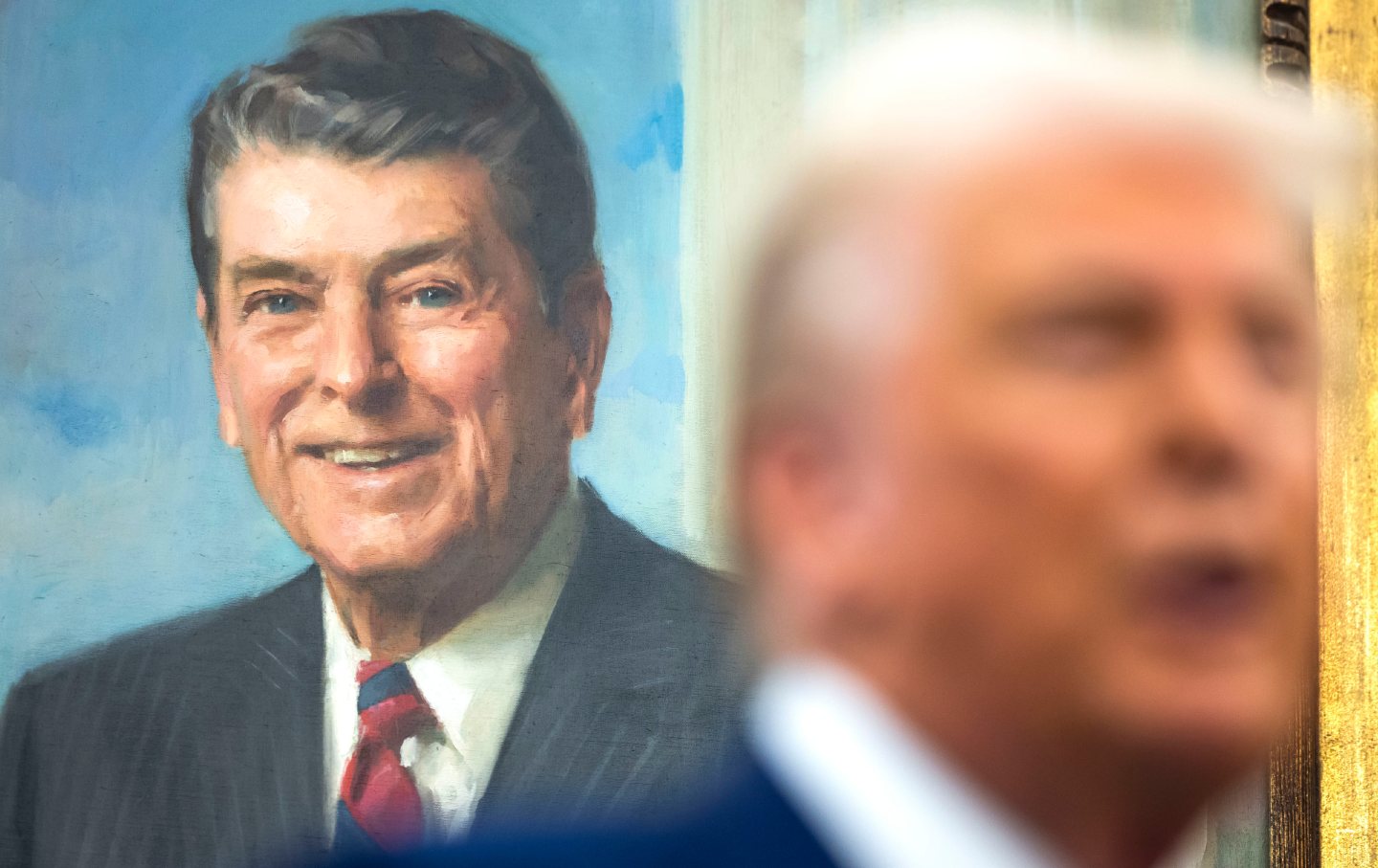
In distinction with the now sober-seeming Reaganites, Trump has taken credit score for the financial system from day one.
Within the winter and spring of 1981, Ronald Reagan took workplace and pushed by means of a large tax lower, home spending cuts and army spending will increase—a supply-side revolution, whereas Federal Reserve Chair Paul Volcker jacked up rates of interest. By summer season, the financial system was heading towards recession, and my boss, chairman Henry Reuss of the Joint Financial Committee, started demanding to know whether or not the brand new administration took duty. “Oh no!” they replied, “Our program hasn’t taken impact!”
The parallels with 2025 are extra obvious than actual. The CBO initiatives that Trump’s tax lower will add $4.1 trillion to the nationwide debt—however that’s solely primarily based on the absurd premise that the 2017 tax cuts would in any other case expire. In actuality, the tax invoice was a comparatively small change to the established order. Spending cuts are a severe blow to Medicaid and SNAP, however small in relation to the financial system. Likewise army will increase. Deregulation is extra severe, however the results—as an example, on the atmosphere—will take time to indicate up. Rates of interest are excessive, however 5 p.c isn’t 20.
And there are tariffs. Reagan’s administration was free commerce in precept, protectionist when handy. Trump’s is very protectionist in precept, however open to stress from the actual world, which is why ultimate diktats on China and on Mexico maintain being delayed. His tariffs will allow some American producers to boost costs and earnings (good for jobs, unhealthy for shoppers) besides the place they disrupt crucial provide chains. That these at the moment are ubiquitous—suppose gallium, germanium, rare-earth magnets—is one thing Trump’s individuals and the Pentagon are discovering out.
In distinction with the now sober-seeming Reaganites, Trump has taken credit score for the financial system from day one. That is in step with his normal worldview, but additionally with the pattern towards magical pondering in economics because the Eighties. The hyperpersonalization of financial coverage (Clintonomics, Bidenomics) has deepened vastly since then, imbuing every president with mysterious powers rooted within the drive of persona and supposedly distinctive concepts. However it’s a two-edged sword, as Trump found when the Bureau of Labor Statistics (BLS) abruptly revised three months of job progress downward. Trump reacted by firing the messenger, one thing that by no means occurred underneath Reagan as a result of we on the Joint Financial Committee defended the BLS, holding hearings on unemployment each month.
Reagan’s individuals knew (and advised me!) that they anticipated Volcker to engineer a deep recession. Monetarists favored this; supply-siders have been opposed; Reagan’s chief economist, Murray Weidenbaum, made non-public jokes in regards to the conflict. Comparable splits bedevil the Trump group—did Scott Bessent (bless his coronary heart) actually take a swing at Elon Musk?—and a few of Trump’s tariff individuals are as crazy because the supply-siders. The ingredient of fine humor seems absent, as additionally the underlying grim realism. Trump seems to wish excellent news on a regular basis, however to not get pleasure from it; Roosevelt and Reagan he isn’t.
Then there may be the rate of interest, then as now a crucial query. With public debt higher than GDP, excessive rates of interest flood cash-holders with cash, whereas locking up the housing market and concentrating inventory capitalization on probably the most speculative (and probably unstable) companies. Trump is correct (so assist me) that rates of interest ought to come down. However his public calls for and threats again Fed chair Jerome Powell right into a nook: Powell can’t comply with out showing to cede “independence.” Solely Congress can order the Fed to vary course, and thus far, Congress is on the sidelines, with the Democrats on the mistaken aspect of the difficulty. Right here the distinction with 1982 is sharp: That yr, Congress did agitate for decrease rates of interest and ultimately obtained them. (The Might 18, 1982, Federal Open Market Committee minutes doc dialogue of a six-page Reuss-to-Volcker letter; modesty precludes my mentioning who drafted it.)
Present Challenge

Lastly, there may be international coverage—a crucial predicate for the success or failure of financial coverage, since with out life on Earth, economies do poorly. On this matter, Reagan (in his second time period) actually did redeem himself—in my eyes—by reaching out to the management of the Soviet Union and ending the Chilly Warfare. Trump has the same ambition—however thus far, the outcomes should not spectacular. The clock is ticking on that, with the Democrats once more on the mistaken aspect of the difficulty, and one can solely hope for one of the best.
Properly, as Marx famously famous in The Eighteenth Brumaire of Louis Bonaparte, Hegel remarked someplace that nice personalities reappear, however “he forgot so as to add, on the primary event as tragedy; on the second as farce.” Reagan’s revolution was the intense daybreak of a mystical age, the start of rule by neoliberal economists. Trump’s appears extra a determined foray by means of the rubble.
Finally, by the best way, Reagan’s individuals agreed to take credit score for the financial system as of the brand new fiscal yr, October 1, 1982. On that day, at my urging, Reuss learn a poem by Archibald MacLeish into the Congressional Document. It’s known as “The Finish of the World”:
Fairly unexpectedly, as Vasserot
The armless ambidextrian was lighting
A match between his nice and second toe,
And Ralph the lion was engaged in biting
The neck of Madame Sossman whereas the drum
Pointed, and Teeny was about to cough
In waltz-time swinging Jocko by the thumb
Fairly unexpectedly to prime blew off:And there, there overhead, there, there hung over
These 1000’s of white faces, these dazed eyes,
There within the starless darkish, the poise, the hover,
There with huge wings throughout the cancelled skies,
There within the sudden blackness the black pall
Of nothing, nothing, nothing—nothing in any respect.
MacLeish, then close to the tip of his life, noticed it and despatched a letter; he was delighted.
On this second of disaster, we want a unified, progressive opposition to Donald Trump.
We’re beginning to see one take form within the streets and at poll bins throughout the nation: from New York Metropolis mayoral candidate Zohran Mamdani’s marketing campaign centered on affordability, to communities defending their neighbors from ICE, to the senators opposing arms shipments to Israel.
The Democratic Get together has an pressing option to make: Will it embrace a politics that’s principled and common, or will it proceed to insist on dropping elections with the out-of-touch elites and consultants that obtained us right here?
At The Nation, we all know which aspect we’re on. Every single day, we make the case for a extra democratic and equal world by championing progressive leaders, lifting up actions combating for justice, and exposing the oligarchs and firms profiting on the expense of us all. Our impartial journalism informs and empowers progressives throughout the nation and helps convey this politics to new readers prepared to affix the battle.
We’d like your assist to proceed this work. Will you donate to help The Nation’s impartial journalism? Each contribution goes to our award-winning reporting, evaluation, and commentary.
Thanks for serving to us tackle Trump and construct the simply society we all know is feasible.
Sincerely,
Bhaskar Sunkara
President, The Nation