Close Menu
    Facebook X (Twitter) Instagram
    TRENDING :
    • Social media’s big tobacco moment is just a first step
    • Ghirardelli Chocolate products recalled over Salmonella fears. Avoid this list of 13 beverage mixes
    • Google, TikTok and Meta could be taxed by Australia to fund its newsrooms
    • MacKenzie Scott says we underestimate the impact of small acts of kindness. Science agrees
    • Trump says Iran ‘better get smart soon’ as economies deal with skyrocketing energy prices
    • A key weapon in America’s ‘Golden Dome’ defense shield is taking shape
    • How F1 is revving up its U.S. takeover at the Miami Grand Prix
    • Why the hardest part of building the future is letting go of the past
    Compatriot Chronicle
    • Home
    • US Politics
    • World Politics
    • Economy
    • Business
    • Headline News
    Compatriot Chronicle
    Home»Business»The silent manipulations that often go unnoticed, according to a Harvard law professor
    Business

    The silent manipulations that often go unnoticed, according to a Harvard law professor

    September 7, 20253 Mins Read
    Share Facebook Twitter Pinterest LinkedIn Tumblr Telegram Email Copy Link
    Follow Us
    Google News Flipboard
    Share
    Facebook Twitter LinkedIn Pinterest Email


    Cass Sunstein is a Harvard Law School professor and one of the most cited legal scholars in the world. He founded the Program on Behavioral Economics and Public Policy at Harvard Law School, served in the White House during the Obama Administration, received the Holberg Prize from the government of Norway, and has written dozens of books on topics ranging from behavioral science to constitutional law.

    What’s the big idea?

    Hidden forces shape our decisions all the time—whether that comes in the form of peer pressure, marketing strategy, or cultural norms. Manipulation is silent, pervasive, and dangerous. We need to find ways to protect ourselves from influences that guide our actions without giving us a fair shot at making deliberate choices.

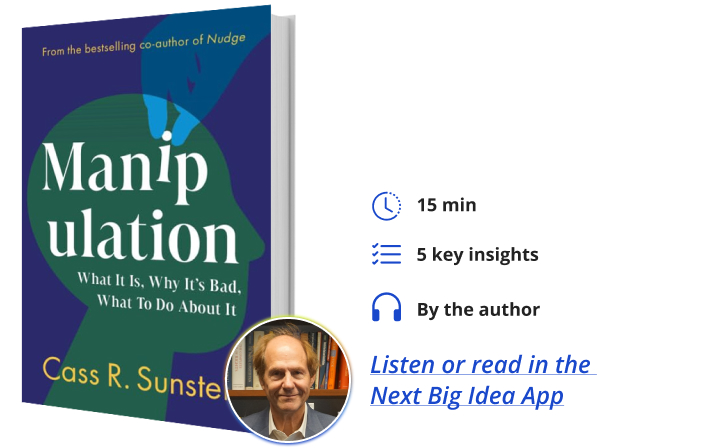
    Below, Cass shares five key insights from his new book, Manipulation: What It Is, Why It’s Bad, and What to Do About It. Listen to the audio version—read by Cass himself—below, or in the Next Big Idea App.

    1. Manipulation undermines your freedom to choose.

    Manipulation isn’t just persuasion—it’s trickery that prevents people from exercising their capacity for deliberation. It might stir emotions, hide crucial information, or bury key terms in fine print so you can’t make a truly informed choice. The danger lies in how it quietly strips away your agency, making you act without genuine reflection.

    2. Sludge is manipulation by a thousand cuts.

    “Sludge” refers to needless barriers—endless forms, hold times, or bureaucratic hoops—that make it hard to get what you want or to escape a bad deal. Companies often make signing up effortless, but impose exhausting obstacles when you try to cancel or change terms. This “easy in, hard out” design is manipulation on steroids.

    3. We need a right to not be manipulated.

    Societies already protect people from fraud and deception, but there’s no legal safeguard against manipulation itself. That’s a problem because manipulation can waste your time, drain your money, and damage your well-being without breaking existing laws. It’s time to create a clear, enforceable right that shields people from such exploitation.

    4. The Barbie Problem: buying what we wish didn’t exist.

    Some goods are bought not out of love, but because social norms make them feel unavoidable. Think of Barbies, cigarettes, certain social media platforms, or any items that most people purchase yet many privately wish would disappear altogether. Companies exploit social pressures to manipulate us into consumer choices that don’t reflect our true preferences. Getting people to buy products they deplore or regret purchasing is a serious problem that we need to find a way to reduce.

    5. Social norms can trap us.

    Once a product exists, refusing it can send an unwanted signal: in some communities, turning down a drink implies you’re no fun; skipping a trendy app makes you seem out of the loop. To avoid that social penalty, we comply—even if we’d be happier without the product entirely. This is manipulation by peer pressure, and is extremely hard to resist because of how certain choices signal specific social perceptions of you.

    This article originally appeared in Next Big Idea Club magazine and is reprinted with permission.


    Source link

    Share. Facebook Twitter Pinterest LinkedIn Tumblr Email

    Related Posts

    Social media’s big tobacco moment is just a first step

    April 29, 2026

    Ghirardelli Chocolate products recalled over Salmonella fears. Avoid this list of 13 beverage mixes

    April 29, 2026

    Google, TikTok and Meta could be taxed by Australia to fund its newsrooms

    April 29, 2026
    Top News

    7 CEOs share their New Year’s resolutions

    By Staff WriterDecember 30, 2025

    Hello and welcome to Modern CEO! I’m Stephanie Mehta, CEO and chief content officer of…

    Airline rewards rankings 2025: These programs offer the best points value, flight change and cancellation perks

    September 10, 2025

    Early Voting Data Indicate Mail-In Voting Won’t Be as Prominent in 2024

    August 18, 2025

    Inside the creative collaboration that turned JFK Jr.’s political magazine into a sexed-up cultural moment

    March 27, 2026
    Top Trending

    Social media’s big tobacco moment is just a first step

    By Staff WriterApril 29, 2026

    Many commentators have called March’s California jury verdict, finding Meta and Google…

    Ghirardelli Chocolate products recalled over Salmonella fears. Avoid this list of 13 beverage mixes

    By Staff WriterApril 29, 2026

    California-based Ghirardelli Chocolate Company has voluntarily recalled 13 of its powdered beverage…

    Google, TikTok and Meta could be taxed by Australia to fund its newsrooms

    By Staff WriterApril 29, 2026

    Australia has proposed taxing digital giants Meta, Google and TikTok on a…

    Categories
    • Business
    • Economy
    • Headline News
    • Top News
    • US Politics
    • World Politics
    About us

    The Populist Bulletin serves as a beacon for the populist movement, which champions the interests of ordinary citizens over the agendas of the powerful and entrenched elitists. Rooted in the belief that the voices of everyday workers, families, and communities are often drowned out by powerful people and institutions, it delivers straightforward, unfiltered, compelling, relatable stories that resonate with the values of the American public.

    The Populist Bulletin was founded with a fervent commitment to inform, inspire, empower and spark meaningful conversations about the economy, business, politics, inequality, government accountability and overreach, globalization, and the preservation of American cultural heritage.

    The site offers a dynamic mix of investigative journalism, opinion editorials, and viral content that amplify populist sentiments and deliver stories that echo the concerns of everyday Americans while boldly challenging mainstream narratives that serve the privileged few.

    Top Picks

    Social media’s big tobacco moment is just a first step

    April 29, 2026

    Ghirardelli Chocolate products recalled over Salmonella fears. Avoid this list of 13 beverage mixes

    April 29, 2026

    Google, TikTok and Meta could be taxed by Australia to fund its newsrooms

    April 29, 2026
    Categories
    • Business
    • Economy
    • Headline News
    • Top News
    • US Politics
    • World Politics
    Copyright © 2025 Populist Bulletin. All Rights Reserved.

    Type above and press Enter to search. Press Esc to cancel.