Close Menu
    Facebook X (Twitter) Instagram
    TRENDING :
    • The case for common sense at work
    • Is Iran Winning & Can Midterms Be A Clean Democratic Sweep?
    • Want to improve your performance? Focus on this
    • Taiwan Is Preparing For The Drone War
    • How marketing and HR can work together to increase sales
    • The Jobs Report Does Not Tell The Whole Story
    • ChatGPT Sites makes building a website feel like making a Google Doc
    • Indonesia: The Sleeping Giant Is Waking Up
    Compatriot Chronicle
    • Home
    • US Politics
    • World Politics
    • Economy
    • Business
    • Headline News
    Compatriot Chronicle
    Home»Business»A foreboding weather pattern has emerged: Here’s what it means for winter
    Business

    A foreboding weather pattern has emerged: Here’s what it means for winter

    October 9, 20253 Mins Read
    Share Facebook Twitter Pinterest LinkedIn Tumblr Telegram Email Copy Link
    Follow Us
    Google News Flipboard
    Share
    Facebook Twitter LinkedIn Pinterest Email


    La Niña, a climate pattern that can affect weather worldwide, has officially arrived.

    La Niña is fueled by colder-than-normal Pacific ocean temperatures, which then affect the pattern of the Pacific jet steam. It’s the cooler counter to El Niño, which involves warmer-than-normal ocean waters. Both are part of a weather system called the El Niño-Southern Oscillation (ENSO).

    La Niña conditions emerged in September, the National Weather Service’s Climate Prediction Center said on Thursday. They’re expected to continue through the end of the year, and potentially until February 2026.

    This La Niña is expected to remain weak, weather experts said, but it could still affect the winter, and even the hurricane season.

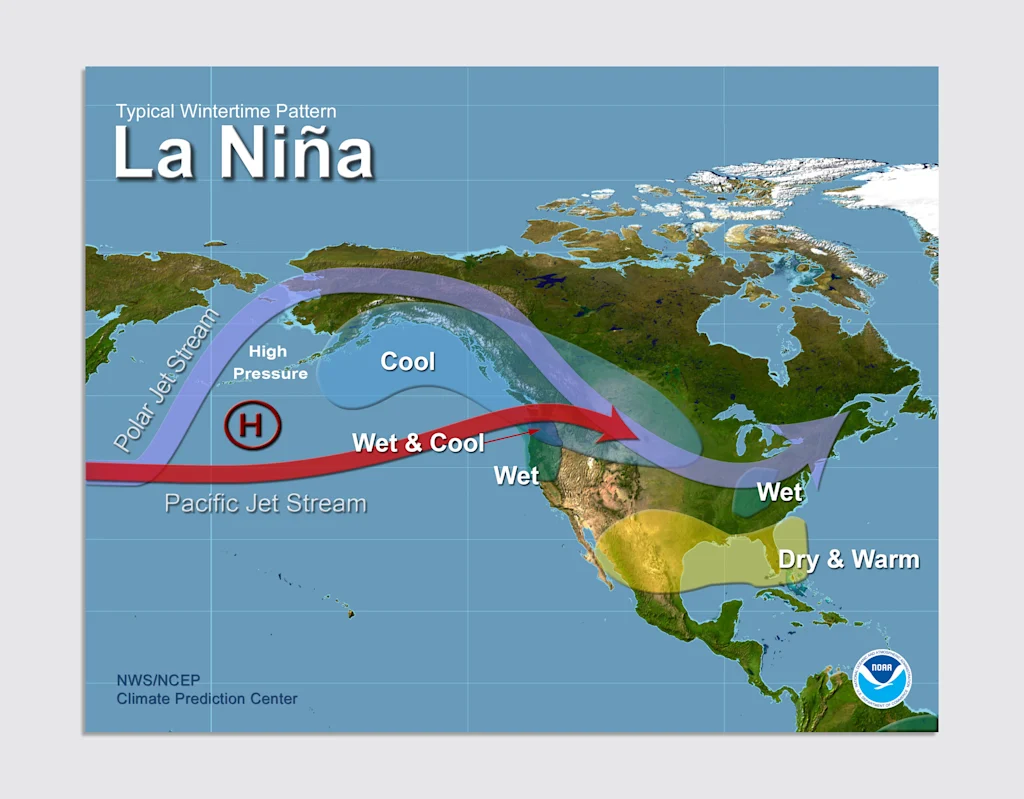
    [Image: NOAA]

    What does La Niña mean for winter weather?

    During La Niña, cold waters push the Pacific jet stream northward, which creates a “ripple effect” on the atmosphere. That jet stream then dips back down, dividing the U.S.

    That then brings dry, warmer-than-usual conditions to southern states. Northern states see colder-than-normal temperatures and wetter conditions, particularly in the Pacific Northwest.

    La Niña winters tend to bring a lot of snow to the Pacific Northwest, and even across the Great Lakes and into New England. Southern states, by contrast, tend to see below-average snowfalls.
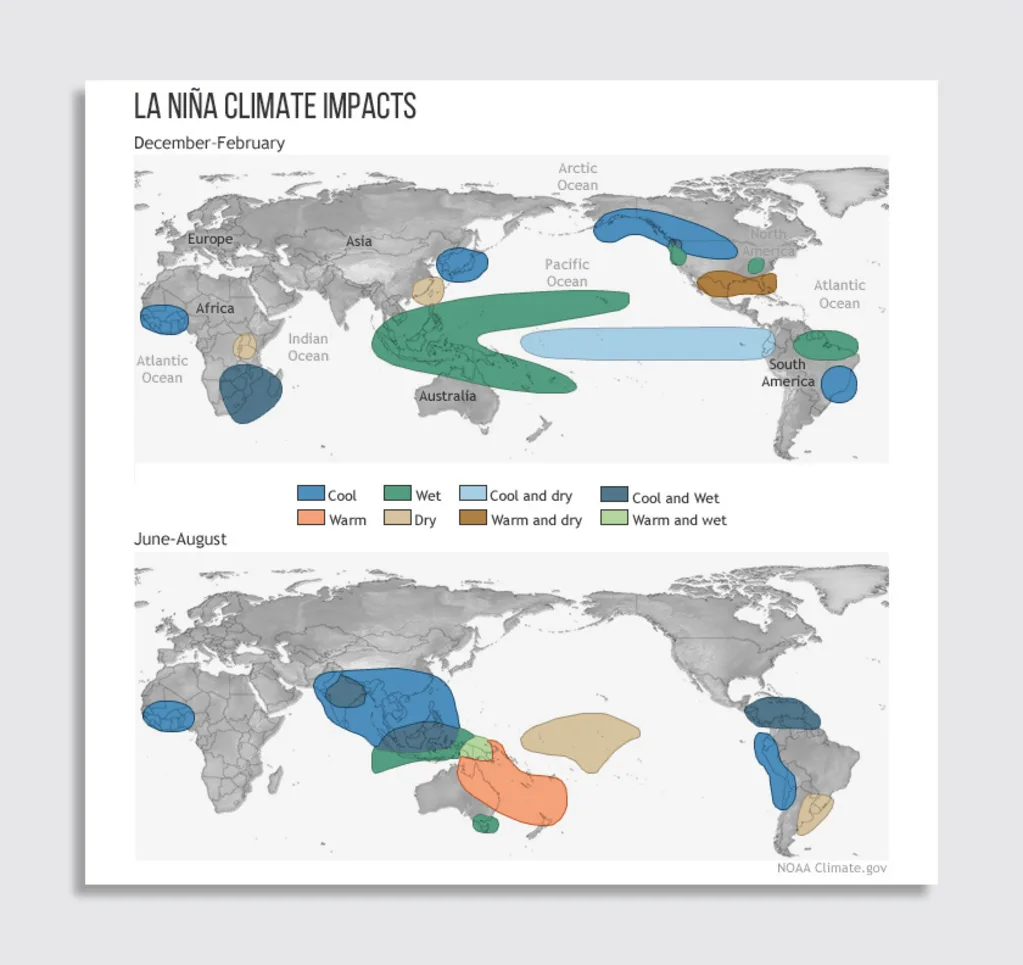
    "Two world maps show global climate impacts of La Niña during December–February and June–August, with regions color-coded by climate effects. In December–February, cool conditions (blue) appear in western Europe, the southeastern United States, and parts of southern South America. Wet areas (green) include northern South America, Southeast Asia, and northern Australia. Cool and dry regions (gray-blue) are found in northern and eastern Africa, while cool and wet areas (dark blue) appear in the northwestern United States and parts of Canada. Warm regions (orange) include southern Africa, southern South America, and parts of southern Asia. Dry areas (beige) are seen in central Asia and parts of the Middle East. In June–August, cool conditions (blue) are present in the southwestern United States, southern South America, and eastern Australia. Wet regions (green) include northern South America and central Africa. Warm and dry areas (orange-beige) cover the southern United States, Mexico, central Australia, and southern Africa. These maps illustrate how La Niña alters global temperature and precipitation patterns seasonally.
    [Image: NOAA]

    La Niña can also mean a more severe Atlantic hurricane season. So far this year, five tropical storms and four hurricanes have formed over the Atlantic, a bit below expectations. (On average, a hurricane season sees 18 topical storms.)

    But La Niña could bring more. “La Niña conditions are associated with more activity (double the amount) in November when compared to ENSO Neutral and especially when compared to Novembers with El Niño conditions,” Matthew Rosencrans, lead hurricane seasonal forecaster with the National Oceanic and Atmospheric Administration (NOAA), told USA Today.

    La Niña events can last one to three years, and a La Niña did span 2020 to 2023. The 2020 hurricane season saw the most tropical storms in the Atlantic ocean in any year on record, with 30 total.

    A weak La Niña, and what’s next

    This La Niña is expected to be weak, experts say, but it could still alter our weather. A weak La Niña can also make it more difficult to predict that weather.

    “A weak La Niña would be less likely to result in conventional winter impacts, though predictable signals could still influence the forecast guidance,” per the Climate Prediction Center.

    2024 saw a weak La Niña winter, but it still gave us “typical” La Niña impacts. “Most of the southern U.S. and northern Mexico were predicted to be and turned out to be drier than average, with record-dry conditions in southern Arizona and parts of New Mexico, NOAA meteorologist Nat Johnson wrote last spring. “Wetter conditions were forecasted and did prevail over the northern part of the continent, particularly in Alaska and parts of the Pacific Northwest.”

    In some instances, though, the reality differed from forecasts, like when a “ribbon of wetter-than-expected” weather hit Texas, Arkansas, Kentucky, and western Virginia. “Despite these regional differences from expectations,” Johnson wrote, “the big picture was pretty La Niña-ish overall.”

    La Niña and El ​​Niño aren’t always active. These events typically happen every two to seven years, on average. The ENSO cycle is a break in normal wind and water patterns, and weather experts say we’ll likely see a transition to “ENSO-neutral” conditions this spring.


    Source link

    Share. Facebook Twitter Pinterest LinkedIn Tumblr Email

    Related Posts

    The case for common sense at work

    September 7, 2026

    Want to improve your performance? Focus on this

    September 7, 2026

    How marketing and HR can work together to increase sales

    September 7, 2026
    Top News

    Mastering Bookkeeping for Your Online Business

    By Staff WriterMay 25, 2026

    Achieving proficiency in bookkeeping for your online business is crucial for your financial management and…

    7 Essential Benefits of Team Building Training

    December 14, 2025

    Trump just replaced his surgeon general pick, and it could change what you’re told about your health

    May 2, 2026

    Turkey’s Treasury Dump | Armstrong Economics

    May 27, 2026
    Top Trending

    The case for common sense at work

    By Staff WriterSeptember 7, 2026

    “Why isn’t common sense more common at work?” I’ve heard some version…

    Is Iran Winning & Can Midterms Be A Clean Democratic Sweep?

    By Staff WriterSeptember 7, 2026

    Some people have complained that I said that Iran was winning and…

    Want to improve your performance? Focus on this

    By Staff WriterSeptember 7, 2026

    There was a time where being a high performer meant putting every…

    Categories
    • Business
    • Economy
    • Headline News
    • Top News
    • US Politics
    • World Politics
    About us

    The Populist Bulletin serves as a beacon for the populist movement, which champions the interests of ordinary citizens over the agendas of the powerful and entrenched elitists. Rooted in the belief that the voices of everyday workers, families, and communities are often drowned out by powerful people and institutions, it delivers straightforward, unfiltered, compelling, relatable stories that resonate with the values of the American public.

    The Populist Bulletin was founded with a fervent commitment to inform, inspire, empower and spark meaningful conversations about the economy, business, politics, inequality, government accountability and overreach, globalization, and the preservation of American cultural heritage.

    The site offers a dynamic mix of investigative journalism, opinion editorials, and viral content that amplify populist sentiments and deliver stories that echo the concerns of everyday Americans while boldly challenging mainstream narratives that serve the privileged few.

    Top Picks

    The case for common sense at work

    September 7, 2026

    Is Iran Winning & Can Midterms Be A Clean Democratic Sweep?

    September 7, 2026

    Want to improve your performance? Focus on this

    September 7, 2026
    Categories
    • Business
    • Economy
    • Headline News
    • Top News
    • US Politics
    • World Politics
    Copyright © 2025 Populist Bulletin. All Rights Reserved.

    Type above and press Enter to search. Press Esc to cancel.