
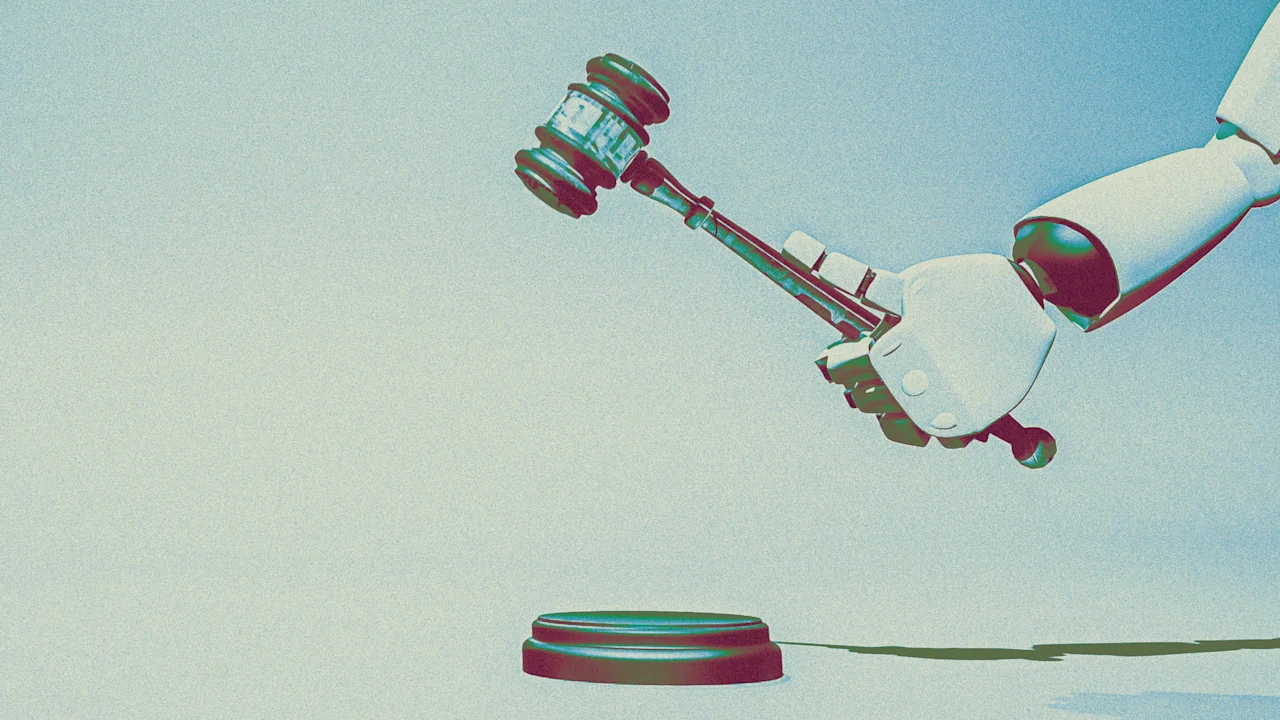
Lawyers notoriously struggle with technology. The legal profession is one of wood-paneled courtrooms and leather-bound lawbooks—not apps and chatbots.
The infamous Lawyer Cat of the early pandemic Zoom era is an especially hilarious example of what happens when lawyers are forced to embrace tech they wouldn’t otherwise touch.
And when lawyers use artificial intelligence, it often goes just as poorly.
A Massachusetts lawyer was sanctioned for citing nonexistent cases hallucinated by ChatGPT in an official court filing, and California recently fined an attorney $10,000 for similar AI-hallucinated errors.
It’s no surprise, then, that lawyers can be reluctant to embrace the large language models (LLMs) and AI agents that other professions are adopting in droves.
A particular quirk of the legal profession, though, may soon force their hand by threatening lawyers with malpractice if they don’t adopt AI.
And the same dynamic could apply to fields like accounting or medicine, catapulting these highly impactful, AI-skeptical fields to the forefront of AI adoption, whether they like it or not.
Since this is a story about lawyers, I’ll pause for a moment to offer the disclaimer that I’m a reporter, not a lawyer, and nothing in here is legal advice—it’s based on my own research and multiple off-the-record conversations with practicing attorneys. If you’re in the profession, you’ll want to consult with your own bar association about these changes.
Forced by fiduciaries
Most people merely need to be good enough at their jobs.
Even if my metaphors are a bit staid or a specific piece I’ve written lacks ample, alluring alliteration, I’ve done my job as a Fast Company contributor if I’ve reported the news truthfully and kept you reasonably well informed.
Lawyers are held to a different standard. In many cases, they’re bound by multiple fiduciary duties—legal obligations to treat their clients in specific ways.
Cases need to be confidential, for example, and lawyers can’t sell out their clients to the other side.
But lawyers are also legally obligated to be competent and to charge their clients reasonable fees—keeping those fees as low as possible while still meeting their clients’ legal needs.
In the past, that’s generally meant avoiding unnecessary legal research that could run up the bill, for example, or avoiding expensing lavish meals and other frivolities to your client’s account.
Now, though, AI may be on the brink of changing the definition of what it means to be “competent.” And AI’s ability to make tasks easier and faster could spell fiduciary trouble for lawyers and other professionals who don’t embrace the tech.
Be Efficient, Or Else
Again, lawyers are often reluctant to embrace new tech. Faced with the risk of made-up cases and big fines, many lawyers have simply chosen to opt out of testing or using AI altogether.
A formal opinion from the American Bar Association (ABA), though, makes clear that it may soon cease to be an option.
“With the ability to quickly create new, seemingly human-crafted content in response to user prompts, generative AI (GAI) tools offer lawyers the potential to increase the efficiency and quality of their legal services to clients,” the ABA says.
Yes, these tools can make errors, the ABA acknowledges, and “lawyers may not abdicate their responsibilities by relying solely on a GAI tool.”
Still, the ABA cautions its members not to be too cautious about AI use.
“Emerging technologies may provide an output that is of distinctively higher quality than current GAI tools produce, or may enable lawyers to perform work markedly faster and more economically,” the opinion says.
If that happens, the ABA cautions, it could trigger the fiduciary duty to be competent and to minimize fees. The tools could become “ubiquitous in legal practice” and establish “conventional expectations regarding lawyers’ duty of competence.”
In other words, AI could become so useful in the legal profession that lawyers who eschew it are wasting their client’s time, or providing inferior representation.
The ABA gives the example of email and PDFs. “A lawyer would have difficulty providing competent legal services in today’s environment without knowing how to use email or create an electronic document,” the ABA says. “As GAI tools continue to develop and become more widely available, it is conceivable that lawyers will eventually have to use them to competently complete certain tasks for clients.”
Again, because of their fiduciary duties, failing to do this wouldn’t simply be bad form—it could potentially count as malpractice.
To drill in the point, the ABA extends its email metaphor, saying that lawyers who fail to use the era’s most up-to-date technology are “potentially liable for malpractice.” The clear implication is that the same penalty could apply to AI laggards, once the tech advances enough.
Off the record, multiple lawyers have told me that that moment is either fast approaching or already here.
The ABA’s opinion was written in 2024, when LLMs were far less powerful and accurate. Today, one longtime attorney told me, LLMs often write up lists of relevant cases—or even entire briefs—in minutes that are just as good as those a lawyer might produce after hours in a traditional law library.
The potential obligation to use AI is apparently already appearing in lawyers’ yearly continuing education materials. And as LLMs get better and better, their power to save time and produce superior output—and the resulting duty for lawyers to embrace them—will only intensify.
Forced to the Forefront
If LLMs and other generative AI tools advance to the point that lawyers are forced to use them in order to remain competent, the legal profession could suddenly be forced to the forefront of AI adoption.
Firms would be tripping over themselves to get their attorneys up to speed on the latest AI tech. And countless companies would undoubtedly spring up to apply AI to every aspect of the law. It would be a gold mine for AI app builders and consultants.
And it’s unlikely that the impact would remain in the legal field—multiple other AI-skeptical professions could become subject to similar ethical and legal duties, and experience the same rapid, forced adoption.
Doctors, for example, take a professional oath to “do no harm.” While the American Medical Association is clear that doctors shouldn’t be penalized for failing to adopt today’s AI, other sources point out that as LLMs advance, a failure to use AI could end up putting patients at unnecessary risk.
A 2024 study reported in The New York Times showed that even that year’s comparatively simple chatbots were better than doctors at diagnosing many illnesses. And worse, when doctors tried to work alongside chatbots, they ended up performing worse than the chatbots did without their help.
Studies have even shown that patients find chatbots more empathetic and better at communicating than actual doctors.
Again, as the tech advances, that could mean doctors who avoid AI will increasingly risk harming their patients. The same goes for accountants, financial planners, real estate agents, and many other professions with fiduciary responsibilities to their clients.
For now, lawyers, doctors, accountants, and other professionals can plausibly point to LLMs’ early-stage status and persistent tendency to hallucinate, and wash their hands of the need to adopt or experiment with the tech.
As the models get better, though, that claim will be harder and harder to make. As the ABA points out, a lawyer who is clueless about email would have been considered entirely competent in 1990. Today, he would be seen as a hack and might be disbarred.
The same dynamic may soon apply to chatbots and LLMs. And if that comes about, the professionals who failed to learn the tech today—or stubbornly insisted that AI is a passing fad unworthy of their time and attention—will have done so at their peril.