
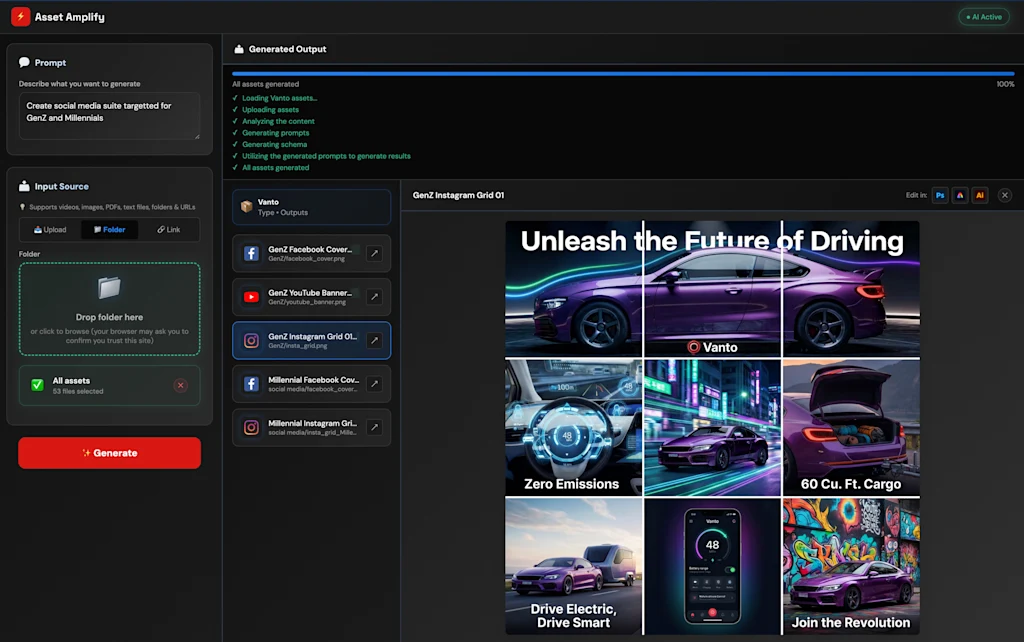
Over the past several months, Adobe has been rolling out a steady stream of AI features and platform updates that make brand design more intuitive, quick, and personalized. Its latest addition to that portfolio is a new tool called Asset Amplify that can generate entire websites, social media posts, and print collateral catered toward specific audience segments, like Gen Zers or millennials.
Asset Amplify is among several prospective tools, called “Sneaks,” that Adobe will be demoing at its 2026 Adobe Summit conference this week. For Adobe, Sneaks are annual UX experiments, crowdsourced from across the company, that may or may not become actual products based on user interest. According to Eric Matisoff, principal evangelist of analytics and data science at Adobe and the mastermind behind the Sneaks program, about 30% of Sneaks typically make it into official Adobe platforms.
Like many other brands currently living in the nebulous overlap between being both an AI- and design-first company, Adobe has been pouring major investments into becoming a one-stop branding shop for the world’s biggest companies. In December, it announced the Adobe AI Foundry, a new consultancy arm for Fortune 2000 companies to develop custom AI models that can craft assets based on their own IP guidelines. And this month, it’s rolling out the public beta for its Firefly AI Assistant, a tool designed to act like an autonomous digital art director.
Asset Amplify builds on what Matisoff says has become a major focus for Adobe: audiences. Brands are moving beyond seeking AI tools that can help generate broad, generalized assets—they want tools that can understand, and build for, their specific audience niche.
How Asset Amplify works
To use Asset Amplify, brands start by uploading assets that represent their product and brand aesthetic directly into the tool. Matisoff says those inputs can range from showroom videos to commercials and existing social posts—the more information a brand is able to provide, the more tailored the tool’s results will be.
Next, the user enters a written prompt describing what kind of asset they’d like and what audience segment they’d like to target. This segmentation can be generational (Gen Zers, Gen Xers, millennials, boomers) or regional (South, Midwest, West Coast, East Coast), depending on the company’s scope and needs.
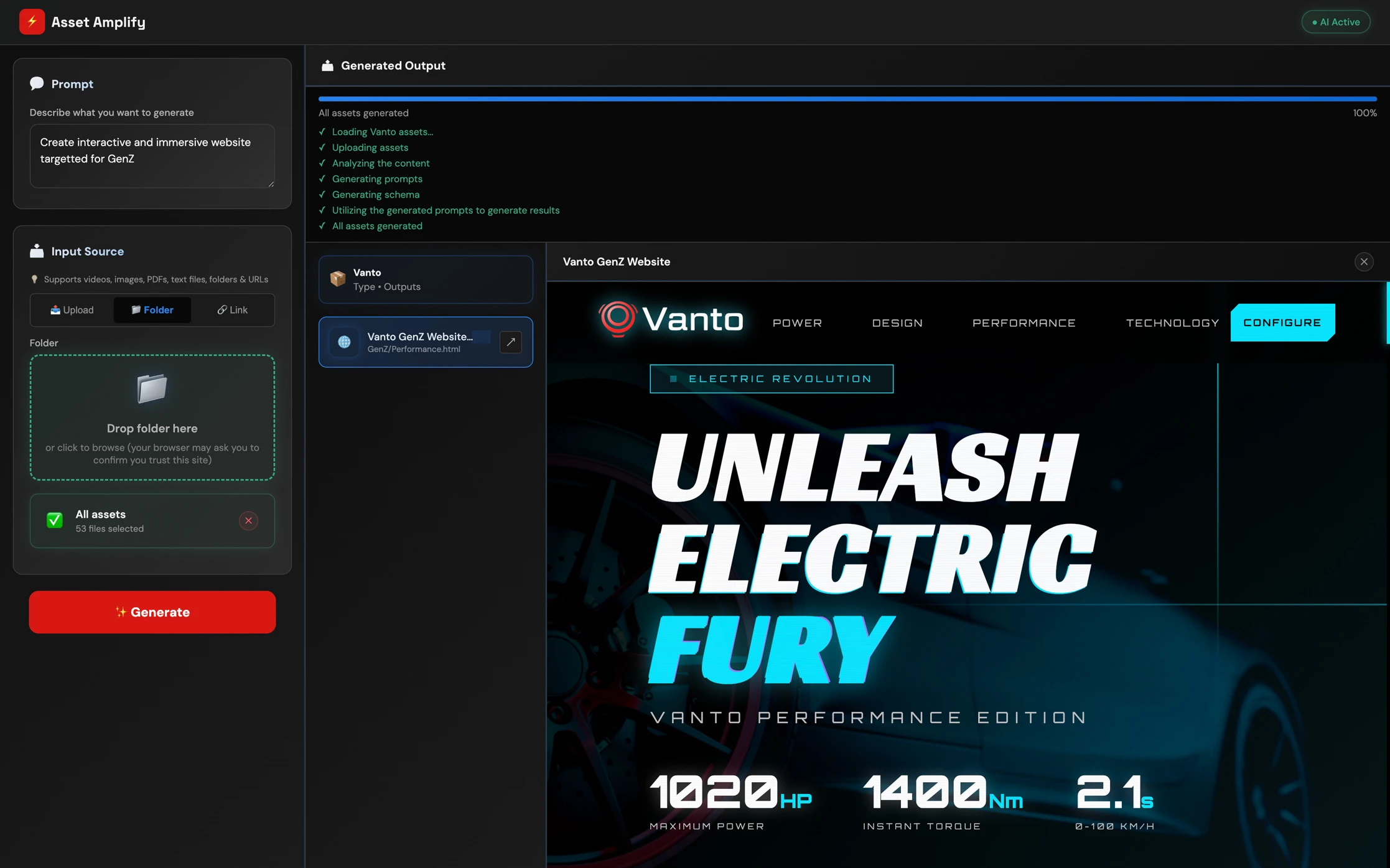
In an exclusive demo shared with Fast Company, an Adobe developer tested the tool with a fictional luxury electric car brand called Vanto. Asset Amplify was asked to generate an “interactive and immersive website” for millennials and Gen Zers—and the results were strikingly different.
The millennial concept focused on sleek, minimalist typography; family-friendly visuals; and copy signaling luxury and comfort, like “Crafted for those who’ve earned it.” The Gen Z version, on the other hand, was an explosion of neon blue hues and Tron-esque visuals, focusing on the electric vehicle’s performance stats with copy like “Unleash electric fury” and “Dominate every road.”
Matisoff says that Asset Amplify’s AI model primarily relies on a brand’s own audience segmentation data to curate these vastly different experiences. In Vanto’s case, for example, the brand’s findings that the millennial consumer is more likely to have kids might inform the LLM to focus on a family-friendly design, while the Gen Z consumer’s interest in EV performance might result in a more stats-heavy layout.
For specific attribute data, such as which colors resonate best with different generations, Asset Amplify can tap into Adobe’s Content Analytics platform, which uses artificial intelligence to analyze image attributes and then pairs that with conversion data to show what’s sticking across different audiences.
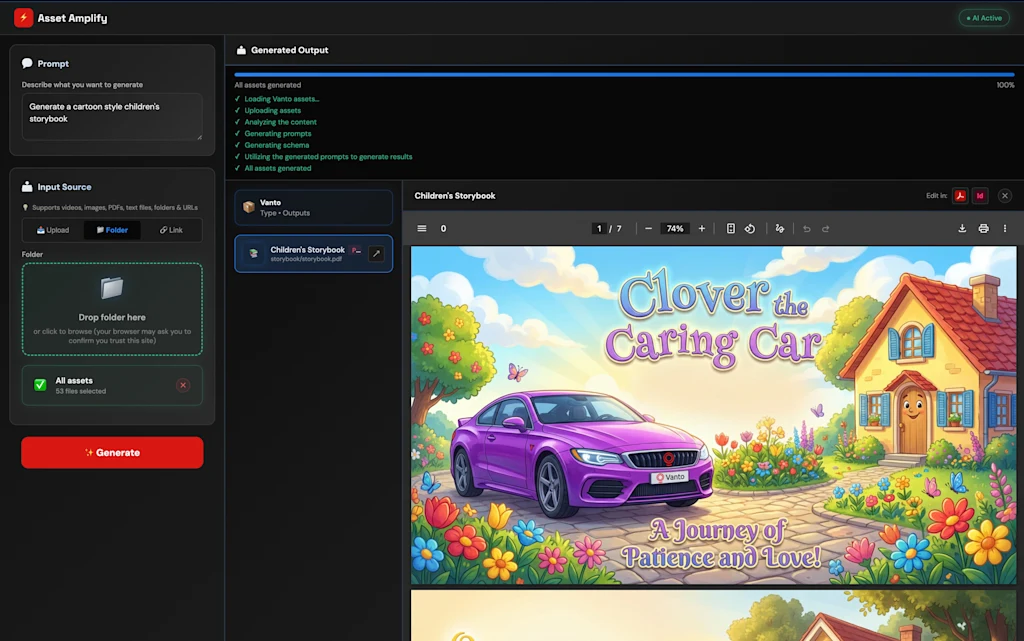
In the demo, the final websites and social media campaigns that Asset Amplify was able to produce certainly didn’t look like finished products—each had a distinctly AI-generated look that most brands would likely be keen to avoid. Generally, though, Adobe is framing this prospective tool as more of a way to quickly map out marketing campaigns in the brainstorming phase, rather than the be-all, end-all for brand design. Once Asset Amplify’s assets are complete, they can easily be opened in Photoshop, Illustrator, or After Effects so that human editors can take the reins on editing.
Asset Amplify can’t produce fully realized brand assets (yet), but it can certainly speed up the process.
How AI is changing Adobe’s whole Sneaks pipeline
Asset Amplify is one of seven final Sneaks debuting at the Summit conference this year, and it’s indicative of a much broader trend at Adobe.
While Sneaks have been around since the ’90s, the program’s tenor has noticeably shifted in recent years: Nowadays, almost every Sneak is an AI tool. According to Matisoff, the acceleration of AI technology has fundamentally changed not only the kinds of Sneaks on show, but how the actual Sneak development process works behind the scenes
“If we had chatted last year about Sneaks, I would have told you we had about 100 or 150 ideas that came from across the company,” Matisoff says. “This year, I think largely because of the access to vibe design, vibe brainstorm, vibe strategize, and vibe code, we had over 500 ideas come across my desk.” Those ideas, he adds, came from every single Adobe office around the globe.
“Genuinely, the pace of innovation at Adobe has been increasing because of our ability to say, ‘Hey, you know what? I have this great idea that I’ve never been able to execute on before, but now I do,’” Matisoff says.