
Hello again, and welcome back to Fast Company’s Plugged In.
In recent years, being gobsmacked by AI’s ever-expanding capabilities has become my new normal. More importantly, I’ve found the technology increasingly essential to my own productivity.
What AI never did until last week was save my bacon.
That changed when I gave OpenAI’s new Dots agent access to my calendar and email. Shortly thereafter, it alerted me to a discrepancy it had spotted. I’d entered a speaking engagement on one date, but a confirmation email mentioned a different day. It turned out that the organizers had forgotten to tell me they’d rescheduled their event. If I’d shown up on the original day, my audience would have consisted of an empty room.
That’s only one of several instances when Dots has proactively brought a significant fact to my attention without me having to ask about it. All of a sudden, agents feel less like a vacuous buzzword and more like a core benefit of weaving AI into my workflow.
OpenAI announced Dots on September 29 at its DevDay conference keynote in San Francisco. So far, it’s only available to people who pay for ChatGPT’s pricier tiers, starting at $100 a month. But the company plans to take agentic AI wide, once it’s refined Dots further and figured out the economics.
(The service runs on OpenAI’s powerful GPT-6 Astra model, which was announced earlier in September, and gives each user a Linux computer in the cloud for Dots to use.)
“You should of course expect us to do a mass-market thing for billions of people someday,” declared CEO Sam Altman at a post-keynote press Q&A.
Even before Dots debuted, personal agents were picking up momentum. As I write, Meta’s free Muse agent is at the top of Apple’s list of the most-downloaded iPhone apps. A startup called Instinct’s namesake agent operates inside texting apps such as WhatsApp and Apple Messages; it still has a waitlist, but is already an obsession in Silicon Valley, with a $10 billion valuation.
I have also been playing with Muse and Instinct, both of which are powerful and resemble Dots in broad strokes. In my experience, however, neither has shown the same spark of insight into how to boost my productivity. That’s not to say your encounters would be similar.
It’s tough to methodically test software that’s capable of doing almost anything, as agents are. (I’ve also begun using Hark Pro, another promising contender that’s free and sports a particularly slick interface; it debuted on October 6, and I want to spend more time with it.)
No personal AI agent can do much unless you grant it access to at least some of your online accounts. It’s these troves of information that let it suss out areas where it might be of help.
In the interest of research, I temporarily set aside any qualms about giving them the keys to my personal kingdom and connected Dots, Muse, and Instinct to my Gmail and Google Calendar. I also let Dots and Muse into Dropbox, which Instinct doesn’t support.
(Bizarrely, the one agent I haven’t been able to connect to Gmail and Google Calendar is Google’s own Gemini Spark. Despite having been announced months ago, it still doesn’t support my paid Google Workspace account, and won’t be of much use until it does.)
My connected accounts reveal only so much about me, my work, and my interests. I rarely talk to my coworkers over email—we do most of our collaborating in Microsoft Teams. But our IT department hasn’t flipped the switch that would enable Dots to see Teams, and I haven’t (yet) asked it to do so.
Still, Dots pieced together an unexpectedly rich picture of what I was up to based on the limited information at its disposal, as if it were a blind man who’d pretty much figured out elephants. Based on scattered Google Docs and Airtable notifications in my email, for instance, it grasped that I was cranking away at our Next Big Things in Tech list, and started sharing relevant items.
Its ability to triage incoming email was even more impressive. Back in May, when I tried an agent called Espa, it was flummoxed by the degree to which my inbox is flooded by pitches from PR people that sound pressing but aren’t. Without me asking for it, Dots started telling me about messages it suspected were urgent or otherwise important.
Dots’s sense of which messages I’d actually care about was dead-on. I’d somehow overlooked one from a freelance author and let it sit in my inbox for weeks. The agent found it there and nudged me to respond.
That sort of heads up is far more valuable to me than the AI built into Gmail and Outlook, both of which are fixated on a form of assistance I don’t want: drafting messages on my behalf.
Shopping is frequently cited as a killer app for agents, as well as an area their makers may monetize through advertising, finder’s fees, or other acts of commerce. I didn’t care to have Dots purchasing stuff on my behalf, in part because visions of it buying the wrong product or otherwise going awry were dancing in my head.
But Dots excelled at the shopping research I threw its way. For example, I got giddy when it came up with a $100-off deal on a Magic Keyboard for my iPad I’d never have located on my own.
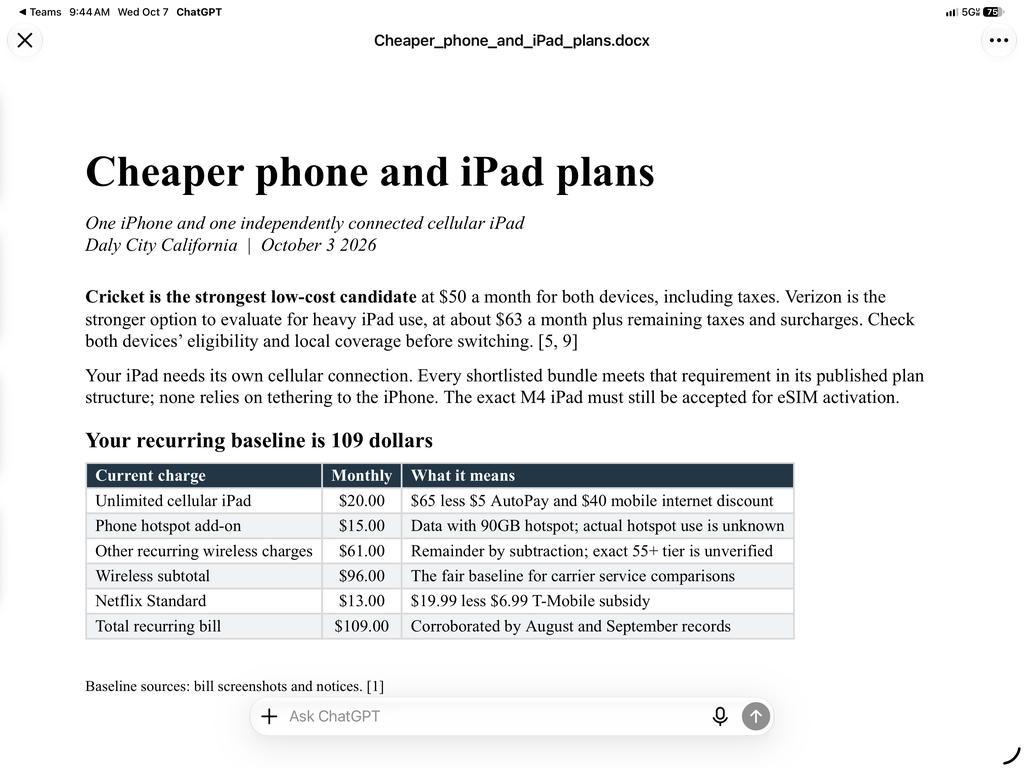
It also prepared a report on wireless plans I might prefer to my current service that took my existing monthly cost and data consumption into account. I didn’t have to provide it with those details; it grabbed them from emailed receipts and overage alerts, something neither Muse nor Instinct was clever enough to pull off.
Those are some of the ways Dots has paid off for me so far, but there are no obvious boundaries to the ways it may prove useful.
Writing about the service in his Platformer newsletter, Casey Newton referenced a 2023 essay in which Bill Gates predicted that agents would soon end the age of discrete apps by pooling every kind of functionality into a conversational experience based on a deep knowledge of your particular needs.
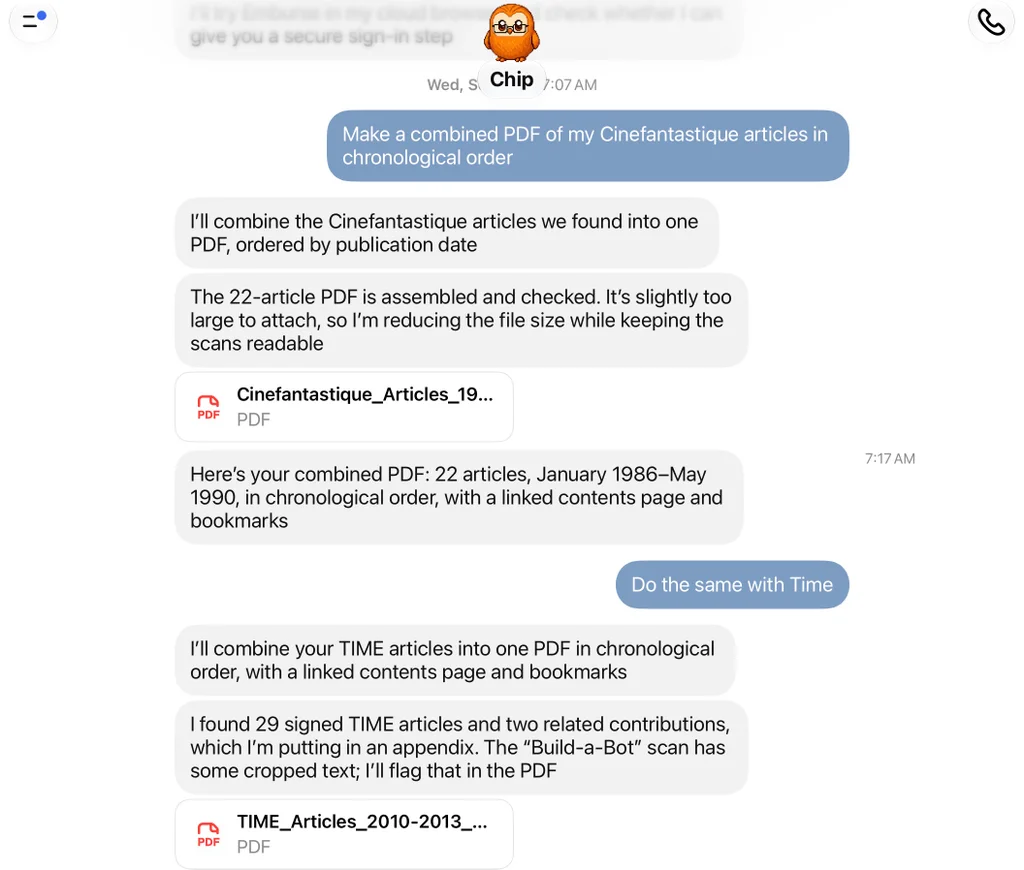
I’ve called on Dots to perform jobs that would have formerly required specialized apps and a lot more of my time, such as slicing and dicing PDFs. After just a few days, it’s hard to imagine going back.
I still can’t envision using an agent for tasks such as, well, writing this article. For the foreseeable future, that will likely call for word processing in its familiar form. Still, if I were in the software business, I’d be a tad nervous about Dots—and Muse, and Instinct, and every other agent that catches on in the months and years ahead.
Which is not to say that any of these tools has nailed the user experience. Just getting into Dots requires rummaging around in the ChatGPT app’s left-hand sidebar each time I want to use it.
Like the overbearingly adorable Muse, it leans into cloying anthropomorphization, though it seemed chastened when I complained about a graphic it generated of itself as a smiling O brandishing a pencil.
Rather than typing, you can speak to it, but I’m not sure why you do that via a simulated phone call rather than the voice mode ChatGPT already had.
Above all, it feels discordant to make users choose between Dots and ChatGPT in its existing form. The app already had three sub-versions—Chat, Work, and the coding agent Codex—whose domains could be blurry. Don’t you really want one do-everything superprompt at your disposal? I know I do.
At OpenAI’s DevDay press Q&A, I asked product chief Thibault Sottiaux whether Dots, or something resembling it, would become the primary interface to the company’s AI over time. What he said suggested that the company sees its new feature as a milestone along the way to figuring out how agentic AI should work, not a destination in itself.
Don’t be surprised if the distinction between ChatGPT and Dots starts to fade: “We’re going to be evolving ChatGPT in place to be this incredible personal assistant very soon,” Sottiaux told me. Longer term, OpenAI’s goal is to make agentic AI increasingly pervasive, on devices that people already use and new ones yet to reach the market.
“Maybe it will show up at work in one of your meetings one day,” Sottiaux explained. “You can reach it by email, by text, and it becomes this very natural part of your life. And at some point, it’s not about the interface anymore. It’s just about this active intelligence.”
In one form or another, visions of ambient intelligence have been around for decades. Many have turned out to be mirages. So I’m not pinning any hopes on OpenAI’s version arriving on a particular timetable, or being the definitive one. But a little over a week with Dots has me newly intrigued by the prospect—and game to further explore what this agent can do right now.
You’ve been reading Plugged In, Fast Company’s weekly tech newsletter from me, global technology editor Harry McCracken. If a friend or colleague forwarded this edition to you—or if you’re reading it on fastcompany.com—you can check out previous issues and sign up to get it yourself every Friday morning. I love hearing from you: Ping me at hmccracken@fastcompany.com with your feedback and ideas for future newsletters. I’m also on Bluesky, Mastodon, and Threads, and you can follow Plugged In on Flipboard.
More top tech stories from Fast Company
Announcing Fast Company’s Next Big Things in Tech list for 2026: The year’s smartest innovations in applied AI, fintech, enterprise, consumer, health, and 26 other categories
Fast Company’s Next Big Things in Tech for 2026 celebrates the year’s smartest advances in 31 categories, including applied AI, fintech, enterprise, consumer, health, space, and more. Read More →
DARPA just picked four early winners for its quantum initiative
The agency tapped four companies for the $300 million validation phase of its Quantum Benchmarking Initiative, but left the door open for a second wave. Read More →
Wall Street is handing more decisions to AI. What could go wrong?
As AI agents take on more of the work of interpreting market information, a bad source or missing context can cascade into real-world decisions before anyone catches it. Read More →
The drone delivery business has a ground problem
The FAA controls the sky. Communities control where drones take off and land. That may be enough to change the fate of last-mile delivery. Read More →
Jaguar finally launched its new EV. Here’s what people are saying
After Jaguar’s polarizing rebrand in 2024, its brutalist sedan is being met with equally polarized opinions. Read More →
Why America can’t build the iPhone
A veteran product designer and Apple alumnus explains how Asia earned the world’s electronics manufacturing business—a shift he helped catalyze. Read More →