
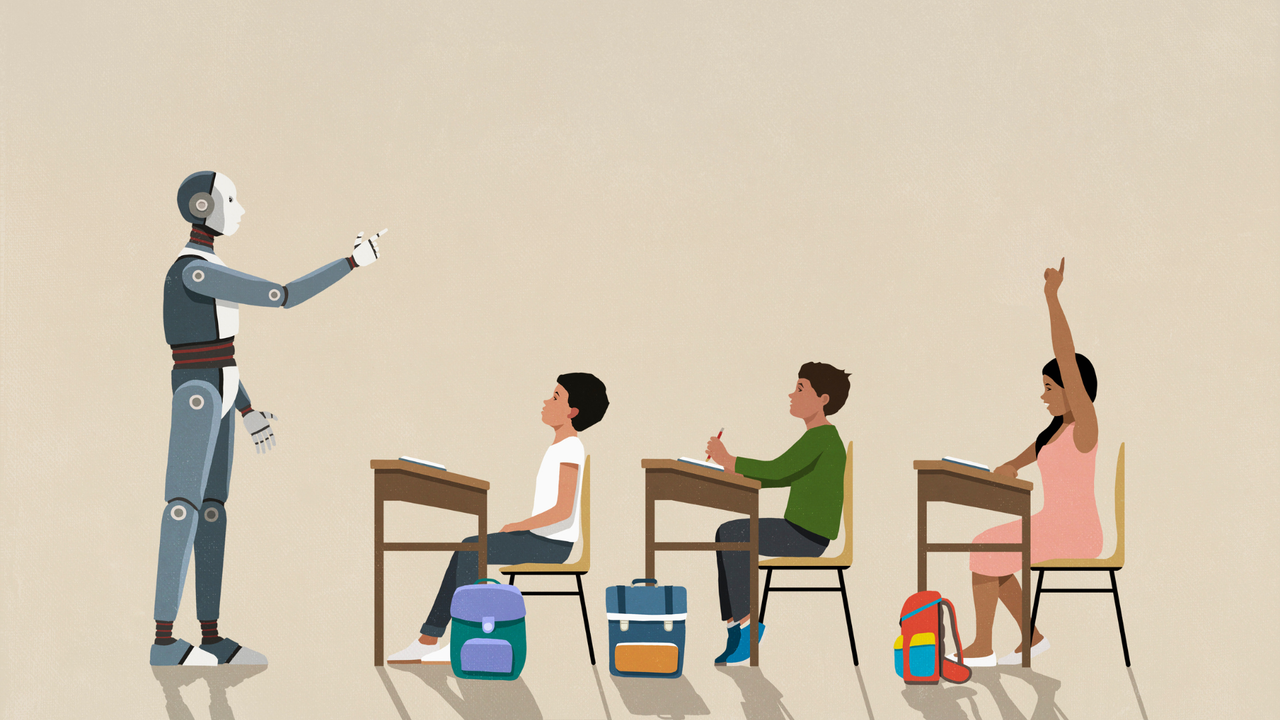
Artificial intelligence is rapidly becoming part of everyday academic life for America’s students. By mid-2025, up to 84% of high school students were using AI for schoolwork, including writing essays, summarizing readings, and completing assignments. Despite widespread usage, students themselves are growing wary of what this means. A 2026 Gallup–Walton Family Foundation survey found Gen Z’s excitement about AI has dropped 14% since 2025, and nearly half of working Gen Zers now believe AI’s risks in the workforce outweigh its benefits.
At the same time, schools are buying AI tools at remarkable speed, often with little independent evidence about how these technologies affect long-term learning outcomes. Districts are making procurement decisions that shape how millions of students think and learn, with almost no infrastructure to evaluate whether any of it is working.
AI is unusually disruptive. A decade ago, kids in a computer lab could Google a research question while writing an essay; today they can access generative AI tools that write the essay for them. Generative AI can draft arguments, solve equations, summarize texts, and simulate expertise across subjects, performing the intellectual tasks students are supposed to learn to do on their own.
EVIDENCE AND INFRASTRUCTURE
Yet the evidence base remains remarkably thin. A recent Stanford Accelerator for Learning review of more than 800 studies on AI in K-12 found only 20 high-quality causal studies examining learning outcomes. And the studies that do exist point to a complicated picture: Students frequently produce stronger work while using AI, but those gains often disappear—and sometimes reverse—when AI access is removed, as the OECD’s 2026 Digital Education Outlook recently found.
Schools lack the infrastructure to evaluate these differences at scale, and only 31% of U.S. public schools even have a written AI policy in place. The Alliance for Learning Innovation (ALI), a coalition of over 140 nonprofits, philanthropies, and private-sector leaders, is working with partners across the federal, state, and local levels to help close that gap, including a recent action agenda with Digital Promise and district leaders on locally led R&D. But no single coalition can substitute for a functioning national research system.
CHALLENGES DUE TO FUNDING CUTS
This kind of evidence gap isn’t new, and we’ve solved it before. The science of reading offers us clues for how a robust, interconnected federal-state-local education R&D system can drive changes that actually move student outcomes. Starting in the late 1990s with the National Reading Panel, the federal government invested in rigorous research on how children learn to read. Through infrastructure like the Regional Educational Laboratories, states—Mississippi, most famously—translated that research into their own context, retraining teachers and adopting evidence-based curricula. And individual districts and schools used student data to direct support to the kids who needed it most. The result was real, measurable gains in reading outcomes. We don’t have decades for AI.
We need a science-of-AI-in-education moment. Instead, we are dismantling the model at exactly the wrong time. The Trump administration proposed a two-thirds budget cut to the Institute of Education Sciences (IES), the research arm of the Department of Education. States are being given more responsibility but are being asked to build the plane while flying it. And districts are buying AI tools faster than anyone can evaluate them, with little capacity to generate independent evidence themselves.
ALI’s work—defending strong IES funding and pushing for a reimagined federal education R&D system that can keep pace with the speed of educational change, supporting states through our State Policy Playbook, and partnering with Digital Promise and district leaders on a locally led R&D agenda—is aimed at rebuilding each layer of that system. Taken together, this is the infrastructure that can produce strong evidence about which AI tools actually work for students, while giving states and districts the capacity to try new tools, evaluate them, and either scale or discontinue their use based on what they learn.
Students are in the middle of a grand AI experiment, and schools are already participating in one of the largest shifts in classroom practice in decades. Responsible AI adoption in education can’t stop at access and guardrails. It has to include evaluation. The goal isn’t to slow AI’s entry into classrooms; it’s to know which tools deserve to be there.
Sara Schapiro is executive director of the Alliance for Learning Innovation.