
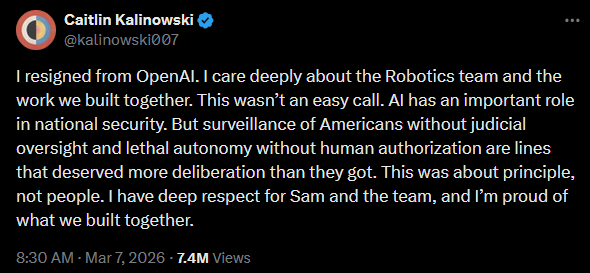
The resignation of Caitlin Kalinowski from OpenAI has triggered a debate that goes far beyond Silicon Valley. Kalinowski stepped down shortly after the company entered into an agreement with the United States Department of Defense to deploy its artificial intelligence models on government systems. The issue was not simply the partnership itself, but the speed at which the decision was made and the implications for how such powerful technology could be used as a weapon against American citizens.
“I resigned from OpenAI. I care deeply about the Robotics team and the work we built together. This wasn’t an easy call.” She was not rejecting national defense outright. She even acknowledged that “AI has an important role in national security.” Yet she warned that certain lines had been crossed. In her own words, “surveillance of Americans without judicial oversight and lethal autonomy without human authorization are lines that deserved more deliberation than they got.”

When someone inside the system walks away and raises that type of alarm, you should pay attention. For years, I have warned that governments are steadily constructing the infrastructure necessary to monitor populations in ways previous generations could not even imagine. After the September 11 attacks, intelligence agencies dramatically expanded their surveillance powers under the banner of protecting national security through the Patriot Act. Phone data, internet activity, and financial transactions became data points feeding enormous intelligence databases. The public was told these programs were narrowly targeted at foreign threats. Behind the curtain, the databases were growing larger every year. Governments now have access to EVERYTHING we do.
What most people do not realize is that the financial system was also pulled into this surveillance web. I have written before that governments began monitoring bank accounts and financial transfers on a scale that few citizens fully appreciate. Under the administration of Obama, programs quietly expanded to allow intelligence agencies to track international banking activity, financial flows, and transaction patterns in the name of national security. Those systems became permanent fixtures inside the intelligence community.
The trend accelerated under Joe Biden, when federal agencies aggressively pushed for greater reporting requirements from banks and financial institutions. Governments argued this was necessary to combat tax evasion, money laundering, and illicit activity. The financial behavior of ordinary citizens came under scrutiny, and Biden’s team was caught red-handed spying on anyone who supported his adversary. Donated to Trump? You’re on a list to be monitored. Hold religious beliefs that do not coincide with current political leanings? Anyone who purchased a Bible was placed on a list. Your bank account, your transactions, and even your spending patterns increasingly became part of enormous government databases.
What Kalinowski exposed is that the next phase is already underway. Once AI becomes embedded in national security systems, the surveillance state moves to an entirely new level. Governments will have the ability to monitor populations in real-time. Populations—not merely persons of interest—but the entire population. The people operating these systems are rarely elected officials. They are bureaucrats, intelligence officers, and agencies operating behind the curtain where the public has almost no visibility. Then the power is placed into the hands of a computer system that can instantly flag and target people or groups without moral discernment.
This is why the Kalinowski resignation matters. She warned openly about AI being used for domestic surveillance without oversight. Once these systems are integrated into government networks, the temptation to expand them becomes irresistible. Governments always claim these tools are necessary for security. But history shows that the definition of “security” tends to expand until it includes monitoring the population itself.
What is even more revealing is that officials within the Pentagon have already begun describing certain advanced AI systems as potential national security risks if they cannot be controlled by the government. In other words, artificial intelligence itself is now viewed as a threat unless it is firmly under the state’s control. That should tell you everything you need to know about where this is heading.
Do not assume these systems will remain limited to foreign adversaries. Surveillance infrastructure rarely stays confined to its original mission. Once built, it inevitably expands. The technology now exists to construct the most comprehensive monitoring system ever devised in human history. And if you think governments will not use it, you have not been paying attention.