
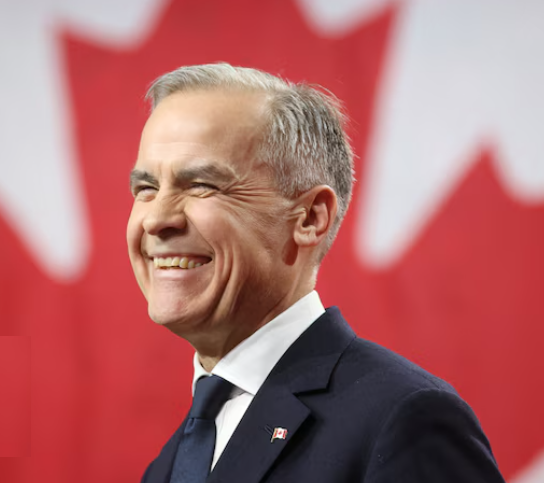
Canada has apparently learned absolutely NOTHING from the immigration disaster under Justin Trudeau. Prime Minister Mark Carney is already discussing increasing immigration again, and now India’s High Commissioner to Canada, Dinesh K. Patnaik, has suggested that Canada’s economic ambitions could require another 15 million workers over the next decade. Canada has a population of approximately 42 million people. We are talking about a number equivalent to more than one-third of the country’s existing population, yet these people discuss such enormous demographic changes as though they were simply adding employees to a corporate payroll. Nobody seems particularly concerned about where these millions of people would live, how much infrastructure would cost, or whether the Canadian economy could actually support such an expansion.
Carney has indicated Canada will eventually resume increasing immigration after the government supposedly brought the previous surge under control. Trudeau had already opened the floodgates, allowing Canada’s population to increase by approximately 1.27 million people in 2023 alone, with international migration accounting for nearly 98% of that growth. Canada admitted nearly 484,000 permanent residents in 2024, and the government is still targeting another 380,000 in 2026. Ottawa is officially reducing temporary admissions, but Carney is already talking about when population growth should accelerate again. They have barely begun cleaning up the mess before discussing another expansion.
Canada has been suffering from a housing affordability crisis, overcrowded public services, and an economy where population growth has not translated into comparable improvements in living standards. The politicians look at GDP and celebrate whenever they can make the total number larger. Add another million consumers and naturally total economic activity can increase. That does not mean the average Canadian has become wealthier. GDP per capita matters because it measures economic output relative to the population. Importing more people does absolutely NOTHING to improve living standards if housing, productivity, wages, and infrastructure cannot keep pace.
Now we have India’s representative discussing 15 million additional workers to support Carney’s proposed investment ambitions. Patnaik was discussing a potential labor requirement, not an immigration agreement committing Canada to admit 15 million Indians. Nevertheless, the sheer scale of the suggestion exposes how these governments approach economic policy. Instead of asking how to improve productivity, encourage investment in machinery, or make it possible for existing citizens to afford families, they continually return to expanding the labor supply. Businesses may welcome a larger pool of workers, particularly when it reduces pressure to increase wages, but the public is left competing for housing and services that governments have failed to expand.
Canada’s fertility rate has fallen to approximately 1.25 children per woman, and politicians present immigration as the only practical solution to an aging population. Perhaps they should ask WHY young Canadians are increasingly unable to afford children. Housing has become outrageously expensive, taxation consumes an enormous portion of income, and the cost of raising a family continues climbing. The government then points to declining birth rates as justification for bringing in more workers without addressing the economic conditions discouraging family formation in the first place. This is the mentality of politicians who treat human beings as entries on an economic spreadsheet.
America should be paying close attention because Canada shares the longest international land border in the world with the United States, stretching approximately 5,525 miles when Alaska is included. We have spent years arguing about securing the southern border while treating the northern border as though geography somehow guarantees security. It does not. If Ottawa pursues immigration policies that overwhelm its ability to screen arrivals or enforce visa rules, Washington cannot simply assume that none of those consequences will reach American territory. The United States has every right to secure its northern border, increase enforcement where necessary, and insist that Canada maintain credible immigration and security controls. A wall along sensitive stretches may eventually become part of that discussion, although no physical barrier could reasonably replace enforcement across the entire frontier.
There is also a growing political divide between Washington and Ottawa. Carney is pursuing closer economic relationships with India, China, and the European Union while attempting to reduce Canada’s dependence on the United States. Canada is entitled to determine its own trade relationships, but Washington is equally entitled to determine who enters American territory. Immigration policies have consequences beyond national borders, particularly when two countries are so closely integrated economically and geographically. American taxpayers should not be expected to absorb the consequences of decisions made in Ottawa.
What makes this particularly absurd is that Canada possesses enormous natural resources, agricultural capacity, energy reserves, and opportunities for industrial development. Its problem is hardly a shortage of land or natural wealth. The political establishment has created an economy increasingly dependent upon government spending, expensive housing, and population expansion rather than productivity and investment. Instead of developing the resources already available and making life affordable for existing citizens, the solution being discussed is to bring in millions more people and hope the economy somehow catches up.
The Canadian people deserve a government that measures success by their standard of living rather than the number of people politicians can add to the population. Immigration can contribute to economic growth when it is properly managed and supported by productive investment, but there is a limit to what housing, infrastructure, and public services can absorb within a given period. Trudeau ignored those constraints, and Carney appears eager to revisit the same policies before the damage has been repaired. If Ottawa refuses to recognize those limits, Washington will have to take its northern border far more seriously. America cannot control Canada’s immigration policy, but it certainly can control its own border.