
Key Takeaways
- Apple is reportedly developing prototypes for a screenless health and fitness tracker.
- The project is part of a broader effort to compete with wearable brands like Whoop and Oura.
- Apple has reportedly been exploring the possibility of a screenless wearable for several months.
The second-most-valuable company in the world has been considering adding new wearables to its lineup.
Apple is the undisputed leader of the global smartwatch market; the Apple Watch holds a 20% to 23% share of worldwide shipments as of early 2026, according to Counterpoint Research.
Apple is not content dominating that space. Bloomberg recently reported that the $4.98 trillion giant is exploring the screenless wearable market and is now in the process of creating prototypes of screenless devices.
Citing “people with knowledge of the matter,” Bloomberg noted that the screenless wearable effort has the backing of top executives, but Apple hasn’t made a final call about if it will develop a product.
The effort is still in a preliminary phase, internally called a technology investigation. If Apple decides to release the device, it will likely make an appearance in 2028 at the earliest, per Bloomberg.
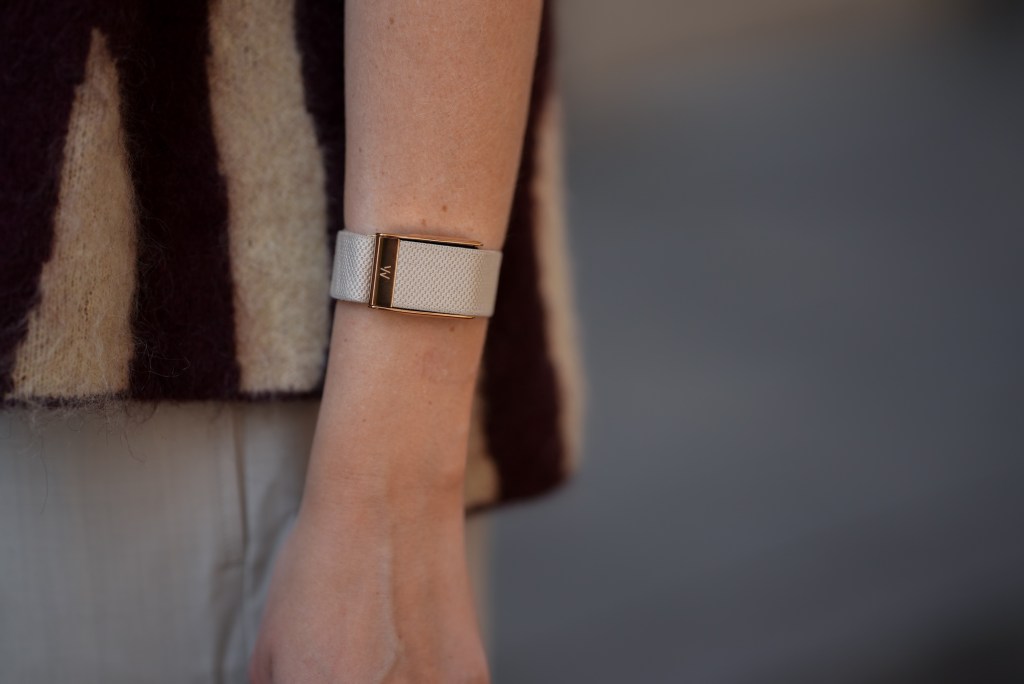
Apple’s early designs reportedly pair a slim fabric strap with a sensor-and-computing unit.
The new devices would go beyond the Apple Watch, which Apple refreshed earlier this month at its annual launch event. The new Apple Watch Series 12, priced at $399, has a new health sensing system with redesigned sensors that provide higher-frequency heart rate data. It tracks heart rate every five seconds, 60 times more than previous models.
Unlike the Apple Watch, the rumored screenless device would forgo a display altogether, focusing instead on passive health and fitness monitoring instead of serving as a hub for apps and alerts.
Apple executive chairman Tim Cook and services chief Eddy Cue are interested in the screenless wearable project, per Bloomberg. Cue assumed responsibility for Apple’s health initiatives late last year as part of a broader reorganization, while Cook stepped down as CEO earlier this month.
The competition
Sales for screenless fitness trackers grew 88% between 2024 and 2025, according to market research firm Circana. Smart ring sales alone grew 195%.
Whoop is a subscription-based wrist wearable with no display. It collects health data around the clock rather than delivering notifications or telling the time. It tracks measures including heart rate, sleep, physical strain, recovery, stress and heart health signals, then turns that information into personalized coaching through its app.
Customers cannot buy a Whoop wearable on its own. Instead, they have to commit to an ongoing subscription from $199 to $359 per year that includes the hardware for free.
Oura takes a different form. The Oura Ring is a lightweight smart ring that tracks sleep, activity, stress and other wellness indicators. The company says the device measures more than 50 health metrics and surfaces personalized insights in the Oura app.
These devices are popular within Apple. Cue reportedly uses a Whoop band and Oura ring for health tracking.
Whoop raised $575 million in March, elevating its valuation to $10.1 billion. Meanwhile, Oura, which was valued at $11 billion in late 2025, is now targeting a valuation of $15.6 billion in its proposed U.S. IPO.
Key Takeaways
- Apple is reportedly developing prototypes for a screenless health and fitness tracker.
- The project is part of a broader effort to compete with wearable brands like Whoop and Oura.
- Apple has reportedly been exploring the possibility of a screenless wearable for several months.
The second-most-valuable company in the world has been considering adding new wearables to its lineup.
Apple is the undisputed leader of the global smartwatch market; the Apple Watch holds a 20% to 23% share of worldwide shipments as of early 2026, according to Counterpoint Research.
Apple is not content dominating that space. Bloomberg recently reported that the $4.98 trillion giant is exploring the screenless wearable market and is now in the process of creating prototypes of screenless devices.