
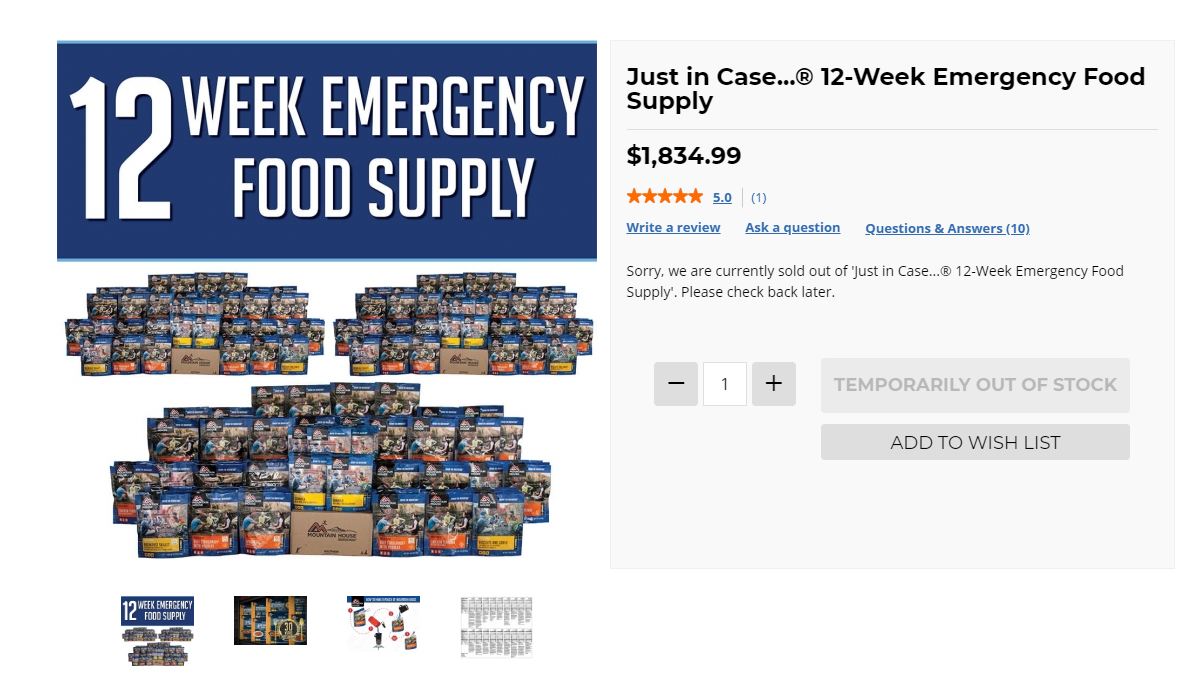
The British government is now telling its citizens to stockpile food, water, cash, and emergency supplies in preparation for a potential cyberattack or disruption to critical infrastructure. The new “Be Ready” campaign advises households to maintain at least 72 hours of essential supplies, warning that electricity, communications, transportation, and even supermarket payment systems could suddenly become unavailable. This is coming from the same political establishment that has spent years promoting a society increasingly dependent upon electricity, digital banking, and centralized infrastructure. I have been discussing these vulnerabilities for years. Now the government is finally admitting that ordinary people need to prepare for the possibility that the systems they depend upon every day may stop functioning.
Britain is advising citizens to store nine liters of drinking water per person, three days of nonperishable food, essential medications, batteries, flashlights, a radio, and physical cash. Security Minister Dan Jarvis has described these as sensible precautions, while Defence Secretary Wes Streeting has raised the possibility of cyberattacks and disruptions caused by hostile states or terrorists. Government research found that only 13% of Britons feel prepared for an emergency that could interrupt essential services. That is an astonishing admission about how dependent modern society has become upon systems that most people assume will always function.
I have repeatedly explained that the power grid will become one of the most important strategic targets during a major war. You do not need to destroy every building or occupy every city to bring a modern economy to its knees. Interrupt the electricity supply and you can cripple banking, telecommunications, fuel distribution, transportation, refrigeration, and large portions of the water system. Hospitals have backup generators, but those systems depend upon fuel and maintenance. Supermarkets cannot operate indefinitely without electricity, and their electronic payment terminals are useless when the networks go down. The public has become so accustomed to immediate access to everything that many people cannot imagine what happens when the infrastructure supporting their daily lives is suddenly unavailable.
Governments have been pushing society toward digital transactions while ignoring the obvious vulnerability that every electronic payment depends upon functioning infrastructure. What happens when you have money in the bank but cannot access it? Your account balance may be perfectly healthy, yet the supermarket cannot process your card, the ATM is offline, and your banking application cannot connect. The European Central Bank’s own advice is to keep physical cash available during emergencies. Even central bankers recognize that cash provides a backup when digital systems fail. Yet politicians continue promoting the elimination of cash as though technological dependency were somehow an improvement in national security.
The same problem applies to the supply chain. Most supermarkets are not warehouses containing months of food for the surrounding population. They depend upon regular deliveries, functioning distribution centers, available fuel, and transportation networks. A major cyberattack against logistics systems could interrupt deliveries even if the farms and factories producing the food remain untouched. Refrigerated products would be particularly vulnerable during prolonged electricity outages. Trucks cannot move without fuel, and fuel stations themselves often require electricity to operate their pumps. A disruption that begins in one sector can rapidly spread into several others. We witnessed during the COVID lockdowns how quickly supply chains can become strained when transportation, production, and distribution are interrupted.
I have also discussed the agricultural cycle and the risks associated with food shortages, particularly when war disrupts energy supplies and international trade. Fertilizer production depends heavily upon natural gas, while agriculture requires diesel, transportation, machinery, and reliable access to international markets. The conflict involving Iran has demonstrated how quickly the interruption of a major shipping route can affect energy supplies and the cost of moving goods. The Strait of Hormuz is not merely an oil issue. Disruptions to energy exports raise costs throughout the global economy, including food production and distribution. A prolonged war can create shortages thousands of miles from the battlefield without a single bomb falling on the country experiencing them.
Physical cash is another essential precaution. I have repeatedly argued against the idea that society should become entirely dependent upon digital currency. During a serious cyber incident, banking systems may remain operational in one region while payment networks fail in another. Even a localized communications outage can prevent merchants from processing transactions. Keeping a reasonable amount of cash in small denominations provides an alternative for essential purchases, although cash will not solve every problem if shops are closed or goods are unavailable. If the government collapses and cash becomes worthless, I highly suggest having items for barter like silver coins that people will accept as a storage of wealth.
The grid itself is becoming more vulnerable as governments increase the number of essential services dependent upon electricity. Europe has spent years pursuing Net Zero policies while reducing certain forms of conventional energy capacity and expanding dependence upon interconnected systems. Renewable generation is not inherently the problem, but an energy transition that fails to provide adequate backup capacity, grid protection, and reliable dispatchable power creates serious risks. Electric vehicles, digital payments, internet-connected infrastructure, and automated logistics all increase the consequences of a prolonged outage. The more dependent society becomes upon a single interconnected system, the more important it is to maintain redundancy.
Cyberattacks are particularly concerning because they can target infrastructure without requiring a conventional military invasion. Governments and private companies face constant attempts to penetrate their networks, and some attacks can compromise systems before vulnerabilities are discovered or repaired. Electricity operators, water utilities, ports, rail networks, hospitals, and financial institutions all present potential targets. A cyberattack does not automatically mean an entire national grid will collapse, and well-designed systems contain protections intended to prevent such failures. Nevertheless, the consequences of a successful attack against critical infrastructure can be enormous. In wartime, the incentive to disrupt an opponent’s economy becomes even greater.
The broader War Cycle is what concerns me. We are witnessing escalating geopolitical tensions, enormous sovereign debt burdens, military rearmament, and growing civil unrest throughout Europe. Governments are preparing for scenarios they would have dismissed as alarmist only a few years ago. The British campaign follows similar preparedness advice issued in several European countries, particularly those closer to Russia. This does not establish that a wider war is inevitable, but it demonstrates that governments are taking the possibility of serious disruption more seriously. Ordinary citizens should do the same without allowing fear to dictate their decisions.
What bothers me most is that governments spent decades encouraging the public to surrender practical independence in exchange for convenience. Everything is becoming digital, interconnected, and dependent upon a functioning power grid. Now those same governments are admitting that the systems they promoted may not be available during a serious emergency. Britain is telling its citizens to prepare for three days without essential services. I would suggest that everyone, regardless of where they live, consider how they would manage if the electricity, banking network, water supply, or local supermarket were unavailable for longer than expected.
The world is entering a period of increasing geopolitical instability, and preparation should not be confused with panic. Nobody knows precisely where the next disruption will occur or how long it will last. It could be a cyberattack, a storm, a transportation failure, a regional war, or a combination of events that overwhelms already strained infrastructure. The point is to reduce dependence upon the assumption that everything will always be available tomorrow. When governments themselves begin advising citizens to stockpile necessities, perhaps people should finally recognize that maintaining a reasonable supply of food, water, medicine, and cash is simply common sense.