
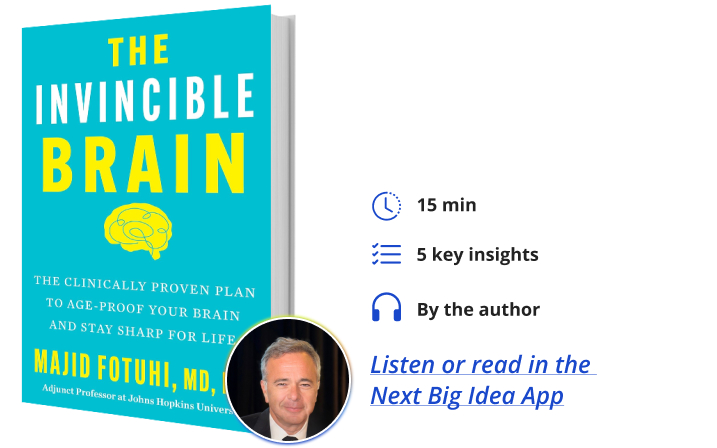
Below, Dr. Majid Fotuhi shares five key insights from his new book, The Invincible Brain: The Clinically Proven Plan to Age-Proof Your Brain and Stay Sharp for Life.
Fotuhi is a neurologist, professor, and neuroscientist, with more than three decades of experience—mostly at The Johns Hopkins University and Harvard Medical School. Over the years, he has treated thousands of patients with memory loss, concussion, ADHD, brain fog, and early stages of Alzheimer’s disease.
What’s the big idea?
Your brain is not fixed. Your intelligence is not limited. And aging does not have to mean decline. By working on improving the five pillars of brain health in your life, anyone—at any age—can tap into the rejuvenating power of neuroplasticity.
Listen to the audio version of this Book Bite—read by Fotuhi himself—in the Next Big Idea app, or buy the book.
Patient Story No. 1: Carl
Carl was a retired accountant in his 70s when he came to see me. He was forgetting appointments, losing track of conversations, and spending most of his days sitting at home doing nothing. He was often confused about what was going on around him. What worried him most was the feeling that his world was slowly shrinking. His family was convinced he was experiencing the early stages of Alzheimer’s disease.
After completing our full clinical assessment, which I call a Brain Portfolio, it became clear that Carl had many medical and lifestyle factors that could be improved to enhance blood flow to his brain, reduce inflammation, and rejuvenate his cognitive abilities. I first tapered some of his medications, treated his sleep apnea, and addressed his depression. Carl then entered my 12-week brain fitness program, receiving brain coaching twice a week. My staff of brain coaches and I worked with him on the five pillars of brain health.
Every week, Carl became a little more alert, engaged, and happier. After 12 weeks, his memory improved, his confidence returned, and he began participating in his church’s community activities. His family could not believe that his Alzheimer’s disease symptoms had vanished. When I saw him six months later for follow-up, he smiled and said, “Thank you, Dr. Fotuhi. I feel like myself again.”
Patient Story No. 2: Lisa
Lisa was a schoolteacher in her 50s. She came to see me because of severe brain fog, mental exhaustion, and trouble concentrating. She was forgetting the names of her students and feared she might be developing Alzheimer’s disease. After completing her Brain Portfolio assessment, I discovered that she had low levels of iron, vitamin B12, and vitamin D, which I corrected with vitamin supplements.
As part of my 12-week brain fitness program, my brain coaches and I focused on the same five pillars of brain health for her: improving her physical stamina, helping her sleep better, teaching her to eat the best food for a healthier brain, reducing her stress, and doing brain training exercises.
Within weeks, her memory improved and her energy returned. By the end of the program, she had learned to memorize a list of 100 items, which she herself could not believe she had done on her own. She felt more confident and was excited about the future. She told me, “I didn’t realize how much better my brain could feel.” Her fear of Alzheimer’s faded, replaced by confidence and hope.
Building a sharper brain is possible, and it is a lot easier than you think. And if you take care of your brain every day, just like you would do specific things to take care of your teeth every day, you can create and maintain a brilliant brain as you age.
1. The most important—and most malleable—parts of your brain.
All your higher brain functions depend on two main brain structures: the cortex and the hippocampus.
The cortex is like a blanket that covers the surface of your brain. It supports cognitive functions such as reading, writing, planning, driving, cooking, problem-solving, doing your taxes, and creating art.
The hippocampus—about the size of your thumb, with one on each side of your brain—is essential for learning new information, forming and consolidating memories, and regulating emotions.
“All your higher brain functions depend on two main brain structures.”
The cortex and hippocampus have an incredible level of malleability. They can shrink or grow based on how you live. They can expand within weeks or months, depending on how much you move, how well you sleep, what you eat, how you manage stress, and how you challenge your mind.
2. You can become more intelligent at any age.
Intelligence means being able to excel in many forms of cognitive functions, not only in areas like math, physics, and logic, but also in cooking well, playing a musical instrument, speaking in public, motivating an audience, fixing things around the house, being a comedian, or connecting with others on a deep emotional level.
In my book, I describe 30 different forms of intelligence and explain how you can excel in any of them that you wish. Everything we call intelligence—every skill and talent—emerges from the health and connectivity of the cortex and hippocampus. When you learn something new, you engage different parts of your cortex and hippocampus and make them stronger.
When your cortex and hippocampus are healthy and optimally connected, you can learn and excel in almost any cognitive capacity, at any age. You can improve your memory, learn to play the piano, become better at public speaking, or even learn to juggle three balls in the air.
“Everything we call intelligence—every skill and talent—emerges from the health and connectivity of the cortex and hippocampus.”
If you also develop a growth mindset—the belief that your brain has the capacity to grow and improve and that you can indeed get better at anything with practice—you will feel more confident and perform even better at any cognitive task.
3. Cognitive decline is due to a soup of problems, not a single disease.
Decades of research have shown that late-life Alzheimer’s disease is not a single entity. When your grandparents appear confused or don’t know what year it is, their brain has shrivelled due to a soup of biological problems—not just a single disease.
The ingredients in this soup of brain shrinkers include gum-like aggregates of toxic proteins (amyloid plaques and tau tangles) as well as damaged and leaky blood vessels, inflammation, and silent strokes. Five common contributors to brain shrinkage with aging are chronic stress, obesity, diabetes, hypertension, and poor sleep.
By preventing and treating these brain shrinkers, you can reduce the forces that slowly damage your brain tissue over the years. This is what I call building resistance to brain aging.
4. The 5 pillars of brain health build resilience.
Reducing damage to your brain is only half the story. The other half is building brain resilience: creating a healthy, strong brain that can function well even if there are footprints of Alzheimer’s disease in your brain.
The five pillars of brain health that boost resilience are:
- Regular physical exercise
- High-quality sleep
- Brain-friendly food
- A healthy mindset
- Consistently challenging your brain
Together, these five pillars of brain health increase blood flow to the brain, reduce inflammation, boost protective brain proteins such as BDNF, generate new neurons, and strengthen neural connections. They literally help grow the size of the cortex and hippocampus in your brain, which is the most effective insurance policy you can ever have against developing the symptoms of Alzheimer’s disease.
5. Brain reserve is the key to becoming a brain super-ager.
Brain reserve means building a brain with fewer brain shrinkers and more factors that grow and protect the cortex and hippocampus. The larger your brain reserve, the more likely you are to remain sharp and independent in your 80s and 90s. This is how you become a brain super-ager.
“The larger your brain reserve, the more likely you are to remain sharp and independent in your 80s and 90s.”
Recent research demonstrates that staying mentally sharp as we age is not reserved for a lucky few with great genes. People who follow the five pillars of brain health can remain independent and active at all times, even when they reach the last two decades of their life.
Enjoy our full library of Book Bites—read by the authors!—in the Next Big Idea app.
This article originally appeared in Next Big Idea Club magazine and is reprinted with permission.