

Last year Canva reworked its user experience and tools in a full-frontal attack on the productivity and enterprise markets now dominated by Microsoft Office and Google Workspace. Now the Australian company is going for Adobe’s jugular.
Affinity—the British company Canva bought in 2024—is out with a new app that aims to sink Photoshop, Illustrator, and InDesign with a simple proposal: If you are a professional designer, here’s an integrated photo editing, vector illustration, and page layout studio seamlessly integrated into a single application, with a feature set comparable to Adobe’s apps and a fully customizable UI. For free.
You know, free free. “Free forever,” as Canva’s cofounder and chief product officer Cameron Adams tells me in a video interview. Free as in not paying a single dime for eternity (allegedly) instead of the up to $70 per month that Adobe charges for its full Creative Cloud subscription.
If the new Affinity lives up to its promise—and, from what I’ve seen, it may actually do that and then some—it will be a hard thing to ignore for any Adobe Creative Cloud user, even if they are fully invested in the company’s apps.
Product Officer Cameron Adams
[Image: Canva]
When Canva bought Affinity, it kept British company independent and injected the capital needed to revamp the Affinity suit of apps into a bona fide Adobe competitor. As Adams tells me, the move was born from a radical rethinking of the entire creative world. “We’re really viewing the entire design ecosystem as one big entity,” he says. “It’s not about separation anymore. It’s not about professionals on one side, nonprofessionals on the other. It’s really about your entire team working together.”
The company also saw an opportunity in the feedback they were getting from the creative community, who Adams says are fed up with “pricing model increases, with lack of transparency, just the feeling they weren’t being listened to, and a lack of innovation in the tools that they’ve been using for a very long time.”
Break the workflow walls
For Affinity CEO Ashley Hewson, this launch fulfills a vision his team has had for a long time: to finally bring the separate apps of Affinity Designer, Photo, and Publisher into one consolidated experience. “That’s what we’ve been building— an entirely new app,” he says.
Simply called Affinity, it organizes its immense power into dedicated “studios”—Vector, Pixel, and Layout—that you can switch between instantly within the same window, using a button bar switch on the top left corner of the UI. This is similar to other apps like DaVinci Resolve, which moves from edit to color correction, automagically morphing the interface to show you the tools you need at each stage without having to move to a new app, import a file, save, and move back to the previous tool.

[Photo: Amber Pollack PhotographyCanva]
With Affinity, the canvas, the layers, and everything else stays as you switch from bitmap to vector to layout and back. This isn’t just about convenience; it’s about eliminating the maddening workflow interruptions that kill creativity.
“Previously, you’d have to kind of change app to do some more advanced vector sort of design work, and that would always mean kind of exporting this, bring it into a different app,” Hewson explains. “Whereas now, I can just go to the Vector Studio if I want to do any of that work.”
Thanks to full GPU acceleration, everything is live and nondestructive, from applying a Gaussian blur to a vector object to painting a pixel-based mask on a filter effect. As Hewson demonstrated for me, you can adjust a gradient, warp text, or scrub through your entire edit history with zero lag. Even with thousands of layers, he claims. “I keep saying it, but it’s kind of very important because, obviously, it’s kind of what the competitors don’t do,” he says with a hint of pride.
Custom interface
In the new Affinity, you can customize the UI in any way you want. Hewson showed me how users can create their own “perfect studio,” a custom workspace that mixes and matches tools from any of the core disciplines. “Let’s say your workflow often includes raster brushes, vector tools, maybe even some layout tools as well,” Hewson says. “What you can do is actually just create your own studio.”
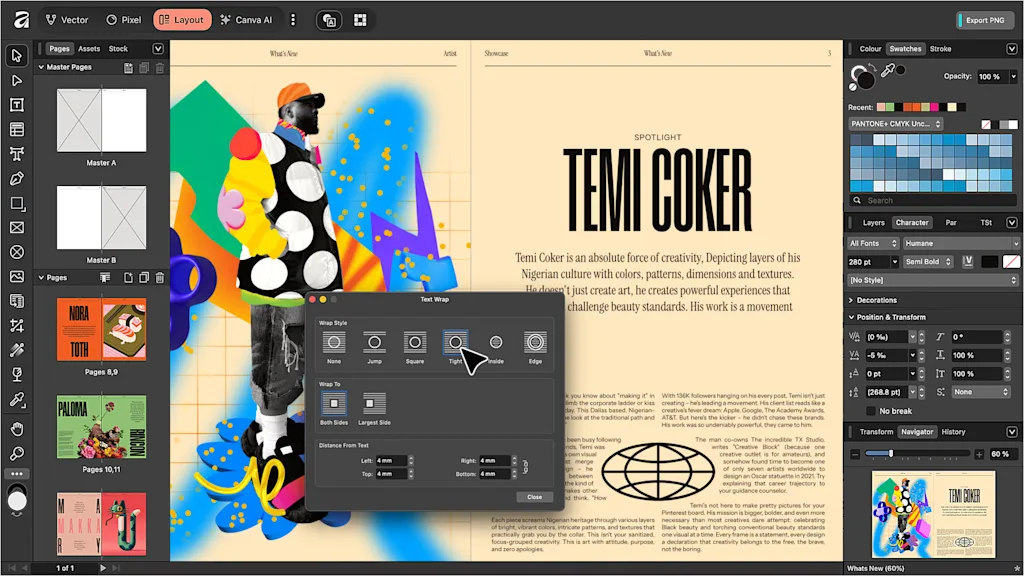
This is a level of personalization that goes far beyond rearranging a few panels. You can build a lean UI for logo design, a robust one for photo compositing, and another for publication layout. These custom studios can then be saved and shared, creating a new way for teams to standardize workflows.
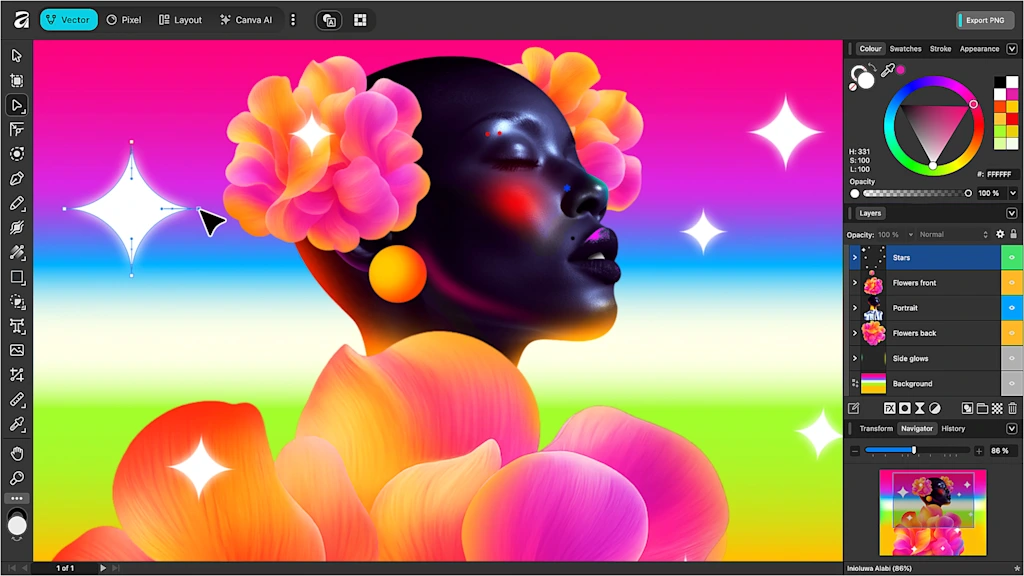
It’s an appealing proposal, given that every designer works differently. It’s also a good solution against the one-size-fits-all bloat that has plagued professional creative software for years. The new Affinity gives you the power to build the exact tool you need, and hide the rest.
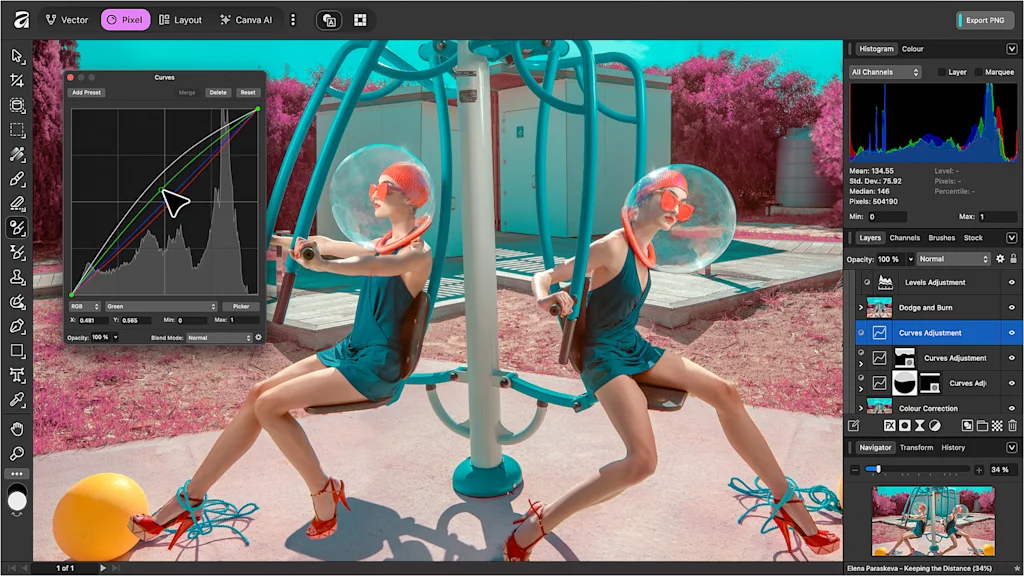
‘Craft to scale’
So, how does a free professional tool make business sense for Canva? Adams explains it to me with a simple mantra: “craft and scale.” The high-end, pixel-perfect “craft” happens in Affinity Studio. The “scale”—where that craft is used to generate massive amounts of content—happens in Canva. By making the craft tool free, Canva is betting it can grow the entire design ecosystem.
The strategy is to build a frictionless bridge between these two worlds. For enterprise teams, this is the endgame. “The high-end designers or the creative team within an enterprise [will be] using Affinity to create all of their brand assets, their templates,” Hewson explains. “But then they upload all of those to Canva seamlessly so the rest of the teams within the business, who are not skilled designers, can scale on that.”
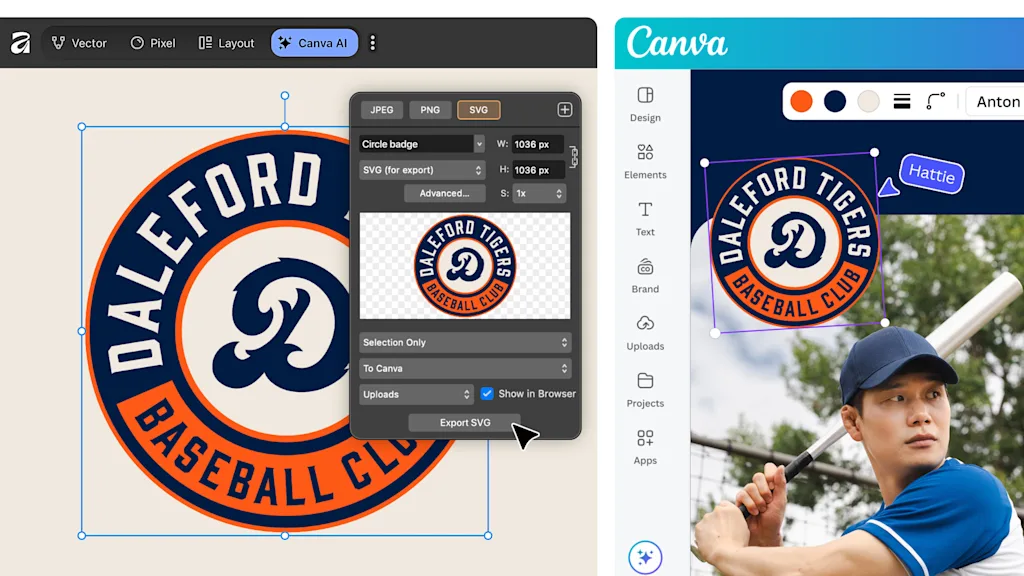
The AI question
Hewson says that unlike Adobe’s tools, the new Affinity remains a pure, unadulterated craft tool with no generative AI baked in except for enhancing existing tools like image scaling, which runs on-device. However, for those who want to edit with AI, that’s available through a new dedicated “Canva AI Studio” panel in the app.
This is an optional, subscription-based layer. As he explains, you need a Canva Premium plan, and the AI features use the same credit pool as your main Canva account. Crucially, the optionality respects the designers who resent paying for AI they don’t want or trust. You can run the entire free experience without ever touching it (or just take it out of the UI altogether). The generative features, like Generative Fill, run on cloud servers using models from Leonardo, an AI company Canva acquired in 2024.
It’s a good approach that runs counter to Adobe’s all-in-on-AI strategy. For professionals who are fed up with Adobe force feeding them generative AI in their subscriptions, Canva’s opt-in assistant option will be appealing.
Combined with a good toolset (still have to test this one) and the zero price tag, Canva may be launching a philosophical and strategic H-bomb at one of its biggest competitors. If it delivers, the creative world is about to feel the shockwave that may finally bust Adobe’s decades-old foundations.