

El Niño is officially here—and it could be one of the strongest in our National Oceanic and Atmospheric Administration’s historic record.
With our oceans already warming from the burning of fossil fuels and human-caused climate change, El Niño adds even more heat.
That means the climate pattern has the potential to amplify weather extremes like droughts, floods, and more damaging forest fires. It could also disrupt fishers and lead to crop loss in certain regions of the world.
Though some have dubbed this year’s climate pattern a “Super El Niño,” NOAA meteorologists don’t use that term. Instead, they classify El Niños as weak, moderate, strong, or very strong.
“There is a 63% chance that we’re looking at a very strong El Niño during the November to January time period,” Ariel Cohen, a meteorologist at the National Weather Service’s Los Angeles office, said during a Thursday press conference.
“That could rank among the largest El Nino events in the historical record, going back to 1950,” he added.
What is El Niño, and what makes a ‘Super’ El Niño?
El Niño is a climate phenomenon concerning above-average sea surface temperatures. Under normal conditions, warm waters over the equatorial Pacific get transported westward, and are followed by areas of cooler water.
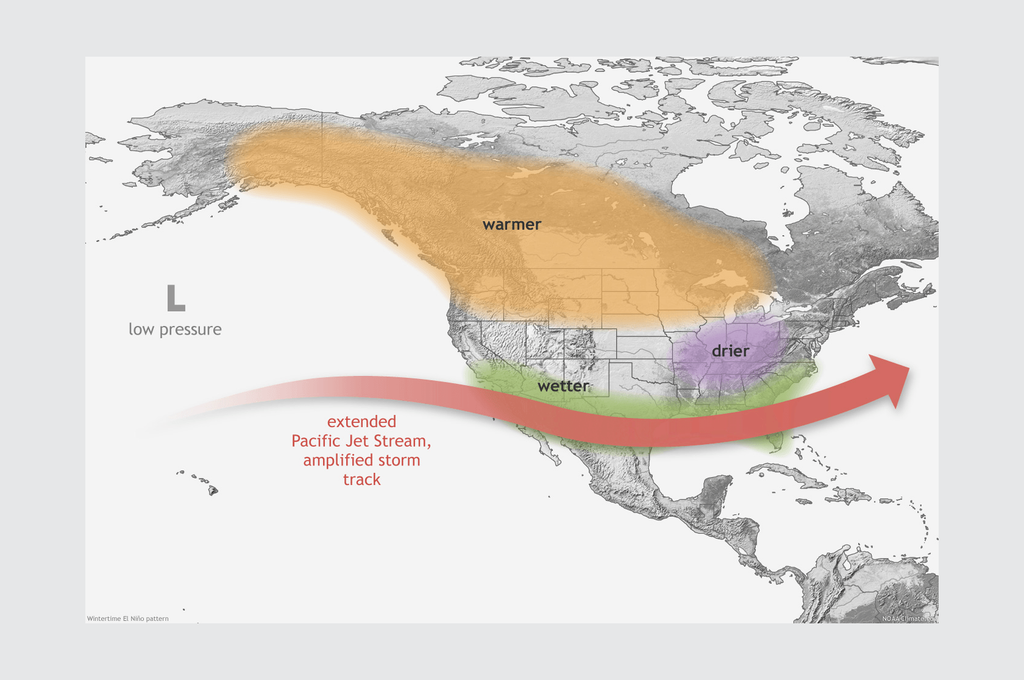
But during an El Niño, Cohen said, trade winds slacken, and that warm pool of water extends farther to the east. That causes the jet stream in our atmosphere to shift. Typically, this leads to wetter conditions across the Southern U.S., and drier than normal conditions farther north.
But there is a lot of variability with El Niños, experts warn—and even with a “very strong” or Super El Niño, that doesn’t mean the same impact is expected everywhere.
Instead, an El Niño “just significantly tilts the odds” toward certain weather events.
For an El Niño to officially form, temperatures in the equatorial Pacific Ocean must reach 0.5 degrees C above average for a few months in a row.
In a “very strong” or Super El Niño, sea surface temperatures climb 2 degrees above average.
“El Niño conditions are already present at this point and expected to strengthen across the Northern Hemisphere over the next several months,” Cohen said.
More floods, droughts, fires, and more
With that extreme warming, “the result could be stronger, more persistent impacts around the world in the form of droughts, floods, cyclones, extreme heat and more,” according to the World Resources Institute.
Warmer and “erratic” climate change conditions could combine with that Super El Niño. Already, our world’s oceans hit a record high temperature in 2025, with the heat they store increasing 23 zettajoules—a figure equivalent to more than 365 million atomic bombs.
“El Niño conditions will pour fuel on the fire of a warming world,” the United Nations Secretary-General said in a video message earlier in June.
“Impacts will hit even harder, travel even farther, and cross borders with devastating speed,” he added.
Scientists are already seeing conditions that look similar to a very strong El Niño we experienced in 1997-98. That El Niño cost governments around the world $45 billion in damages, the World Bank estimated, “due to severe storms, droughts and other effects.”
Along with droughts, storms, and flooding, El Niños can bring hotter, drier conditions to areas that already have an increased fire risk, which lowers “ignition thresholds,” per WRI, for forest fires.
How El Niño affects marine life, and our food system
El Niños affect marine life, too, because of how marine heat waves impact ecosystems
With strong El Niños of the past, plankton abundance goes down, Andrew Leising, NOAA’s Southwest Fisheries Science Center, said at the press event. That’s concerning because plankton are the base of the marine food web.
Previous strong El Niños have also led to more whale entanglements in fishing gear, as the mammals come closer to shore for food. Seals, sea lions, and marine birds have died off. Sharks come closer to shore.
There’s also an increased probability of harmful algal blooms, which harms wildlife, and also our food system. In the past, those blooms have led to several closures of crab and shellfish fishers, Leising said.
Our food supply could be impacted by those droughts and extreme weather events, as well. A potential Super El Niño, WRI notes, would “layer drought, heat or flooding risks onto an already fragile system, increasing the likelihood that high costs turn into real food shortages.”
Experts caution that there are still many unknowns with this potentially very strong El Niño.
“Things are still going to play out in any number of ways,” Cohen said. “We can’t guarantee weather conditions being a specific form in several months from now.”
The main message, he added, is for people to stay attuned to credible sources like the National Weather Service, and to pay attention to any guidance from emergency management officials.