
Key Takeaways
- Oatly gives its creative team an unusual amount of autonomy, allowing it to develop and execute its own briefs.
- The company intentionally avoids using a rigid brand book to maintain maximum creative freedom for its messaging.
- As a company gets bigger, creative risks often become harder. You’ll only remain sharp if you bake creativity into the structure of the company.
When new creative employees join Oatly, the onboarding starts with a single instruction: “Unlearn everything you know about marketing.”
According to Oatly creative director Michael Lee, that’s the only way to build a truly distinctive brand voice: You must operate without the guidelines that bind most other companies — including how decisions are made, how teams are structured, and how the brand voice is even defined.
For example, most big companies have a “brand book.” It’s a style guide that defines how the brand looks and speaks, so that every touchpoint is consistent. But Oatly does not have one.
“We’ve always kind of refused to do kind of brand books,” Lee says. “Whenever we work with a partner, they’re always asking us about our brand book. And we don’t have one because as soon as you do one, you feel like you have to stick to it, and we’d rather have the freedom to just do something completely different if we felt like it.”
For a company that’s grown into a global provocateur beloved for its packaging and relentlessly human tone, that freedom matters enormously. Here’s what Lee’s approach reveals about what it actually takes to build a brand with real perspective — and why it gets harder, not easier, the bigger you get.
The Oatly origins
Oatly launched in Sweden in 1994, originally positioned as oat-based alternative to dairy. Its branding was quiet and boring.
Things began to change in 2012, when Toni Petersson became its new CEO. John Schoolcraft him joined him as chief creative officer, then eliminated the entire marketing department and rebuilt it with creatives at the center of the business. Their goal: Transform Oatly into a brand with personality and international appeal.
Schoolcraft’s new model was unusual. Oatly’s creative team (which named itself the Department of Mind Control) would operate largely on its own. It would write its own briefs, set its own strategy, and execute its own work.
Schoolcraft departed in 2025, but that structure still remains.
“No one really can veto what we’re doing,” says Lee, who joined as creative director in 2017, the same year Oatly entered the U.S. market. “It’s not like we’re presenting to any marketing director or sales guys.”
This is a genuinely rare setup, but Lee believes it’s a vital one. If you want a distinct brand voice, he says, you can’t just hire creative people and hope for the best. You must remove the layers of approval that instinctively sand down anything provocative, and empower creatives to truly own and operate their work.
But with great creative power comes great creative responsibility.
“When things go well, great. But you also have to take it in the chin when things don’t go well,” Lee says. “Then you must have the wherewithal and courage to continue being at that edge.”
Oatly’s creative director, Michael Lee.
Image Credit: Courtesy of Oatly
A Brand Voice is a Feeling
That unusual corporate structure has produced an unusually voice-driven product. Oatly is full of creatively distinct decisions, and speaks in a funny, often provocative way that helped turn the brand into something beloved and distinct.
Here are a few of those unusual choices:
- On the front of its carton, the name Oatly appears like this: OAT-LY. Why the hyphen? Just because it looked cool.
- The side of its oat milk carton is full of dense, self-referential, constantly changing text. One version began: “Before we wrote this sentence, there was a lot of empty space on the side of this package and we didn’t know what to do with it…”
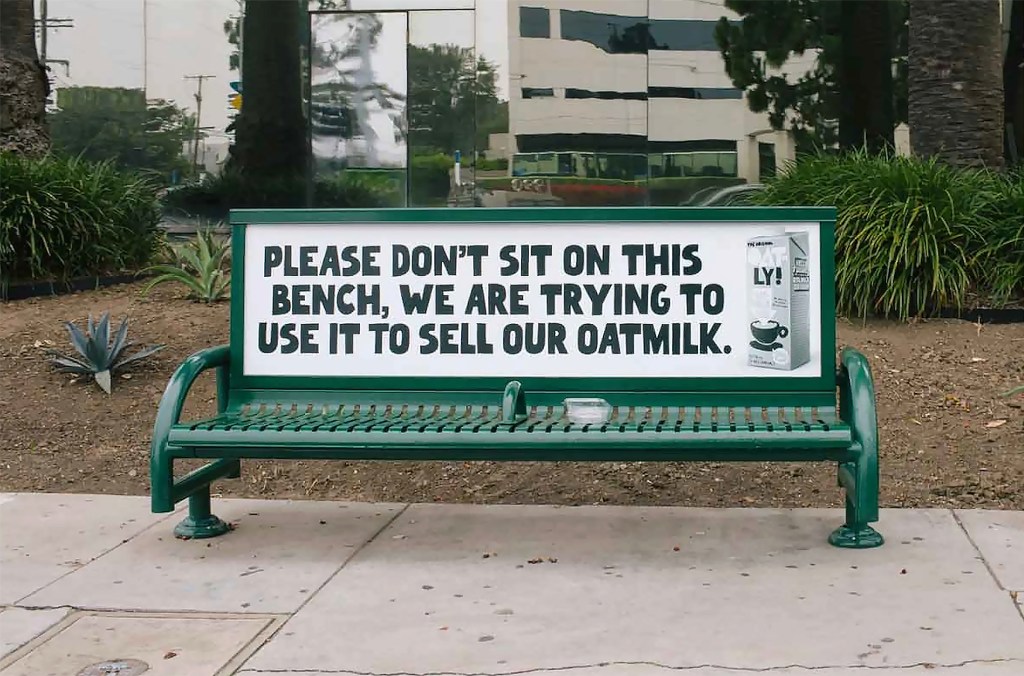
- Its marketing often follows suit. One billboard said: “Why do giant oat-milk ads have to ruin cool neighborhoods?” Another said: “Maybe a social media celebrity will take a photo of this poster and you will see it on Instagram and like it way more than you do right now.”
- Oatly once described oat milk as “like milk but made for humans.” That prompted a lawsuit from Sweden’s dairy lobby, which Oatly then (ahem) milked for a lot of public press and sympathy.
But despite Oatly’s distinctive voice, Lee says he can’t exactly explain what’s “on brand” for this brand. Nor does he want to.
“There is an Oatly idea, and there is… that is not an Oatly idea,” he says. “How do you know? I don’t know. It’s just you develop a feeling. You develop this sense for what feels Oatly and what doesn’t feel Oatly, and it’s hard to wrap words around it.”
This might sound frustrating for anyone seeking a repeatable process. But Lee’s point is that a real brand voice resists being reduced to a checklist. It must become a fluid, ever-evolving thing.
“A lot of what I’ve spoken about — a company acting human and doing human things — is easy to say, and it sounds kind of normal,” Lee says. “But the reality within corporations and businesses it is extremely difficult. Because as everyone knows, when you go into a company, suddenly it’s company speak. You talk like you wouldn’t talk at home.”
As a result, he says, brand leaders often become police officers: Their jobs are to create guidelines that feel safe and prevent bad ideas. But Lee thinks a creative leader should do the opposite, by building enough shared instinct for everyone to recognize a good idea. That way, they can collectively reject ideas that are safe but don’t feel true to brand.
Courage Gets Harder As You Scale
Startup founders often lament: If only I had the marketing budget of the big guys…
But Lee says startup founders should take advantage of their size. When you’re small, it’s easier to take large risks. “It is much harder to be disruptive and courageous with your brand at the $100 million level than it is at the $10 million level,” he says. “That, I think, is the most difficult challenge — to maintain that edge and continue to be disruptive.”
At scale, every campaign faces more scrutiny, more internal stakeholders, and more pressure to protect what’s already been built. This is when most brands quietly sand off their edges, he says. They trade their original voice for something safer.
So how do you preserve that creative integrity? Lee says it all goes back to fundamentals: How are you structured? And is the company truly built to support creatives? Commitment must come “not from just the creative director, but the entire company, from the top all the way down,” he says.
That’s one more reason he’s grateful for the structure at Oatly.
When there’s no brand book, the creative team must constantly shape and refine the brand itself. When there’s no layers of approval, the creative team feels a deep obligation to get it right. And when a new team member is told to “forget everything you know about marketing,” they can start to define a new way for themselves.
Key Takeaways
- Oatly gives its creative team an unusual amount of autonomy, allowing it to develop and execute its own briefs.
- The company intentionally avoids using a rigid brand book to maintain maximum creative freedom for its messaging.
- As a company gets bigger, creative risks often become harder. You’ll only remain sharp if you bake creativity into the structure of the company.
When new creative employees join Oatly, the onboarding starts with a single instruction: “Unlearn everything you know about marketing.”
According to Oatly creative director Michael Lee, that’s the only way to build a truly distinctive brand voice: You must operate without the guidelines that bind most other companies — including how decisions are made, how teams are structured, and how the brand voice is even defined.
For example, most big companies have a “brand book.” It’s a style guide that defines how the brand looks and speaks, so that every touchpoint is consistent. But Oatly does not have one.