

This summer, Ryan Reynolds and Hugh Jackman became co-owners of Australia’s three-time champion SailGP team. Days earlier, Anne Hathaway joined a female-led consortium purchasing Italy’s team for around $45 million. Kylian Mbappé has bought into France’s squad, while Sebastian Vettel, Deontay Wilder, and DeAndre Hopkins have each acquired stakes in teams.
So, what’s drawing A-list celebrities away from traditional sports properties and toward a sailing league that’s only been around for six years?
The answer lies in how SailGP has cracked a code that eluded the sport for centuries. What Russell Coutts, the league’s CEO and cofounder, described as once being “white triangles on a blue background racing far away from shore” now looks more like Formula 1 on water.
Flying boats, record speeds
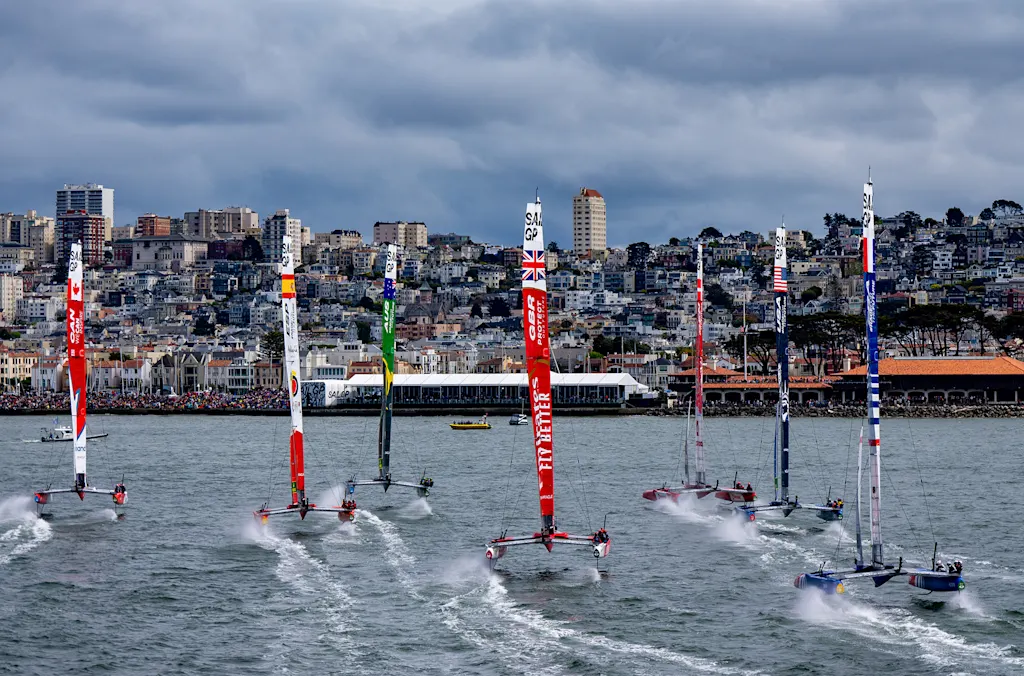
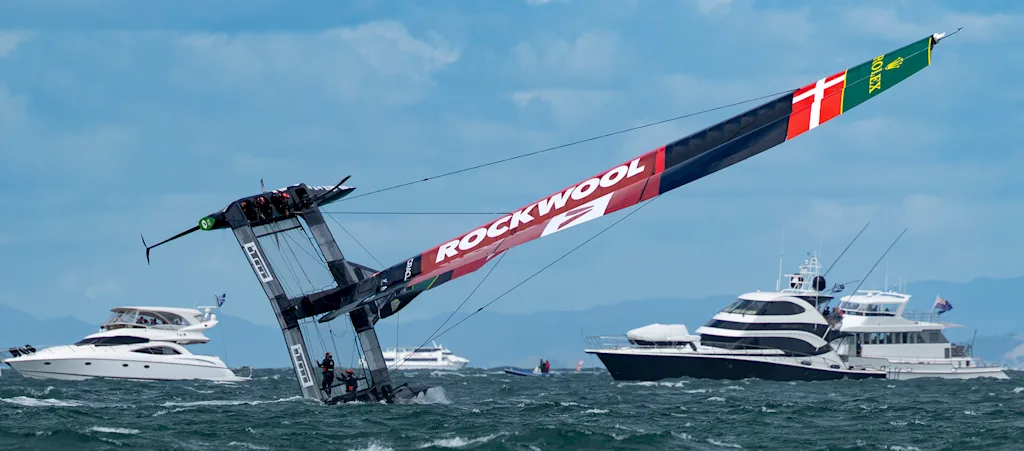
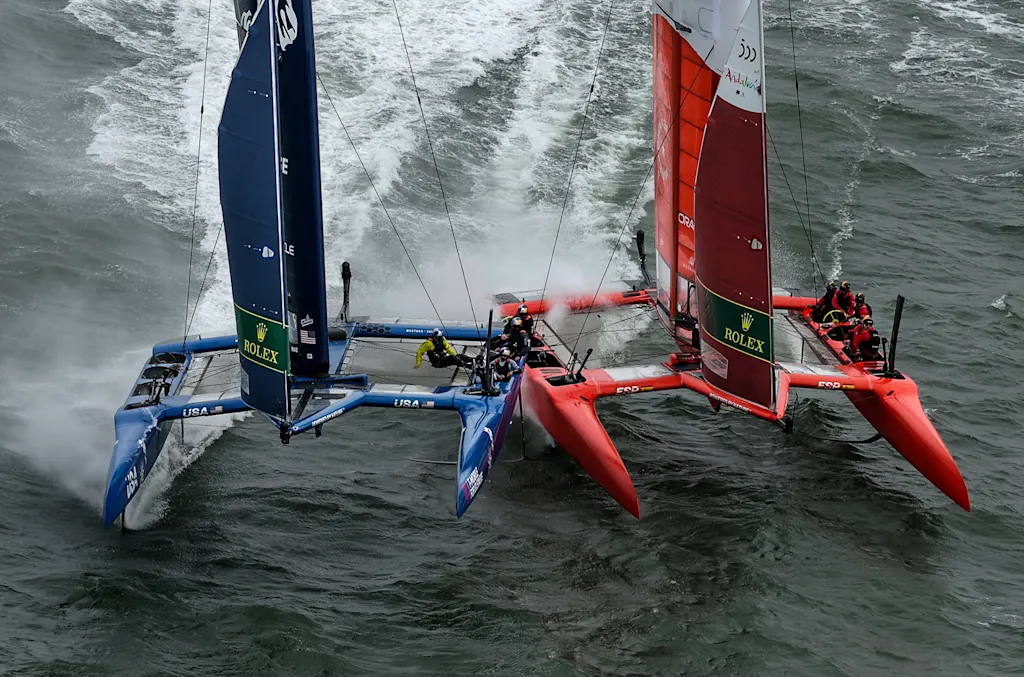
Forget everything you think you know about sailboats. SailGP’s F50 catamarans fly above the water on hydrofoils—underwater wings that lift the hulls completely out of the water—at speeds exceeding 100 kilometers per hour.
That’s 62 mph. On water. Powered only by wind.
Most powerboats can’t even keep up.
The boats don’t use traditional sails. Instead, the 50-foot boats have rigid wings built like airplane wings turned vertical, standing up to 80 feet tall. “This produces what we, in engineering terms, call a lift coefficient that is three times higher than a thin membrane sail,” Coutts explains.
Translation: They catch wind more efficiently than conventional sails, generating massive thrust even in light conditions.
When a boat moves forward, it creates its own wind—just like how your hand feels resistance when you stick it out a car window. By angling these high-efficiency wings correctly, F50s use both the actual wind and the wind they create through their own speed to go more than three times faster than the wind itself.
Nine-minute races and $80 tickets
Traditional sailing races stretched for hours with boats barely visible from shore. SailGP races last nine to 12 minutes and feature four races per day: short, intense bursts with enough time between heats for a bathroom break and a cocktail.
The shorter race format enables something traditional sailing never could: close-to-shore competition in iconic harbors. Events happen in places like Sydney Harbor, New York Harbor, and San Francisco Bay. Stadium seating sells out weeks in advance. Auckland and Portsmouth each drew 25,000 ticketed fans.
Tickets start at $80 for waterfront grandstand seats—accessible pricing that brings the sport to a far broader audience than the yacht club exclusivity of traditional sailing. Fans can watch from grandstands or rent a boat and watch from the water. It’s part race, part waterfront festival.
The spectacle translates to screens, too. Augmented reality graphics superimposed on the water create a visible playing field with boundaries, like the yard markers on a football field. Before this, even dedicated sailing fans struggled to follow races on TV. Now, even the most casual fan can understand who’s winning and why.
Since launching in 2019, viewership has reached 200 million per season across 212 territories globally. CBS attracted 1.78 million viewers for its Spain Sail Grand Prix broadcast—the largest audience for a sailing event in the U.S. in 30 years—exceeding what some regular-season NHL games pull. More recently, on November 23, CBS’s broadcast of The Race to Abu Dhabi drew 3.47 million viewers, breaking the previous U.S. viewership record for a sailing event established by the 1992 America’s Cup on ABC.
“We were pleasantly surprised to find that the appeal to the racing fan was identical to the appeal to the avid sailing fan,” Coutts recalls. “We’ve got confidence now that the product stands up.”
From money pit to money maker
In 2019, Coutts and Oracle cofounder Larry Ellison launched SailGP with one deceptively simple innovation: a regular season.
For decades, professional sailing meant wealthy enthusiasts funding expensive hobbies with no return. The America’s Cup—sailing’s premier event for 174 years—exemplified the broken model.
Imagine if the Super Bowl happened once every four years with no regular season in between. No predictable schedule. No way for athletes to plan or build a career. That’s been the America’s Cup. Sponsors couldn’t justify the investment. Broadcasters couldn’t build programming around it. Teams couldn’t make it profitable.
“It sounds so simple, doesn’t it?” says Jimmy Spithill, CEO and co-owner of the Red Bull Italy SailGP Team. “But whether you’re an athlete, a sponsor, or a broadcaster—if it wasn’t a regular season, how could you plan?”
Upon founding, Ellison committed to funding the league for five years. But the transformation happened faster than anyone expected. Teams that couldn’t be sold in 2019 now command $60 to $70 million valuations. Four of the league’s 12 teams are already profitable—a milestone that took the WNBA 13 years to achieve and that Wrexham, Reynolds’ soccer team, still hasn’t reached.
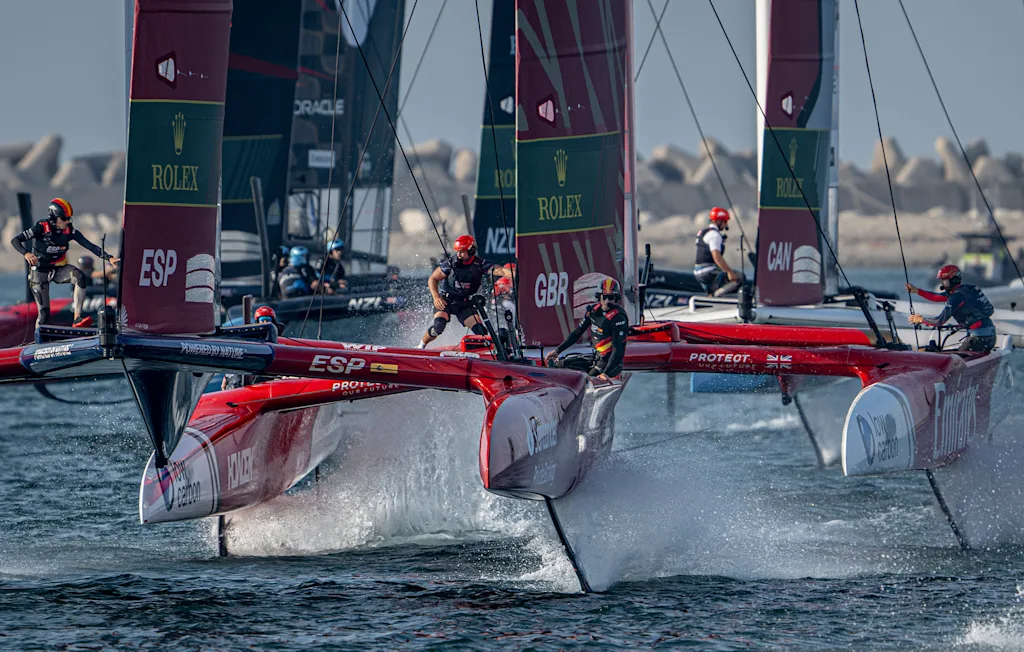
In traditional sailing, teams burned millions on secret boat development that never stopped. That game is over. The business model prevents this money pit problem. All teams race identical boats. All performance data is completely shared—boat telemetry, race strategies, even engineering insights. When the league develops an upgrade—new hydrofoils, better control systems—every team gets it simultaneously. There is no buying wins.
“Everyone’s on the same equipment,” Spithill says. “So no one has a technical advantage.”
The investment thesis that sold Hollywood
When Gian Luca Passi de Preposulo evaluated investing in the Red Bull Italy team, he saw something bigger than sailing. The Italian luxury brand executive who spent years at Giorgio Armani and Moncler recognized a familiar pattern.
“I saw a growing sport with an incredible heritage because of the America’s Cup,” he says. “Millions of fans following this through generations, but no competition on a weekly or monthly base.”
Passi de Preposulo recognized the pattern: a legacy sport with millions of fans but no consistent competition to follow—exactly the gap SailGP’s regular season format filled.
But he also saw that the business model offers investment advantages impossible in more mature leagues. National team scarcity—one per country, capped at around 20 teams total—creates inherent value. Buying a $60 million SailGP team gives you a significantly larger ownership stake and more governance rights than putting that same money into a $5 billion NFL franchise. Men and women race together on the same boats—unusual in professional sports—doubling the target audience and appealing to the increasing pool of investors backing women’s sports.
Teams operate on standard sports economics: sponsorship, broadcast revenue shares, and licensing. But only six years in, most revenue streams remain undeveloped. The four profitable teams achieved this through sponsorship alone. Cash cows like broadcast rights and licensing represent pure upside. Team valuations reflect this trajectory.
“In season three, you could have bought a team for $20 million,” Coutts says. “Now you’re not going to buy a team for under $70.”
Scaling SailGP
From six teams and five events in 2019, SailGP now runs 12 teams across 12 events. The target: 20-plus events annually, matching Formula 1’s 24. Teams 13 and 14 are already sold for the 2026 and 2027 seasons, and the league projects over $200 million in annual revenue by season’s end, which culminates this weekend with the Grand Final in Abu Dhabi, where the top three teams will compete for a $2 million prize.
Rolex signed a 10-year title sponsorship, renaming the competition the Rolex SailGP Championship. “It’s by far the biggest partnership in sailing,” Coutts says. Amazon, Tommy Hilfiger, and T-Mobile have also joined as team sponsors.
Events now generate an average $26.2 million in economic impact for host cities—quadruple the $6.8 million from Season 1, according to SailGP. For context, Formula 1 races generate $200 to $400 million.
The celebrity investment impact is measurable. Market research firm YouGov tracks “buzz scores”—a measure of whether people are hearing positive or negative things about a brand. In Australia, SailGP scores jumped from 22.0 to 26.3 in two weeks following the Reynolds and Jackman announcement. France saw similar lifts after Mbappé’s investment.
For Reynolds, SailGP represents another portfolio expansion. His Maximum Effort Investments backs Wrexham AFC, Club Necaxa, La Equidad, and Alpine F1. His Wrexham success—transforming an obscure Welsh soccer club through marketing genius and storytelling—offers a template as SailGP looks to continue its growth, both in investment and global audience.
“The fact that we can get that sort of [celebrity] involvement in one of the teams is amazing,” Coutts says. “And they’ll have some fun with it too, which is what it’s all about.”