
Planning summer travel is hard. Planning it for a busy family, visiting multiple destinations with three little kids in tow, can feel downright impossible.
I’m a professional news and travel photographer, so I need to plan a lot of trips with my wife and our three boys. I’m also an AI expert with a Cog Sci degree from Johns Hopkins, and a decade of experience in the field.
So naturally, I decided to combine those two passions. To that end, I built an AI digital twin of my family, which uses multiple rounds of simulation and advanced agentic AI to plan every aspect of our summer trips.
I’ve tested it in planning multiple real-world trips, and its ideas are fantastic–with some big caveats.
Vibing with Claude
To build my travel planning AI, I turned to Anthropic’s Claude. I’ve written Python code for years, so I know how to code up a basic script and integrate with an API.
In my experience, though, Claude is far better at these things than I am. When I first started testing Claude and its ilk several years ago, the Python they wrote was buggy and kludge-filled. By the time I finished debugging, I often felt it would be easier to just write the code myself.
Not anymore. With Claude’s new Fable 5 model, you can describe a piece of software you’d like to build in intense detail, and the model will spend 20 minutes or more understanding your brief and spinning up perfectly optimized Python code that works right out of the box.
People call the process “vibe coding”, but that’s always felt a bit pejorative to me. Working with today’s best coding LLMs feels more like having a mid-level software engineer in your pocket than using a simple model to spin up a cutesy web interface or yet another Pacman clone.
For my AI travel planner, I told Claude that I wanted to describe each member of my family in detail, building a travel profile for each of us.
I then wanted to hand the system details like our travel dates, lodging plans and trip preferences, and have it research ideas for our travel, as well as looking up basics like weather and closures.
Armed with these details, the system would simulate our trip multiple times, predicting how each of us would react to each travel idea. Finally, the system would prepare a detailed report and itinerary based on its findings.
I wanted the end result to be easy to use on the go, and easy to modify. So I asked Claude to build the system in the form of a Google Colab notebook. Colab is a free service that lets you run complex Python scripts in Google’s cloud for free, with a Google-docs-like web interface.
Claude dutifully got to work. Several minutes later, I had over 1,000 lines of Python code ready to go.
The final system uses the OpenAI API to send out multiple AI agents, researching 40-plus restaurants, activities and general sights for any spot we’re planning to visit. It pulls in weather data from Open Meteo, runs 10 rounds of simulations using the digital twin of each family member, and then writes up a 5-plus page itinerary and travel plan.
To build our profiles, I turned to ChatGPT. I often chat about travel plans with the bot, and it now has an extensive memory function. I asked it to recall all it had learned about each of us from these previous travel conversations, and build a profile of our likes and dislikes, in a machine-readable JSON format.
Many of these were spot-on. ChatGPT correctly determined that my oldest son loves LEGOs and mini golf, my youngest has a deep passion for ice cream, and my six year old loves–a bit inexplicably–birdwatching.
I took these basic profiles, added my own insights, and then loaded them into Claude’s framework. After an afternoon of tinkering, my AI digital twin travel planner was ready to use.
Boots on the ground
I’ve used my agentic digital twin system to plan at least five trips this Summer, from quick day trips to weekend trips and even week-long getaways.
Using the system is easy–I plug in trip details, fire it up, and wait about 10 minutes for a report to come back.
Like many agentic AI systems, my travel planner burns through an ungodly number of tokens–the currency of AI compute time–to produce its results.
On a recent run, I planned a single day-trip to Capitola, California. Doing so burned through a cool 256,503 tokens, costing me a little under $5. In June alone, I used over 8 million tokens for travel planning.
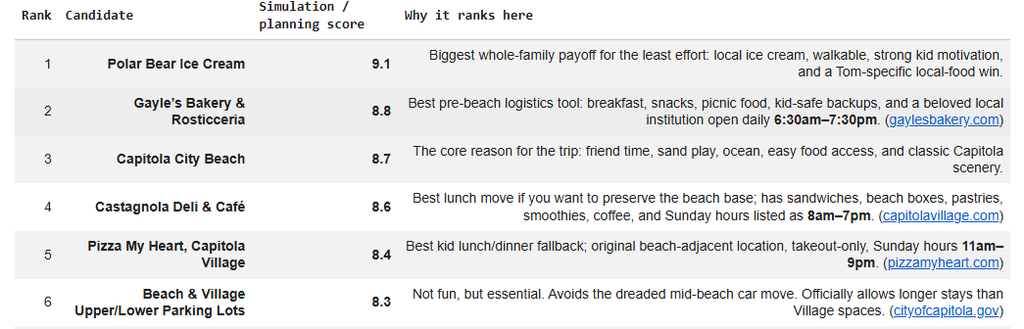
The results are worth it, though. My system’s reports are informative and extremely detailed. Each report leads with a summarized, ranked table, showing the results of its simulations and describing the activities and restaurants we’re likely to enjoy the most.
For that trip, the system found a local ice cream place (Polar Bear) it thought we’d love, and also advised us “If you are not already fully packed with food, stop at Gayle’s Bakery & Rosticceria before committing to beach parking.”
The ice cream spot was indeed fantastic, and Gayles was one of the best picnic provision places we’ve ever visited.
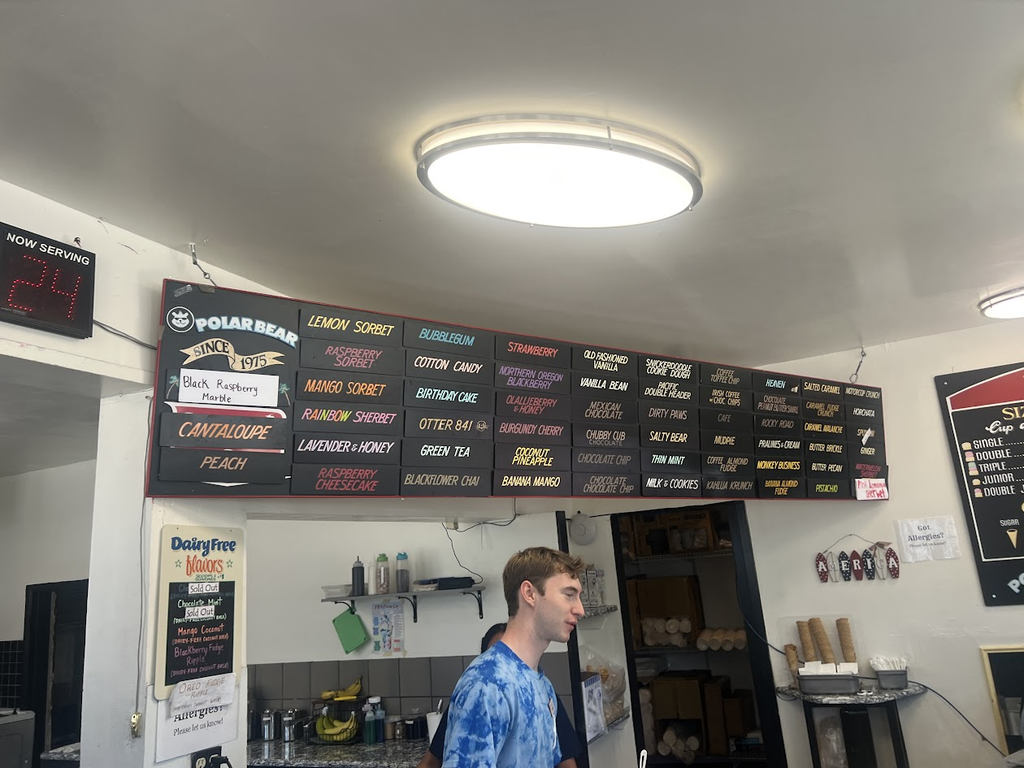
Ice cream recommendations were spot-on. Photo credit Thomas Smith
My system also picked the best beach for our family, and even the best parking lot–no small thing in car-obsessed, space-crunched California!
The system does a great job of balancing competing needs. It knows that I’m a pro photographer, and will need to visit and photograph interesting sights for my work.
But it also knows that three little kids can handle only so much of this, and builds in quiet activities–and plenty of ice cream–to keep the trip in balance.
And it keeps things real. My natural tendency is to visit and photograph lots of places. But in planning a bigger summer trip to Hawaii, the system reminded me that our kids would want to spend most of their time floating around the hotel pool.
Perhaps a bit passive-aggressively, it ranked various aspects of the pool (a water slide, a themed cave, and the like) as our top “must do” activities, while shoving ambitious things I might enjoy (like a farm tour on the other side of the island) much further down the list.
Point taken, AI!
The system is good, but it isn’t perfect. Once you’ve got actual boots on the ground, problems with its recommendations sometimes quickly emerge.
On a recent fruit-picking trip, for example, it advised us to visit a farm with the absolute best-tasting peaches.
The peaches turned out to be fantastic. But picking them also required slogging around an exposed, sunny field and climbing a 7-foot agricultural ladder at each tree. The kids struggled.
We left after a few minutes and visited a different farm with underripe fruit but easy access and short trees. My kids loved it.
The system, in other words, is good at optimizing, but doesn’t always optimize for the right thing–a common problem for AI in general, and agentic AI in particular.
The coder in my pocket
I learned a lot by building my AI digital twin travel planner.
It showed me firsthand that AI agents–with their ability to read through thousands of webpages, Reddit posts, Tripadvisor reviews and the like–are fantastic at unearthing unexpected information and the kinds of “hidden gems” that travel pros constantly spill ink over.
Googling on my own, I’m likely to find prominent sights and tourist stops in a target destination, but I’d probably miss small, local spots that may not have a polished website (or a marketing budget). My system’s agents find these and highlight them–albeit after expensively crunching through a lot of content!
I also learned that feeding AI models reams of great background data matters. If I ask Claude out of the box to find “activities in Costa Mesa for a family with three kids”, it’s likely to recommend fairly generic, kid-friendly spots.
Asking it to find activities for a nine year old with an adventurous pallet who doesn’t mind spicy foods, a bird-focused six year old, and a five year old who loves numbers and locally-made candy yields much better, more tailored results.
My biggest takeaway from building the system, though, is a realization of how powerful today’s AI coding tools have become.
In a pre-AI world, I’d never invest tens of hours to code up a digital-twin based simulator with full web crawling and tie-ins to live meteorological data in order to plan a few summer trips.
Claude, though, can build something like that in minutes. That doesn’t only make my job as an amateur coder easier–it opens up projects I would never dream of tackling without AI’s help.
Although I’ve found my system genuinely useful in my photographic career, I mostly built it for fun.
But in doing so, I can now easily see how a true software engineer–armed with even better LLM-powered tools than Claude’s basic coding system–could build astonishing things in no time at all.
Chatbots are increasingly capable writers and communicators. But it’s their ability to speak the true language of our time–computer code–where they have the most potential impact.
My travel planner is great at finding local ice cream spots and sandwich joints. But I can see how a similar agentic system–built by a true coding pro with access to cutting edge tools and data–could solve intractable problems in science, medicine or finance with relative ease.
LLMs get lots of praise and opprobrium for their prose and their advice. But it’s their coding prowess where the models will truly change (or break) the world.