
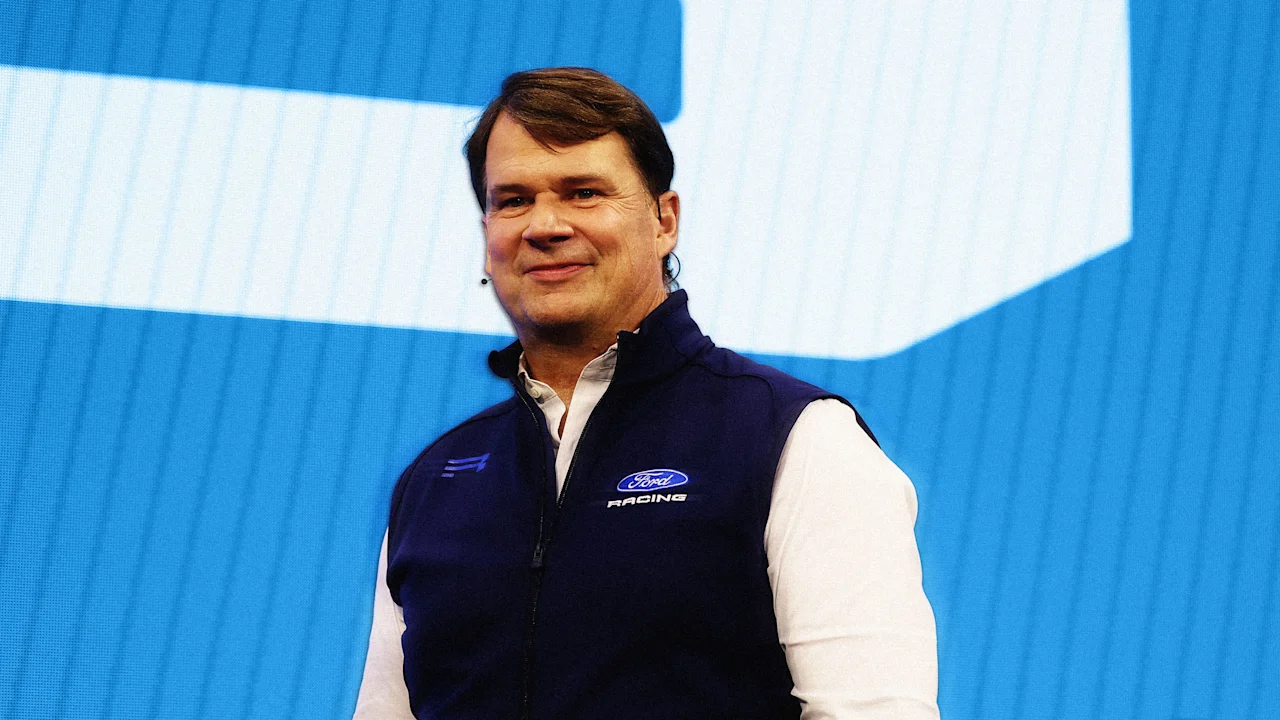
With the Strait of Hormuz in crisis and gas prices surging, few executives are feeling the pressure more acutely than Ford Motor Company CEO Jim Farley. He gives a candid account of what the turmoil means for the auto industry, and for an iconic American brand navigating one of the most turbulent moments in its history. Plus, Farley gets frank about the China threat reshaping the global auto business, and his frustration with Ford’s own ingenuity.
This is an abridged transcript of an interview from Rapid Response, hosted by the former editor-in-chief of Fast Company Bob Safian. From the team behind the Masters of Scale podcast, Rapid Response features candid conversations with today’s top business leaders navigating real-time challenges. Subscribe to Rapid Response wherever you get your podcasts to ensure you never miss an episode.
The big question mark looming over everything right now is the activity around Iran and the Middle East, what happens with the Strait of Hormuz, and oil prices. You’re on the front lines of all that impact in your business. What are you seeing? What are you feeling? Are there any strategic adjustments you’re making?
It’s been an interesting couple of weeks. It’s very asymmetric around the world. Ford is still a global company. A lot of our North America competitors have left Europe. We’re the biggest pickup truck maker in the world, in Thailand and Australia—these are huge pickup markets—even China now. And we face off with Chinese companies in all these markets. Two things are happening while this war is going on. In the first quarter, the Chinese market, which is a third of all new vehicles sold on the planet, was down almost 30%. And they’re already the largest exporter in the world, far beyond the Japanese and South Koreans. Their exports are up 43% this year, and they are already No. 1. So the war is happening, and the electrification in the first quarter is happening. Of course, fuel price is way up. In places like Australia, where they get a lot of the oil through the straits, they’re out of fuel.
Most companies are asking people to stay at home. Many provinces are giving away free transportation because you just can’t get fuel. In places like the Middle East, the business has completely stopped. And that’s very important for logistics. Commodity costs have gone up—not just oil, but all commodity costs have gone up. So we have to adjust to the higher cost level. But I would say what we’ve really learned is that electric cars are very vibrant. Prices have gone up almost $10,000 in the U.S. for electric cars, and electric cars are now up to 7% of the U.S. industry. That’s not a small amount, with no government support. But what’s selling in EVs is more important, which is that the truly affordable EVs are more popular. Used EVs are super popular right now. So the market has changed. I like to look at the used market even more than the new market to understand what consumers’ mindset is, and they’re more interested in hybrids.
Late last year, you announced some scaling back on some of your electric vehicle production. Do these changes and the surge in pump prices make you rethink any of that, or is what you’re seeing the same in the marketplace that you were reacting to?
Thank you for asking this question. Everything that we’ve seen with escalating fuel prices in the U.S. is reinforcing our choices. Not because I’m the CEO of Ford and we’re always right. It’s because we moved first among all the competitors—before Toyota, before GM, before all the traditional OEMs. We were No. 2 to Tesla for three or four years in EVs. We moved really fast, but these were designed the wrong way, let’s put it that way. So they lost a lot of money, but we got to see how customers choose. And we also came out with the hybrid F-150, America’s best-selling truck. We hybridized it before Ram, and they still don’t even have a hybrid. So we got to learn, Bob, before any of our competitors, where the EV market was already going. And with the escalated fuel price, it’s only reinforced it.
We got out of our high-end EVs, but what we decided to do is double down on our affordable ones, and that is what’s selling today around the world, not just in the U.S. You look at Australia, you look at China, you look at Europe. All those markets are moving to a pure EV being more of a commuter-type, low-cost vehicle. That’s really where the market has already gone.
You mentioned China a couple of times, and I think for folks in the US, it’s often surprising or confusing because there aren’t as many Chinese vehicles here, and there’s blockage of certain Chinese vehicles coming to the U.S. But you’ve had some amazing quotes—”the most humbling thing I’ve ever seen,” “an existential threat”—referring to their EV prowess. It sounds like that has not slowed down.
It’s sped up. You’re absolutely right. Look at it this way. I could argue that the car business in most industrial countries is the heart and soul of the manufacturing base. It creates a lot of jobs. It has a bigger impact. For every job you create in a factory, there’s tenfold that gets created in the economy. And it’s very hard to make a car. It’s tens of thousands of pieces from all over the world, and it takes heavy manufacturing and know-how. So these are really important jobs. Today, the Chinese car industry sells about 29 million new vehicles there every year, but they have 50 million units of capacity to build cars.
So their factories would be half full if they just made cars for their own market. It’s not excess capacity because they built that for a reason. They’re now the largest exporter in the world. And in fact, their production capacity in China is so large, it could basically take care of the entire North America market. Their average Chinese vehicle has $4,000 to $5,000 of subsidies, indirect and direct, from the government.
I was going to ask if that’s what keeps the price down—the scale of the manufacturing they’re doing—or how much of it is the subsidies that they’re getting.
Both. The Western companies made a lot of money in China for a long time—not Ford, but many of our competitors. They made billions and billions. And I think the Chinese government is very practical. They said, just like solar and other industries, we want to really dominate global automotive. So we’re going to bet on this change of propulsion, electrification. And they made this bet many years ago. The thing about cars that everyone knows, but when you point it out, they’re like, oh yeah, I guess that makes sense, is that these cars have 10 cameras in them. They have sophisticated communication. They’re all connected. They’re autonomous in many ways. So these vehicles should be reviewed by the Defense Department for national security. They have sensitive PI information. They have camera images of your whole life, where you drive, including a military base, an electrical substation, all sorts of stuff.
You were personally driving a Chinese EV, which someone could see as a diss to Ford-branded vehicles. But it seems like maybe that was the point—to motivate everybody to say, “You’ve got to get in this game.”
Xiaomi, yes, the SU7. If you’re an American and you want us to beat the Chinese in the car business, you’re all going to want to pay attention, not necessarily to Tesla. Nothing against Tesla—they’ve been doing great—but they really don’t have an updated vehicle. The best in the business for us, cost-wise and competition-wise, supply chain, manufacturing expertise, and the IP in the vehicle, was really BYD. And BYD became the highest-volume brand in China, not VW or the Western brands. Last year, Geely actually just surpassed it. If we’re smart, we’ll take the cost competitiveness of BYD and then compete with that platform in parts of the market where we know our customers really well. In this next cycle of EV customers in the US, they want pickups and utilities and all these different body styles, but they want them at $30,000, not $50,000. Like the first inning, they want them affordably.
That is the gift that China gave us: to be fearful and respectful enough of their progress that we could not organically just phone it in. We needed to do what Americans sometimes do great, which is use innovation to compete against the best in the world.