

Once upon a time, San Francisco was a manufacturing town. For decades, the Union Iron Works built ships—such as the U.S. Navy’s U.S.S. Oregon (1893) and U.S.S. Wisconsin (1898)—in its plant on Pier 70 in the neighborhood now known as Dogpatch. In recent years, that sprawling, long-abandoned complex has been rehabbed and filled with office space, housing, retail, and art studios. Among its tenants are startup accelerator Y Combinator and HR platform Gusto, neither of which has much in common with the Union Iron Works.
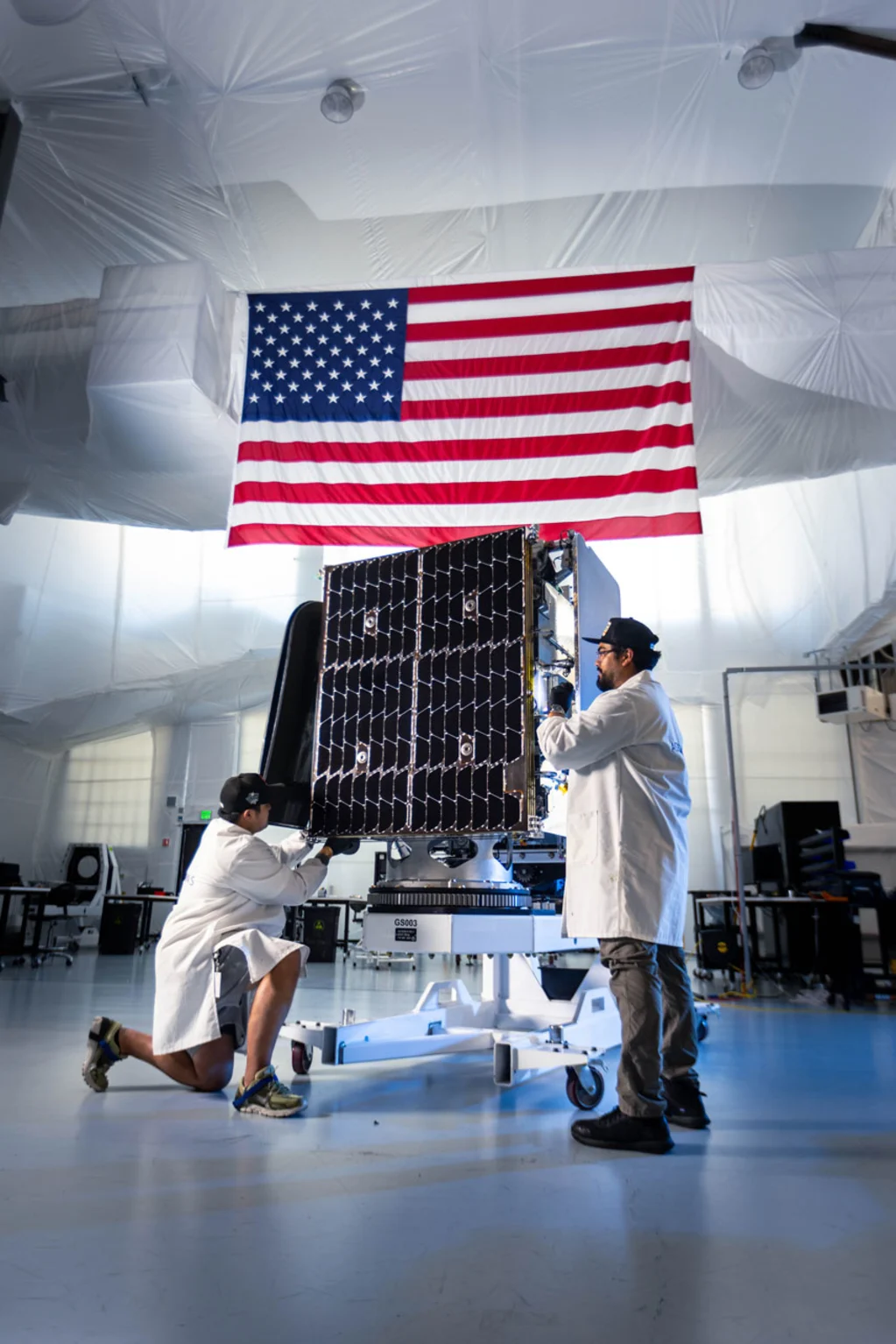
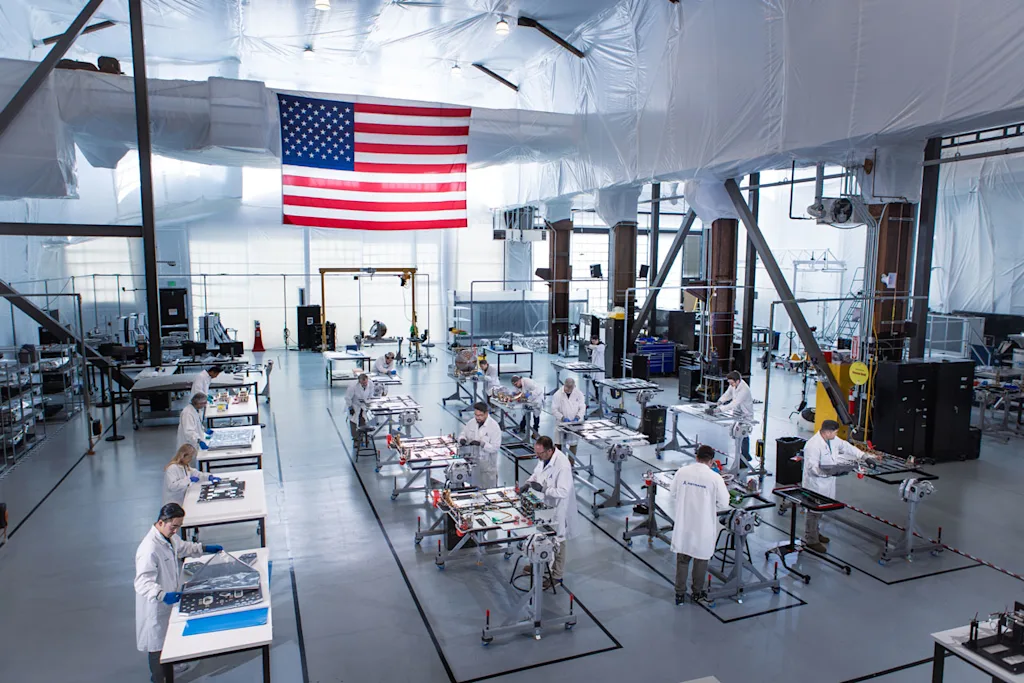
And then there’s Astranis. The company is returning Pier 70 to its roots by applying human labor to turn raw materials into finished products. The products in question happen to be high-orbit satellites. Astranis has sent five of them into space, is currently building five more, and intends to scale up its capacity to manufacture 24 at a time.
Now, by the standards of consumer electronics, cranking out 24 of something may not sound like a feat. For satellites, however, it’s ”a completely unprecedented number for geostationary and high orbits, where these satellites have historically been built one at a time,” says Astranis cofounder and CEO John Gedmark.
Astranis’s breakthrough isn’t just about speed of production. Its MicroGEO satellites are remarkably compact—about the size of a commercial washing machine, downsized from typical school bus-sized units. They are designed to be affordable, in an industry where cost overruns in the billions have been common. Rather than relying on analog technology, they use software-defined radios, which make customization and updates far more practical.
So far, Astranis’s quest has taken a decade and $800 million in funding from investors such as Andreessen Horowitz, BlackRock, and Fidelity. Signs that the company is on its way to success include its announcement in early August that two satellites it had launched for Anuvu—a provider of mobile Wi-Fi whose customers include Southwest Airlines—had reached orbit and were operating as intended. Later in the month, it said that it had been named as a prime contractor for the U.S. Space Force program, with an initial six-month contract to design and test a jam-resistant military satellite.
If Astranis is still in the process of proving the worth of its unique approach to satellites, it’s in part because what it’s trying to do is so complex that nobody has attempted it before. “We had to go get a few hundred of the world’s best hardware engineers and put them all in one building, and have them working for years at a time, like a Manhattan Project, to get to this point,” says Gedmark. “To us, it’s not surprising that it hasn’t happened already, because it just turns out it’s really hard.”
Space’s next frontiers
Astranis’s current momentum is the culmination of Gedmark’s entire career in space technology. The son of a doctor and a hospital chaplain, he was born and raised in Kentucky. After earning degrees in aerospace engineering from Purdue and Stanford, he found work at big aerospace and defense contractors but was frustrated by the industry’s plodding pace. He then became director of rocket flight operations for the X Prize Foundation, which led to him cofounding and running a nonprofit trade group called the Commercial Space Federation (CSF).
These jobs exposed him to the progress being made by new-wave space startups such as SpaceX and Virgin Galactic. “I got to see the birth of this new industry,” he remembers.
During the first Obama administration, as the U.S. plotted a post-Space Shuttle future, Gedmark‘s role at the CSF allowed him to be part of the conversation. The ultimate decision was to rely on private companies to perform tasks such as delivering crew and cargo to the International Space Station, greatly accelerating the commercial space industry.
Though Gedmark found this boom inspiring, he also identified a hole in it. “All the new activity and hype and excitement were in low earth orbit,” he says. “And nobody was doing things in these high orbits, like geostationary orbit [GEO]. And the crazy thing was that those orbits are actually incredibly important, and are historically where most of the value has been created in space.”
Like the International Space Station, most satellites are in low earth orbit, no more than 1,200 miles away. Geostationary orbit is 22,236 miles from us. Rockets can’t get a satellite all the way there; the final leg of the journey requires onboard propulsion. But Gedmark and Astranis cofounder and CTO Ryan McLinko realized that even a small satellite in GEO could “cover an entire medium-sized country with broadband connectivity,” Gedmark explains.
That fact—and the potential for a startup to move more quickly than the satellite industry’s giants—led them to start Astranis. In 2016, the company participated in Y Combinator’s accelerator program, years before they became Pier 70 neighbors. And a little over two years after its founding, it notched its first achievement by launching a 10-cm-square satellite, dubbed DemoSat 2, into orbit to help test its software-defined radio technology. “We decided when we were just a handful of people basically working out of an apartment that we wanted to put something in space and show we could do it quickly and show that it worked,” says Gedmark.
Since then, Astranis has continued to chip away at its vision for transforming communications, though not without blips along the way. For example, the company didn’t meet its original goal of launching its first satellite in 2019. After further pandemic-related delays, its Arcturus satellite took off on SpaceX’s Falcon Heavy launch vehicle in April 2023. Problems with a component provided by a third-party supplier ultimately prevented Arcturus from fulfilling its original mission of providing internet access for an Alaska-based telecom company. “Space is hard,” noted Gedmark in a blog post about the mishap.
Astranis VP Christian Keil joined the company in 2019, when it had 50 employees. Praising Gedmark as “super analytical” and “very, very detail oriented,” he says that space is particularly hard when your approach involves so many disruptive elements.
“We’ve learned so much from doing all these things for the first time that if you transported any one of us back seven years, we’d be able to avoid some of the mistakes that we made along the way,” he acknowledges. “But that’s part of doing something new.”
Made in San Francisco
Almost eight years after its DemoSat 2 launch, Astranis has grown from a handful of people to 500 staffers. At first blush, it might be startling that the vast majority of them are in San Francisco. After all, the U.S. manufacturing renaissance, such as it is, has gravitated toward parts of the country where labor costs are lower. For instance, a few years ago, when Intel announced plans to dramatically ramp up its domestic chip production capacity, they involved expansion in Arizona and Ohio, both far afield of its Santa Clara, California headquarters.
But Gedmark, who relocated to the Bay Area in 2012, says that everything about what Astranis was trying to accomplish told him it should be in San Francisco, from getting access to capital to hiring people who might otherwise be working at companies such as Broadcom or Qualcomm. “The Bay Area has those talent pools across all those different specialties in one place, I think, quite uniquely,” he says. “And then there’s something in the air of this place, knowing that you can go start some crazy new idea and people will jump in quickly and work on it.”
The property the company ended up leasing at Pier 70 retains evocative evidence of its shipbuilding legacy. For instance, a vintage crane marked “30 TONS” still hovers majestically from the ceiling. But the place also has more recent ties to the San Francisco innovation economy—and maybe some reminders that not every hyper-ambitious attempt to change the world from San Francisco leads anywhere.
That’s because most of it was originally rehabbed for Uber ATG, the ride-hailing company’s gambit to develop its own self-driving vehicles. The handsome renovation brought the long-decaying space up to modern earthquake safety code and even won architectural awards. Soon thereafter, however, Uber gave up on building its own robotaxis. It ended up offloading ATG to the autonomous trucking company Aurora, providing Astranis with the opportunity to snag itself a freshly remodeled headquarters.
When the company expanded into an adjoining building, it found mysterious blueprints of giant orbs lying around. Only later did it learn that the previous occupant was a display technology startup that had been acquired by Madison Square Garden when it was creating Las Vegas’s Sphere.
Astranis needs as much space as it does because it’s taking on full responsibility for its satellites, from crafting components and developing software to owning and operating the fleet. As Steve Jobs might have put it, the company is building the whole widget—not standard practice in the space business, where subcontracting and outsourcing are typical, and the companies that build satellites usually don’t manage them once they’re in orbit.
Consequently, a portion of the company’s San Francisco headquarters is devoted to a 24/7 mission control center. Gedmark describes the company’s MicroGEO satellites as “pretty autonomous” and the atmosphere in mission control as “pretty chill,” though human oversight is crucial during launches and early deployment. It’s also occasionally necessary to fire thrusters to keep a satellite in its appointed orbital slot.

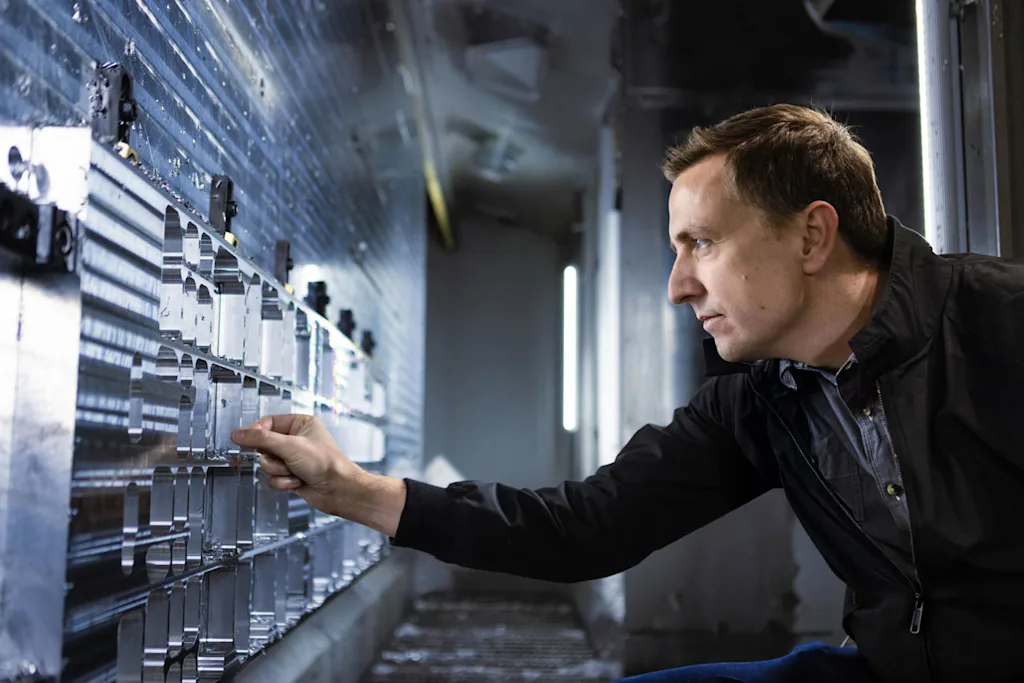
As for the manufacturing process, Gedmark says that one of the big lessons has been how hard it is to move fast when you’re dependent on others. “We’ve had to do a lot more in-house than we thought we were going to need to,” he told me. “Lead times are a lot longer than we thought they would be.” And so, during my two visits to Astranis’s headquarters, the big news was the arrival of an enormous piece of machining equipment known as the Makino Mag3.EX.
A lightly used second-hand model—Gedmark thinks it was formerly used in the production of F-35 fighter jets—Astranis’s Mag3.EX allows the company to make its own parts out of blocks of aluminum alloy. The process is responsible for the oily whiff of coolant in the air and produces detritus in the form of humongous quantities of tiny aluminum shards. They sit by the vatful near the Mag3.EX, awaiting recycling.
Before Astranis was able to crank out aluminum components on the premises, it contracted out to get ones made using honeycomb sandwich construction, a common technique in satellite manufacturing. Such parts are lightweight and sturdy. But you might have to wait a year for your order to be filled. Aluminum is a tad heavier, but Gedmark says that the trade-off is eminently worth it.
Astranis everywhere
Watching Astranis at work, it’s clear that the company has come a long way since it was an untested big idea. The company’s original mission—cutting satellites down to size to bring affordable connectivity to underserved parts of the world—remains critical, and the company’s customer list is truly international, reflecting the U.S.’s dominance of the commercial space industry. “When [other countries] need something like this, they have to come to us,” says Gedmark.
After I’d toured the factory, Gedmark told me that one of the satellites I’d seen in the process of being manufactured was for a customer in Thailand. Another was headed for the Philippines. Two more were for a Mexican internet service provider (ISP) that wants to provide 5 million people with broadband they can afford. Still another satellite currently in production was ordered by Taiwan’s largest telecommunications company. It will be the country’s first dedicated satellite.
Taiwan also factors into a market that has emerged more recently for Astranis’s satellites: defense applications. That’s because of the long-feared possibility of the country being invaded by China, which Gedmark says he believes could become a reality in two to three years. The U.S.’s dependence on relatively few satellites could lead to war in space, with China seeking to hobble any attempts to come to Taiwan’s rescue.
“In a conflict with China over Taiwan, one of the first things that will happen— literally on day one—is that a bunch of our most important military satellites will just blink out,” says Gedmark. “And by the way, we won’t necessarily know exactly who did it.” The impact would instantly overflow into civilian life, which is dependent on services such as GPS for everything from wireless phone calls to air traffic control.
Already, Gedmark says, China has invested in a bevy of anti-satellite technologies, from lasers to satellites equipped with robot arms that would allow them to grab other satellites. It’s a terrifying prospect, but one that a swarm of MicroGEO satellites might be able to help forestall, he argues. “The hope is that it’s a deterrent, if you have enough of these satellites up that the Chinese are just like, “Oh, okay, we can’t shoot all of them down. It’s just too many.’ Then hopefully they decide not to go after this tempting target.’”
Astranis fortifying the U.S.’s ability to defend itself in such a scenario is dependent on the company realizing its targets for satellite production and deployment. But developments such as the company being named as a prime contractor suggest it could have a future in military technology, an industry long dominated by a few slow-moving behemoths. Last year, it was also one of four companies that won Space Force contracts to work on design concepts for Resilient GPS, a version of the technology less susceptible to attack.
According to Gedmark, the Pentagon is continuing to dial back the bureaucracy that has stood in the way of it acquiring technology from smaller companies, mirroring the changes at NASA that made the commercial space business possible. “It’s very exciting to see the Department of Defense, or the Department of War, come around,” he says, calling the organization by both its post-WWII name and the Trump administration’s bellicose rebrand. “It’s the exact same playbook.”
Could a relatively small company such as Astranis play a meaningful role in maintaining the U.S.’s preeminence over China, this century’s other space superpower? Gedmark thinks so. And he contends that the entrepreneurial model that made his startup possible in the first place still beats Chinese central planning.
”This is a uniquely American thing,” he says. “This is our edge. It’s our ability to get the capital together, get the people together, and go build a new thing that previously just did not exist.” Maybe the fact that Astranis built its factory in San Francisco—the epicenter of that go-for-it spirit—isn’t such a shocker after all.