
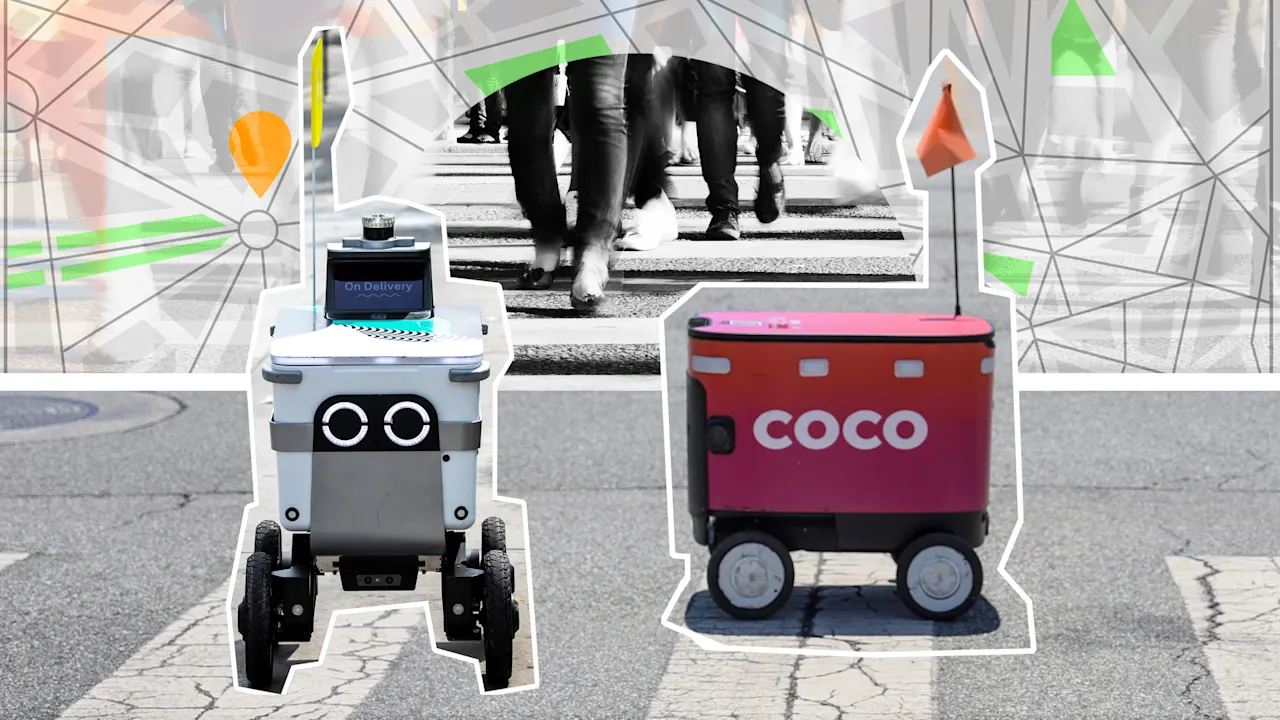
It’s easy to be charmed by the first delivery robot you see. I was driving with my kids in our Chicago neighborhood when I spotted one out the window last year. It was a cheerful pink color, with an orange flag fluttering at about eye level and four black-and-white wheels. It looked almost like an overgrown toy.
When I told the kids that it was labeled “Coco,” they started waving and giggling as it crossed the street. Over the months that followed, spotting Cocos rolling down the sidewalk became one of our favorite games.
Then, last fall, another type of delivery robot appeared. This one was green and white, with hardier all-terrain wheels and slow-blinking LED eyes. My kids and I tried to read the name printed on its side as it idled across the street: Peggy? Polly?
I later learned that the green newcomer was a Coco competitor made by a company called Serve Robotics. Every Serve robot is christened with its own individual moniker.
At first, my interactions with the robots were mostly polite. One slowed to a stop while my dog cocked his head and sniffed curiously. Another waited patiently while we crossed Lincoln Avenue on our daily walk home from school, giving my stroller right of way on the ramp at the curb.
In principle, they seemed like an improvement over double-parked delivery drivers and careening e-bikes.
But some of my neighbors were having more negative experiences.
Josh Robertson, who lives around the corner from me with his wife and two young children, was unnerved enough by a standoff with a robot that he decided to start a petition: “No Sidewalk Bots.” Thus far, more than 3,300 people have signed, with nearly one-third of those submitting an incident report.
Through the incident field, Robertson has heard about feet being run over—a Serve robot weighs 220 pounds and can carry 15 gallons—near-collisions, unwelcome noise, blocked entryways, and more. In one case, a man required stitches around his eye after stumbling into a robot’s visibility flag.
“Sidewalks are for people,” Robertson says. “Vehicles, in general, should be in the streets.”
Robertson’s petition, the first so far in the cities where Coco and Serve operate, has revealed a groundswell of frustration over the strategically cute autonomous vehicles.
In conversations with the CEOs of Coco and Serve, I got a close-up look at the arguments in favor of delivery robots, which the companies say are better suited to short-distance deliveries than 2-ton cars. If they have their way, what’s happening where I live will soon be playing out across dozens of cities as these well-capitalized startups seek to deploy thousands of their sidewalk bots.
But in a matter of months, my neighborhood’s robots have arguably gone from novelty to nuisance. Silicon Valley startups are good at launching bright ideas, but bad at estimating their collateral damage.
Are our sidewalks destined to be their next victim?
From cute to concern
In early December, around the same time the petition started to get local media coverage and gain momentum, I found myself sympathizing for the first time with the petitioners’ point of view.
I was running an errand on a sidewalk that was crusted on one side with a thick layer of dirty snow when I noticed a Serve robot named Shima inching forward in my direction. It stopped as I approached, per Serve’s protocols. But in order to pass it by without stepping onto the snow, I had to navigate an inches-wide lane of space. If I had been pushing a wagon or a stroller, I wouldn’t have fit.
The tree-lined sidewalks in my neighborhood are among the reasons I love living here. Outside my front door, near DePaul University, there is a constant stream of activity: bedraggled undergrads, eager dogs, bundled babies, dedicated runners. Within a 10-minute walking radius, I can find coffee, ice cream, playgrounds, vintage shopping, two Michelin-starred restaurants, my doctor, and my dentist.
I began to worry that delivery robots would change Lincoln Park’s sidewalks for the worse.
Why delivery robots are suddenly everywhere
In the U.S., startups have been experimenting with delivery robots for close to a decade. Perhaps not surprisingly, some of the first were deployed in San Francisco. By 2017, the Bay Area city had become a hotbed for robot innovation—and residents’ frustration. In December of that year, city lawmakers passed an unusually restrictive policy limiting companies to deploying just three robots and requiring that a human chaperone accompany them.
But the idea of sidewalk-based robots remained attractive to both entrepreneurs and delivery companies. Zach Rash and Brad Squicciarini founded Coco in 2020; as UCLA undergrads, they had built research robots to assess transportation and accessibility issues on campus. The following year, Uber spun Serve Robotics out of Postmates (which it had acquired for $2.65 billion to bolster its Uber Eats business), installing Ali Kashani, who had led Postmates X, as CEO.
The delivery economy is booming, with three in four restaurant orders now eaten outside of the restaurant itself. For eateries and the platforms that enable their deliveries, robots offer a way around the labor costs and unpredictability associated with drivers. In an investor presentation from last year, Serve projected that its cost of delivery, with increased scale and autonomy, could be just $1 per trip.
Mass adoption of delivery robots is now possible because of recent technology advancements, says Rash, Coco’s CEO, as he ticks off the list. “We have Nvidia compute on the vehicles that’s designed for robotics. Battery capacity has gotten a lot better, so you can drive multiple days without needing to recharge. Then, we have really robust supply chains around wheels, motors, motor controllers—a lot of the basic stuff you need to drive these things.”
Put it all together, and Coco aims to operate a global fleet of 10,000-plus vehicles in select U.S. cities and overseas locations like Helsinki. “We’re delivering hot food, so [the robot] has to be able to get from point A to point B incredibly reliably every single time while maintaining a really low cost,” Rash says.
Though Coco, like Serve, is only as wide as the shoulder width of an average adult, it can tote four grocery bags or even eight large pizzas. “It can fit all the types of things people need delivered,” says Rash, “but it’s incredibly compact, it’s safe, it’s energy efficient, and I think it’s the best way to shuttle stuff around our cities.”
For now, that stuff consists almost entirely of restaurant deliveries. Both Coco and Serve have partnerships with Uber Eats and DoorDash.
But the vision for the two startups extends far beyond burgers and burritos. “Someday our kids are going to look back and think how weird it was that a person had to be attached to every package that comes to our front door every day,” says Serve’s Kashani, who believes delivery robots’ true transformative potential lies in last-mile delivery.
“I ordered a pair of climbing shoes for my daughter, and it was the wrong size,” he says. “It took two days to come, and then I had to deal with the reverse logistics of shipping it back and waiting for the next pair. Well, instead of ordering from Amazon, I could have ordered from a local store. [A delivery robot] could have shown up with two, three sizes. The robot could have waited while we tried the shoes and taken back the ones that didn’t fit. So you have all these new types of things that people can do that weren’t possible before because last-mile was just too inefficient and expensive.”
Serve started 2025 with roughly 100 robots. By December, it had built 2,000. “That’s a point where it makes sense for the Walmarts of the world to want to integrate because now there’s a fleet they can access,” Kashani says, noting that Serve’s robots can accommodate more than 80% of Walmart’s SKUs.
How Coco and Serve approach safety
Coco and Serve, along with competitors like Starship (which raised a $50 million Series C last October and announced at the time it planned to have 12,000 robots by 2027), are all, in a sense, bets on autonomy.
Behind the scenes, human operators are training the robots and stepping in to resolve problems. But the success of the model ultimately hinges on how well the vehicles learn to navigate neighborhoods on their own.
Robot companies often point out that unlike self-driving cars, bots can usually just hit the brakes to de-escalate an encounter or avoid a collision.
“It’s usually appropriate to stop, right? A car can’t just stop; you might cause an accident,” says Rash, acknowledging, though, that the sidewalk is a “much less structured environment” with “a lot more chaos.”
“If my robot stops in the middle of a sidewalk, nothing bad happens,” echoes Kashani, adding that Serve robots have thousands of times less kinetic energy than a car. “That also gives us some affordances. Because we are moving more slowly, we have more time to think. So we don’t need as expensive of sensors, for example, or as many computers to achieve the same thing [as a self-driving car].”
But despite those advantages, combined with years of training data, robots are still making mistakes. Social media abounds with robot bloopers—and worse. In one recent example, a high-speed passenger train in Miami mowed down a delivery robot stopped at a crossing on the tracks. Stopping, in that case, was fatal to the robot.
In my own experience, one of the challenges pedestrians encounter with robots is simply their unpredictability. Coco’s robots tend to drive more smoothly, perhaps a result of the startup’s choice to have human pilots more involved.
“Coco has been operating in Chicago for over a year with strong community support and without any major incidents or safety concerns,” Rash says. “Safety and community partnership are our top priorities.”
Serve’s robots, in contrast, are more reliant on lidar and AI; their stilted driving often reminds me of the remote-controlled toy car my son used to drive as a toddler.
A Serve spokesperson tells Fast Company: “We are working closely with city officials and local stakeholders to ensure responsible deployments, and we are committed to being a positive, safe, and respectful presence in the communities we serve.”
Knowing that the robot is designed to cede to pedestrians is little comfort when it’s jerking back and forth right in front of you.
What’s next for Chicago
Robot deployment in Chicago is still, technically, part of a pilot program. Two city agencies, the Chicago Department of Business Affairs and Consumer Protection and the Chicago Department of Transportation, are jointly involved in licensing and assessment. If the City Council doesn’t renew the pilot, Coco and Serve’s licenses will expire in spring 2027. This week, one city alderman began soliciting feedback from his constituents as Coco and Serve seek to expand into other Chicago neighborhoods.
Robertson, who created the anti-bots petition, is calling for an immediate halt to the program. The delivery robots’ promised benefits are appealing, he acknowledges, from reduced emissions to lower congestion. “But I think we should be skeptical [of those claims] and make sure we’re taking a data-driven approach,” he says. “What if robot trips replace bike trips instead of car trips? Or what if opening our sidewalks to these little vehicles leaves the total number of trips in the street unchanged? We need data. Then Chicagoans will be able to decide for ourselves if that’s how we want to tackle emissions and street congestion.”
Robertson also raises the problem of enshittification, a term coined by author and journalist Cory Doctorow in 2022 to describe the perhaps inevitable degradation of online platforms over time as they seek to wring greater profits from their users. “Eventually, these robot companies, even if they do save consumers a buck or two right now on delivery fees, they’ve got to make a return for their investors, people like Sam Altman,” he says. (OpenAI cofounder and CEO Altman has invested in multiple rounds of Coco’s funding; last spring, OpenAI and Coco announced a partnership that will make use of Coco’s real-world data.)
Already, ads supplement Serve’s revenue, turning some robots into rolling billboards and inserting the commercial into the public way.
Last month in Chicago was bitterly cold and snowy, the kind of weather that drains robot batteries and presents obstacles to even all-terrain robot wheels. After growing accustomed to seeing Coco and Serve on a daily basis, I found myself wondering whether they were even attempting to brave the frigid January sidewalks.
But I can’t say that I missed them.