
There are many, many maps of New York City. There are the decor maps, sold on Amazon, and the tourist maps, which mostly focus, erroneously, only on Manhattan. There’s the iconic subway map, as well as the MTA’s new version. There’s the Eater and Grubhub maps, which tell us where to eat.
And then there’s the map that really matters: the official legal map for the city, which quite literally rules the streets of the city, complete with boundaries and widths. It’s also the map that doesn’t currently exist, at least in one singular and easy-to-use form.
That’s changing, though. On Tuesday night, New Yorkers appeared poised to approve Proposal 5, a measure that will push the city to create a unified official map representing its five boroughs for the first time. The effort should help officials finally catch up with unification efforts, which began more than a century ago in 1898, when areas throughout modern-day Queens, Brooklyn, Staten Island, Manhattan, and the Bronx were combined to form one city government.
While the city has streamlined most operations, New York’s maps were never synthesized into one document, scattering authority over these official charts across the city and resulting in thousands of paper topographical documents. Today, the diffuse nature of these official maps slows down housing construction, adding another hurdle to solving the city’s extreme housing crisis, advocates argue.
The passage of the proposition means that these paper maps will finally be distilled into a single visualization and eventually digitized. The goal is to speed up any city process that typically requires verification with an official city map or updating a city map to mark a change to street geography.
The creation of a unified city map should also help officials more accurately represent the city’s waterfront, particularly as climate change alters the coastline. Plus, it should help eradicate the problem of “paper streets”– streets that are still recorded on official paper maps, but no longer exist in real life.
Fast Company chatted with Casey Berkovitz, who is on staff at the Charter Revision Commission, which was charged with considering New York’s official city charter and putting forth ballot initiatives, including the now-passed map proposal. Earlier this year, the group found that changes to the current map were, in their words, “overdue.”
This interview was edited for clarity and length.
Rebecca Heilweil: Can you explain what people voted for?
Casey Berkovitz: Today in New York City, we have a very archaic system in which the official city map is spread out across five separate borough offices. On paper we think it’s about 8,000 paper maps across the five boroughs. This is really an artifact of a time before, not just digitization, but also borough consolidation. The five boroughs became one city in 1898, but the borough presidents maintained jurisdiction over things like street maintenance through the middle of the 20th century.
The city just never updated to consolidate its official city map into one unified map. Certainly as digitization and the internet have become more widespread in recent decades, the city never moved to modernize, either. This measure would do both.
Rebecca Heilweil: Growing up here, I was familiar with all sorts of New York City maps. There’s the lot numbers maps, there areConEdison maps, and there’s school zone maps. Will all of those kinds of functions that the city provides, and which are mapped spatially, end up on this map? Will it show everything related to municipal activity?
Casey Berkovitz: When we talk about the official city map, we refer to a pretty specific function, which is the map of things like street borders, street widths, property lines, in some cases, waterfront borders, which hasve to do with construction and infrastructure.
There are other maps like you mentioned. There are school district maps and city council districts and community districts all on down the line that are obviously important and frequently interact with the official city map, but that are their own distinct maps and that wouldn’t be affected by this proposal.
Rebecca Heilweil: Can you talk a little bit about the digital aspect of it? What is that going to look like when people hear “digital map”? They might think Google Maps.
Casey Berkovitz: We actually already have the vast majority of what a digital city map would look like online, but doesn’t have any binding authority because it is not the official city map laid out in the city charter [Editor’s note: This unofficial map is available here].
In terms of what it would mean for New Yorkers today, if you want to build housing infrastructure, or any number of things, many of those functions require either confirming on the city map or updating the city map. These are things like property lines or the width of a street or the grade of a street that have impacts on what you can build.
Those functions can take months or years because they require going to each individual borough map office, finding the right paper map, confirming what it looks like, and changing what it looks like. That’s a long process. There are frequently long queues at those borough offices to do those sorts of things. That adds, again, months or years to the process of building important infrastructure and housing.
Not all of those functions would become instantaneous with the digital map, but they would be significantly faster than the process today of finding the individual paper fragment of a map and updating or confirming the information that’s on it.
Rebecca Heilweil: How long is switching to a unified map system going to take?
Casey Berkovitz: Taking that many paper maps […] unifying it, confirming the information, will take time as well from five borough offices to one central office. Granting it the official status as a city map will require essentially a zoning action to grant it that official status. That’s another benchmark in the timeline moving forward over the next couple of years.
Rebecca Heilweil: What are some of the design considerations or, I don’t want to say aesthetics, but things that in terms of what this map should actually look like that you’re thinking about? There are so many different types of maps and so many different ways of representing things.
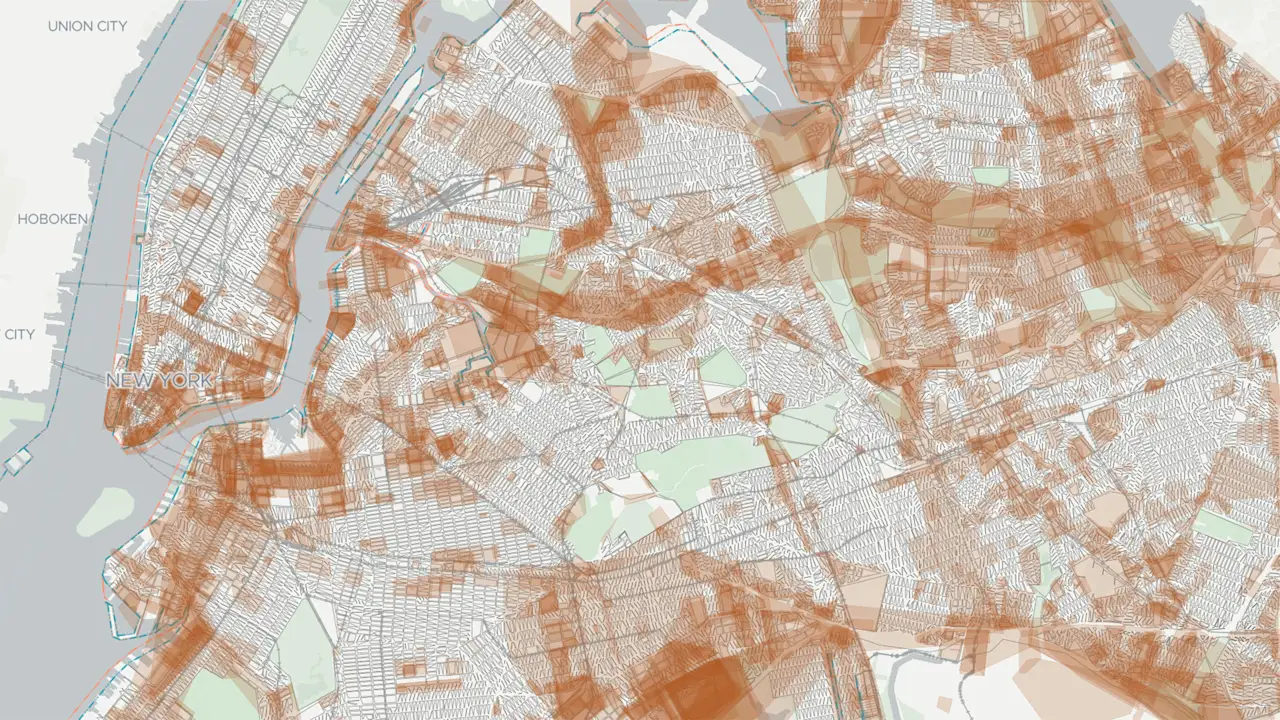
Casey Berkovitz: The important thing here is that street and property lines are clear, that street widths are clear, and that changes over time are visible. In the preview map today, we have overlays of where there have been changes to the city map over time so that New Yorkers who are interested can see where streets have been remapped or de-mapped over time.
Rebecca Heilweil: Can you talk a little bit about what you anticipate the biggest challenge being, moving forward?
Casey Berkovitz: It is a lot of paper maps to unify and to make sense of. They are amazing historic documents and certainly, we’ll want to take good care of them and preserve them, even if they’re no longer the official binding government document. Balancing care for the physical maps with efficiency of unifying them and digitizing them is going to be relatively important. It’s going to take a dedicated effort from city staff.
Rebecca Heilweil: What should I have asked you that I didn’t about New York’s upcoming digital map?
Casey Berkovitz: This is pretty in the weeds, but it may be interesting to people who are interested in maps is that New York City actually has a number of what are called paper streets that are streets that exist on the city map today, but are not real streets in real life.
A number of the construction or zoning actions that would be sped up by the unified and digitized map related to, if you either want to get rid of a paper street in order to do construction there or if you want to otherwise change the street kid.
The other thing that is maybe a little more broadly applicable is how the map modernization intersects with the climate crisis.
New York City has 520 miles of waterfront, along the bay and then along the rivers. Particularly as the climate has changed, waterfront borders have changed […] This proposal might make a big difference … either in development or resiliency efforts, where the paper maps when they were created genuinely do not reflect where the actual waterfront border is today.