

Route 66. The name alone evokes nostalgia for a simpler, freer time in American history, when roadies stopped for a hot dog with ketchup, then drove into ocher sunsets suspended over the Mojave desert.
Ever since it was built in 1926, the “Mother Road” has gained mythical status, drawing millions of visitors from around the world yearning for a taste of old America—the one before the interstate highway system favored speed over experience.
For Rhys Martin, who has spent years on the road with his camera, this isn’t what Route 66 is about. Yes, you can travel back in time and get a glimpse of Americana, but the route isn’t fossilized in the past. It’s very much still breathing.
“Route 66 is more than just this 1950s sanitized version of American history,” he says. “It’s diverse, it’s evolving, and I like to say that no matter who you are or where you’re from, somewhere on Route 66, you’ll find your reflection.”
Martin, who manages the Preserve Route 66 program at the National Trust for Historic Preservation, is part of a group of advocates and preservationists who want to change the narrative around Route 66 from one that paints the road as a mirror into the past to one that reflects the present, where many communities still live and people still work.
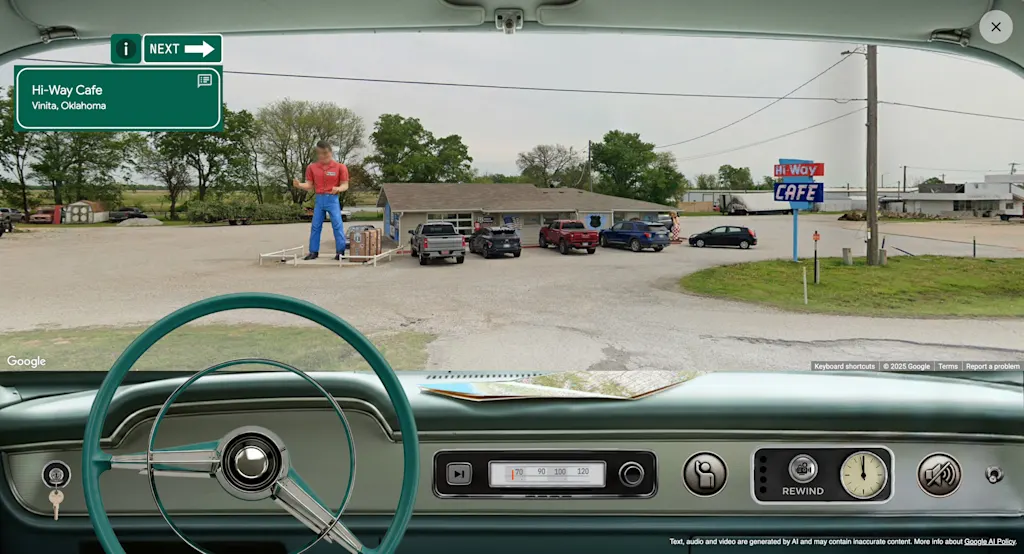
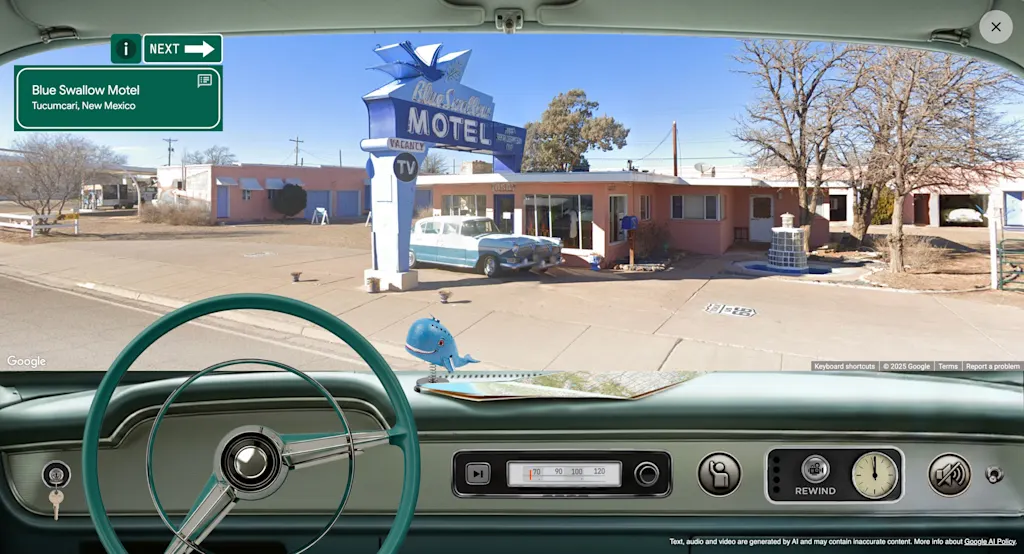
His team’s mission has now culminated in Route 66 Rewind: a browser-based experience that lets users drive across 33 landmarks along the route from their own (virtual) vintage car or motorcycle. You can steer the wheel, pick a radio station, and see how the Midpoint Cafe or the U-Drop Inn looked in previous decades.
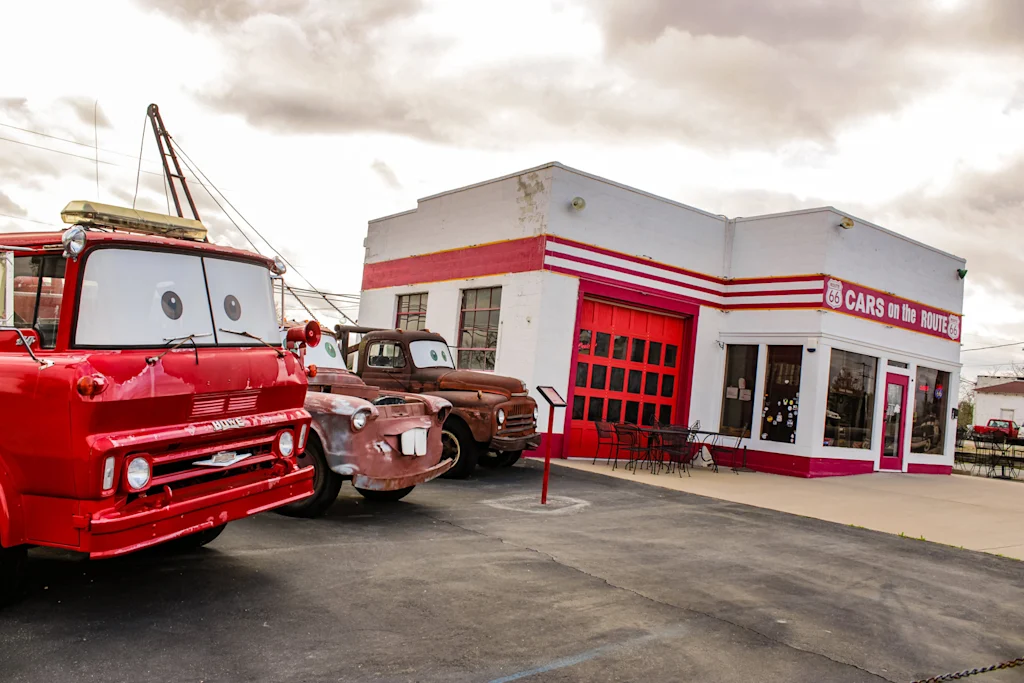
The experience was codeveloped by Google Arts & Culture with the National Trust for Historic Preservation, and is part of a larger storytelling hub that lives on the Google Arts & Culture platform. The team turned archival photographs into videos using Google’s AI video generator Veo, composed the radio music using music generation model Lyria, and wrote the radio commentary using Gemini. The result is a sim road trip that uses AI in the best possible way: to direct the narrative back to people, and highlight the human experience that continues to shape the route today.
Route 66: A “corridor of stories”
Martin first saw the road through the lens of a camera. Growing up in Tulsa, Oklahoma, he’d heard of Route 66, but he knew only the broad strokes. Then one day in 2013, he hopped into his late father’s Mustang and drove to Miami, Oklahoma, to photograph the Coleman Theatre—a 1929 vaudeville theater with a facade “so ornate it had no business being in the town of Miami,” he recalls. The surprising discovery had him wondering: What else was on the highway?
Martin’s curiosity led him on a two-year road trip across Route 66 that grew into a decade-long love affair with the people he met along the way. “Eventually I realized it’s a corridor of stories,” he says.
One of the biggest misconceptions about Route 66 is that the destinations along its route have faded into ghost towns. The construction of the interstate highway system in the ’50s and ’60s, followed by the decommissioning of the route in 1985, no doubt stripped many of these towns of their purpose. As travel evolved and car speeds got faster, the need for frequent gas stations and motels diminished. The government divested. People left towns.
But not everyone left. In Tulsa, entrepreneurs like Mary Beth Babcock have spent years revitalizing stretches of the road. In 2019, she transformed the historic Pemco gas station into a souvenir shop called Buck Atom’s Cosmic Curios, complete with two very on-brand, 20-foot-tall mascots that double as roadside attractions.
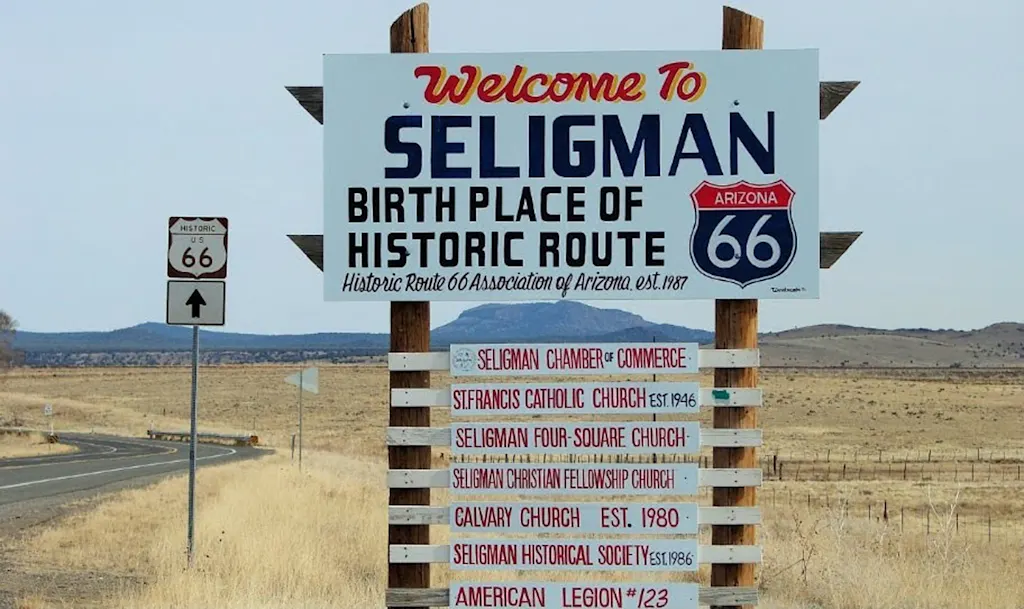
That same year, Dutch entrepreneur Sebastiaan de Boorder and his wife, Anna Marie Gonzalez, renovated the 1919 Aztec Motel in Seligman, Arizona, which reopened as the Aztec Motel & Creative Space in 2021. “There is so much development still coming to Route 66, and most of it is mom and pops who’ve always dreamed of having a business on Route 66,” Martin says.
Today, the American dream that once defined Route 66 looks different. Some might say it doesn’t exist at all. But for Martin, it lives on along the Mother Road.
“I agree that the American dream doesn’t quite hit like it used to,” he tells me, “but on Route 66, you still find people who have bought into the cliché that Route 66 means freedom, and they are adding their story to this highway that’s now entering its second century.”
AI fills “the gaps of archival memory”
Route 66 is now approaching its centennial. Next year, various destinations along the route will burst into caravans and car parades to celebrate the route’s legacy. But for the team behind Route 66 Rewind, the goal isn’t just to celebrate the past but to galvanize the next generation.
“Preservation creates,” says Martin, noting that anytime a building is preserved, it activates the connection people had with it while helping young people engage with the conversation. “That’s how you inspire the next generation to add their story to this long history.”
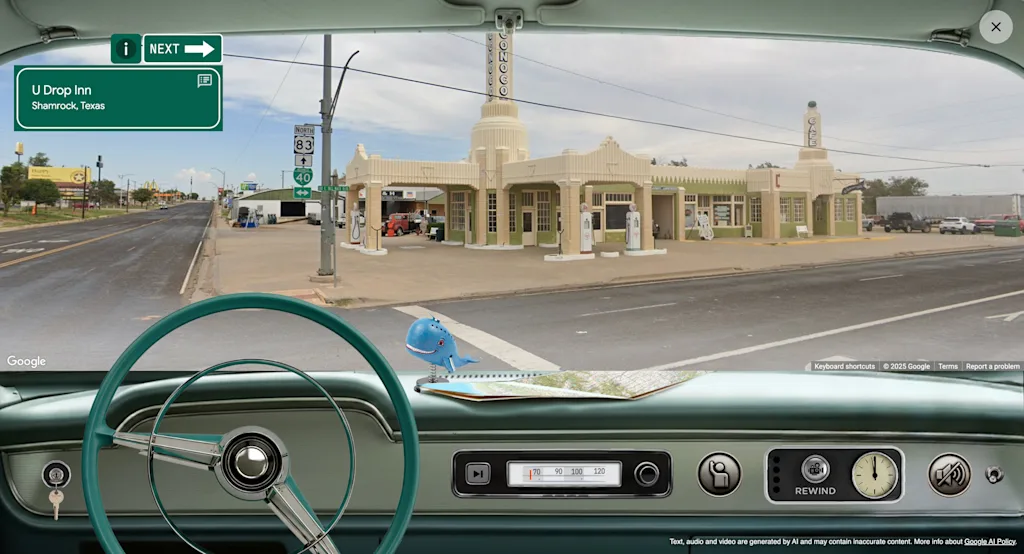
With its AI-powered features and fun UX, Route 66 Rewind presented itself as a way to make history exciting for younger people. But when the team sat down to convey said history, they realized they didn’t know how many of these places looked in their heyday, beyond a few archival photographs. AI became a way to fill in what Amit Sood, the founder and director of Google Arts & Culture, calls “the gaps of archival memory.”
The Google team worked with the National Trust team to collect black-and-white photos and written accounts they could use to prompt AI, cross-referencing each output with experts at the Trust.
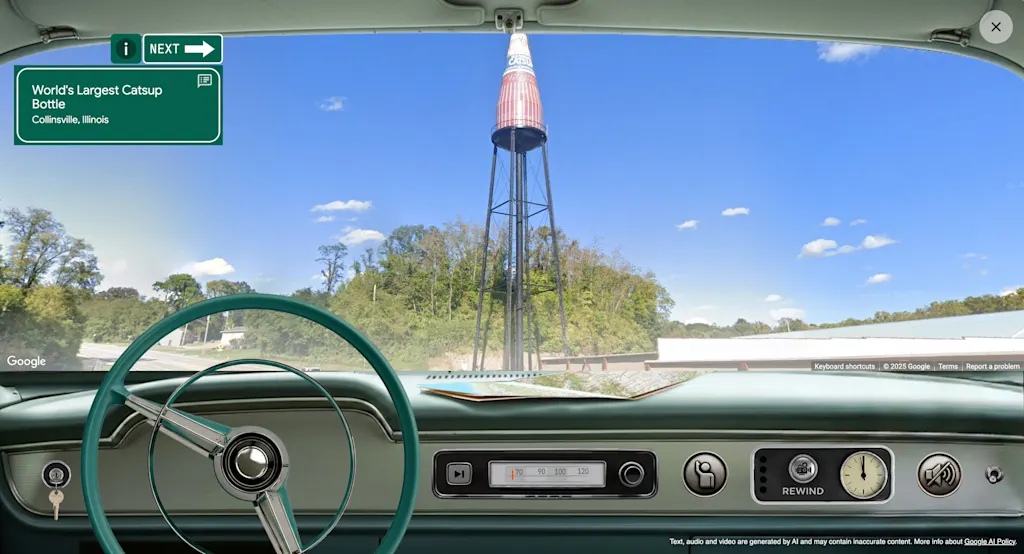
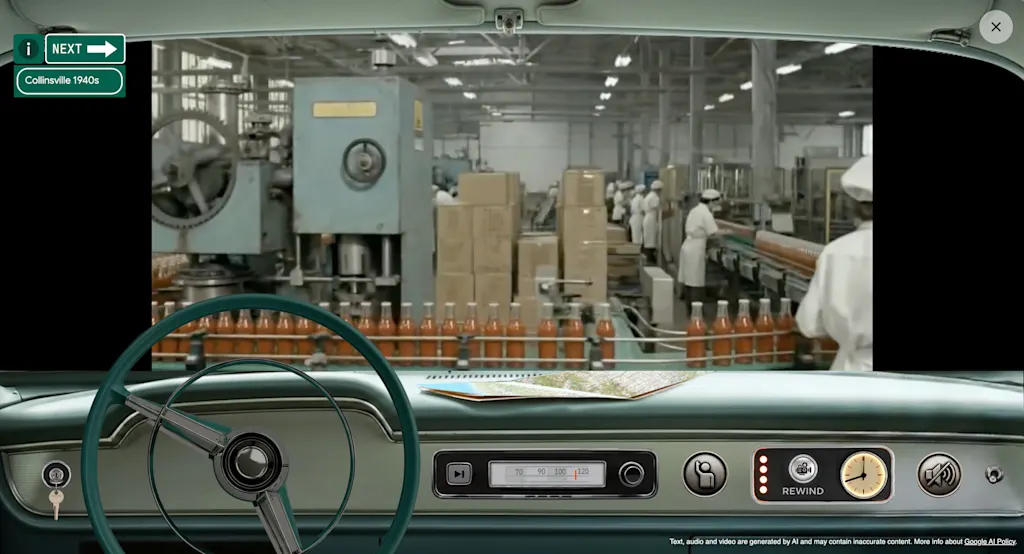
The resulting videos act as miniature time capsules of a bygone era. In Collinsville, Illinois, you can follow ketchup bottles stream past on a conveyor belt inside the now-defunct Brooks Foods ketchup factory. In Lebanon, Missouri, you can peek inside the now-closed Munger Moss Motel, its iconic neon sign flickering under a 1960s sun.
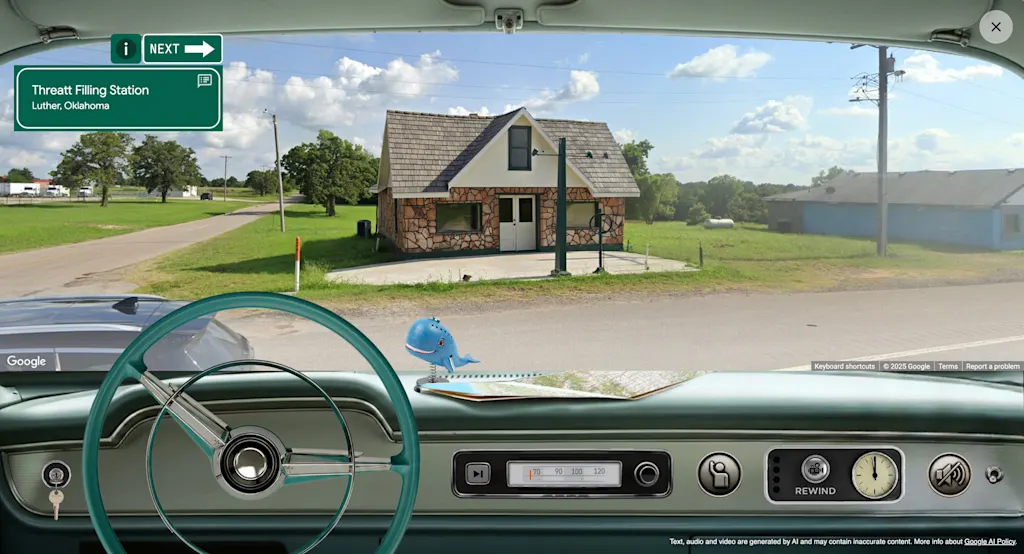
But as Sood points out, these dreamy snapshots inspire you to preserve, too. The hope is that the AI-powered vision of, say, the Threatt Filling Station—the only Black-owned-and-operated gas station during the Jim Crow era—will pique your interest enough for you to visit the storytelling hub and learn about the craftsmen who are now working to restore the building’s “giraffe-stone” exterior.
Next year, Route 66 is likely to be designated a National Historic Trail. The designation, which is being championed by members of both the U.S. House and Senate, could help preserve the historic route, boost tourism, and support local economies ahead of the highway’s centennial celebration.
In the meantime, perhaps the AI-powered platform will galvanize tourists both domestically and from abroad to get on the road and see how the myth lives on. “The goal is to keep the car rolling down the street and get more people engaged,” Martin says. “It’s going to be a big party [next year], but that’s definitely not the end. It’s the start of the next 100 years.”