
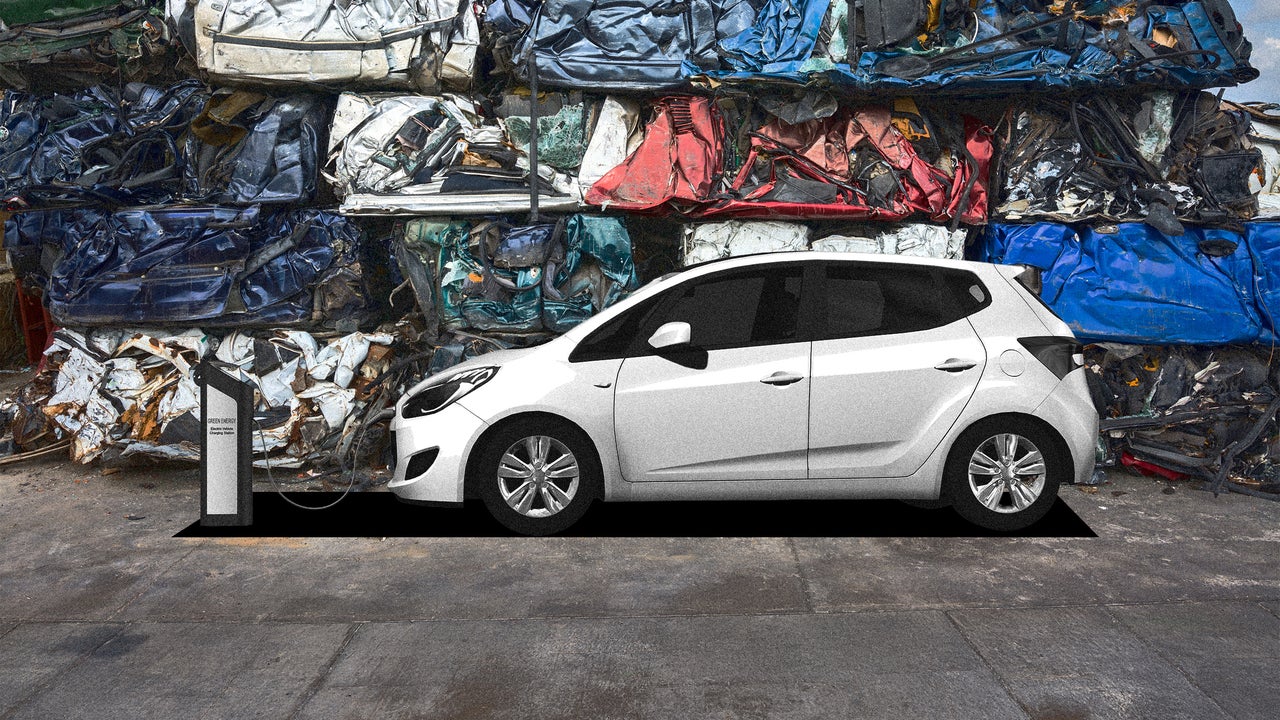
If you really want to reduce your transportation emissions, it would actually be better to scrap a brand new gas-powered car and switch to an electric vehicle instead of waiting until that gas car stopped working.
That’s true even when factoring in the emissions from mining the materials, making each component, and assembling and shipping the cars, as well as powering your new EV with an electric grid that uses fossil fuels.
That may be surprising to some car owners, especially those who are used to repairing and prolonging their goods for the sake of the planet.
“My mantra is ‘repair and reuse’ . . . I even re-soled my flip flops once,” says Elliott Campbell, the study’s lead author, in exploring this EV question.
An environmental studies professor at the University of California Santa Cruz, Campbell admits he thought it would make some environmental sense to repair and keep using a gas-powered car, rather than switching.
“But as you see in the study, for all cars—even new cars that are really efficient, even for the most efficient hybrids—it still made sense to scrap it immediately, or at least whenever it’s financially viable,” he says.
He added, “I was shocked that even the most efficient gas cars should be scrapped if you want to save greenhouse gasses.”
The study was published this month in Science.
EV emissions calculations
As Campbell and his students talked to people about how they think about when to transition to an EV, one conundrum kept coming up.
People would ask, “Do I keep repairing my [gas] car until the wheels fall off before I make the switch, or do I make it sooner?” he says.
While there have been lots of studies on the emissions associated with EVs, and even the monetary savings from switching to electric, there was a gap in the literature when it came to what timing was best.
To find the answer, Campbell and his team calculated the percent difference in emissions from driving a gas-powered vehicle for its full life (about 16 years), compared to scrapping and replacing that car with an EV at earlier years.
Those calculations considered all the energy and emissions that go into creating these vehicles—the mining, assembling, shipping, and so on—as well as the use of the vehicle, like how much gas an internal combustion engine car burns over its lifespan, compared to an EV sourcing energy from the grid.
They considered more than 400 internal combustion engine and battery electric models, and looked at vehicle efficiency, electricity sources, mileage, and also the size of EV batteries and the emissions associated with manufacturing batteries specifically.
“We tried to turn every knob we could imagine,” he says, “but really, in most contexts, the electric vehicle is a clear winner.”
In 92% of scenarios the researchers modeled, it was better, in terms of greenhouse gas emissions, to scrap the gas car and switch to an EV—even if that gas car was a new, more efficient model right off the lot.’’
The EV picture will keep improving
Some arguments against EVs have focused on how energy intensive it is to manufacture them.
And it might seem wasteful, the study admits, to get rid of a new gas car. (It also doesn’t make financial sense; Campbell understands that few people can actually afford to get rid of a new car in order to switch to an EV.)
But while there are emissions associated with manufacturing an EV, gas cars require so much more energy to operate. Just 20% of the energy in the gasoline that goes into a car goes toward moving the vehicle; the other 80% is lost as heat.
“A gas car is like a hair dryer on wheels,” Campbell says. “You would almost imagine that it’s a heater that has this byproduct of transportation.”
EVs, by contrast, flip that: 80% of the electricity that goes through the battery gets used for moving the vehicle, and only 20% is lost as heat.
By getting a gas car off the road sooner rather than later, more miles are driven with the lower emissions associated with EVs. And since transportation is the top source of direct greenhouse gas emissions in the U.S., accounting for more than a quarter of the nation’s emissions, that change can have a big impact.
Though Campbell’s study only considered greenhouse gas emissions, he also touched on the materials that go into each kind of vehicle. The average EV battery weighs roughly half a ton; that’s a way to quantify how much of the materials need to be taken out of the earth to create it.
For a gas-powered vehicle, petroleum needs to be constantly mined to keep that car running. Over that car’s lifespan, it uses something like 20 tons of petroleum, “a factor of 40 difference there in the material Intensity,” Campbell says.
Then, it’s worth considering what happens to those materials. EV batteries can be recycled, with up to 98% of the minerals inside recovered for reuse. EV recycling is still somewhat nascent, but it’s an industry that is ramping up quickly.
By contrast, Campbell says, “When you burn 20 tons of petroleum over the lifetime of a car, it becomes CO2. You’ve lost the petroleum forever.”
Campbell hopes this study can highlight the clear environmental advantages of EVs, and potentially inspire more policymakers to expand or launch scrap-and-replace programs, in which people can get financial incentives to trade their more polluting cars for a zero-emissions vehicle.
And as more renewable energy gets added to our electricity grids, and advancements are made with EV efficiency and battery recycling, that will all factor into the total emissions picture for EVs.
“If we stay on that path,” Campbell says, “things are just going to get better and better for electric vehicles.”