
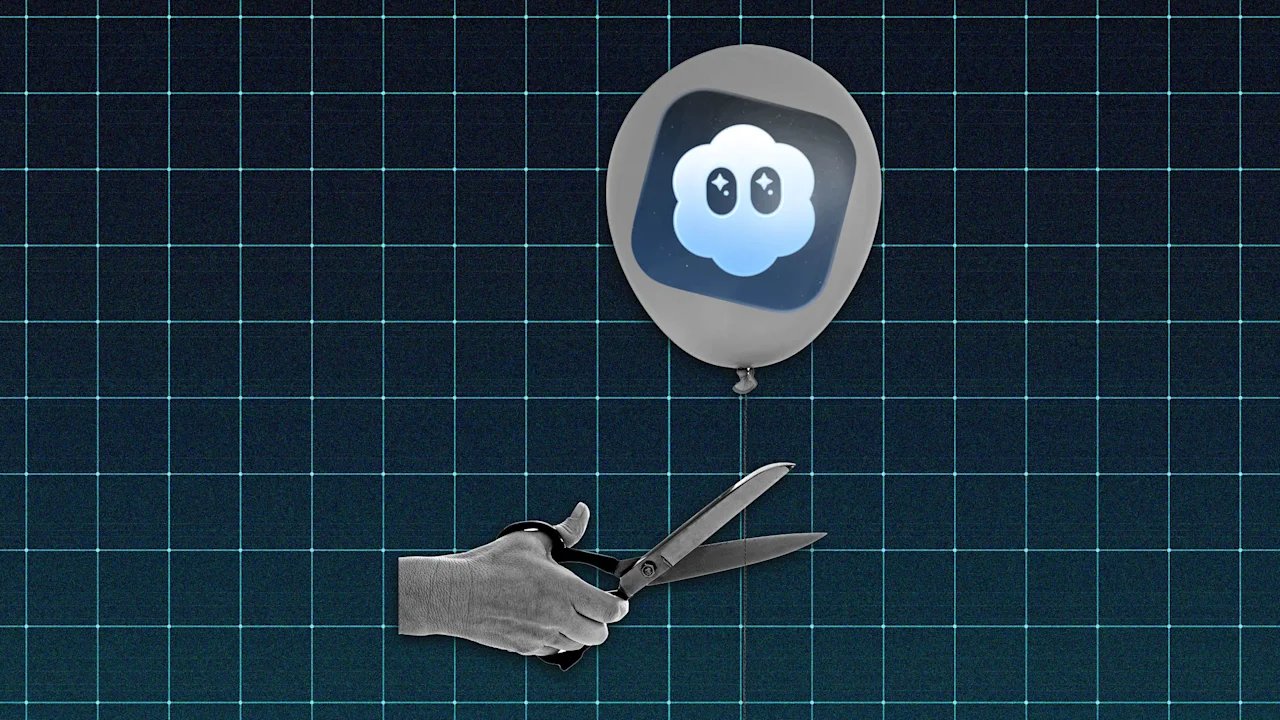
Ding-dong, Sora is dead! So says the executive team at OpenAI, which now wants its talented staff to say goodbye to the generative AI social media platform—which was only online for a few months—and invest most of its efforts on its core business: enterprise services and coding. In other words, OpenAI is back to focusing on its key goal (beating Anthropic), instead of what the company’s CEO of applications reportedly described as a “side quest” (trying to overtake TikTok). Disney, which was hoping to license its iconic characters for use in Sora, is now ditching its investment in the AI giant.
In truth, Sora was probably never going to succeed as a social media service. Social media platforms anchor in the real world. No one really thinks TikTok or Facebook are “real life,” but the apps hook us by promising at least the pretense of reality. People do find news on X, and their real friends and family on Instagram. Influencers on TikTok suggest that you, too, can look like that, can cook like that, can dance like that. Yes, algorithms and misinformation, and now, increasingly, generative AI, are polluting these online ecosystems. But the platforms start from a foundation of connecting us to the real world, even if they’re also warping our perceptions of it, too.
Sora was the contrapositive. The creative universe forged by Sora’s users was one of infinite world-building, a forever-scroll of overly-rendered disrealities. The content available on Sora was, indeed, very cool, but was something more akin to what people look for when they play the Sims (or sign up for an art class), not a hit social media platform. And sure enough, the app only had a bit more than a million weekly users earlier this year, according to a third-party estimate. (For comparison, as TechCrunch pointed out, some 900 million people use ChatGPT every week).
That’s not to say there wasn’t anything to like about Sora. The platform gave people an unprecedented pathway to producing their own fantastical content, funneling to users artistic freedom that might have, a few years earlier, only been available to those employed by Hollywood animation studios. How about a talk show featuring Kermit the Frog explaining what “content moderation” means? Or a livestream of Moses parting the Red Sea? Or an astronaut performing ballet on the moon. All of this content snippets, and far more, are available on Sora, at least before OpenAI officially turns it off.
(For people who genuinely enjoyed the app, or at least used it as an expressive outlet, OpenAI says they plan to release more information soon about how to save their work before the app goes offline for good. “What you made with Sora mattered, and we know this news is disappointing,” the company said in a post on X on Tuesday.)
In the end, though, Sora scratched users’ creative itch, not their consumptive desires.
There was plenty else off-putting about Sora, too. There was the offensive way the service allowed users to bring celebrities back from the dead, including—until the company backtracked and sort of apologized—Martin Luther King Jr. There was the confusing way the app approached political content. No, you couldn’t take a user name associated with a political figure, as Fast Company reported, but you could generate images of a man that looked just like Donald Trump. There were AI-generated images of kids doing cocaine and passing marijuana and other simulations of violence toward young people, which multiple child safety experts had told Fast Company was, err, not good.
Critically, the app’s “Cameo” feature allowed users to lend their face to AI, allowing them (or approved friends) to plop their likeness into all sorts of generated scenarios. This, of course, raised all sorts of concerns, including around minors and copyright.
But it’s also not clear that this feature, which aims to connect our real selves to Sora’s generative AI environment, enables the kind of content most people actually want to watch. I would love to imagine myself rendered on a spaceship, or hanging out with Albert Einstein, or ruling some ancient kingdom. And yes, my friends would probably like one, maybe a few of these videos. Still, I am self-aware to know this is not the content they crave. This is AI self-actualization, not art for an audience.
The best and founding promise of social media is that we’re all operating in one shared digital universe, despite boundaries and borders and limitations of real life. We can see the whole world, this world, in a single feed. That’s the opposite of what Sora created: bifurcating ourselves into an endless supply of imagined universes.