

Know-how Reporter
 Astrolight
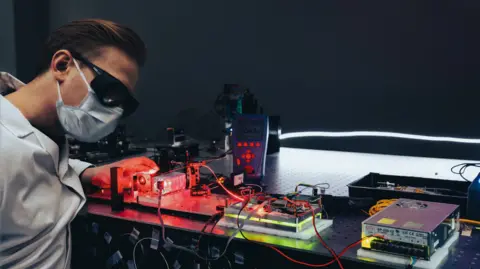
I am led via a collection of concrete corridors at Vilnius Tech College, Lithuania; the murals give a Soviet-era vibe, and it appears an unlikely location for a high-tech lab engaged on a laser communication system.
However that is the place you will discover the headquarters of Astrolight, a six-year-old Lithuanian space-tech start-up that has simply raised €2.8m ($3.3m; £2.4m) to construct what it calls an “optical information freeway”.
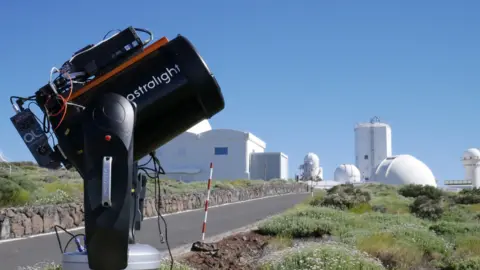
You could possibly consider the tech as invisible web cables, designed to hyperlink up satellites with Earth.
With 70,000 satellites expected to launch within the subsequent 5 years, it is a market with numerous potential.
The corporate hopes to be a part of a shift from conventional radio frequency-based communication, to sooner, safer and higher-bandwidth laser know-how.
Astrolight’s house laser know-how may have defence purposes as effectively, which is well timed given Russia’s current aggressive attitude in direction of its neighbours.
Astrolight is already a part of Nato’s Diana undertaking (Defence Innovation Accelerator for the North Atlantic), an incubator, arrange in 2023 to use civilian know-how to defence challenges.
In Astrolight’s case, Nato is eager to leverage its quick, hack-proof laser communications to transmit essential intelligence in defence operations – one thing the Lithuanian Navy is already doing.
It approached Astrolight three years in the past on the lookout for a laser that may permit ships to speak throughout radio silence.
“So we stated, ‘all proper – we all know the way to do it for house. It appears to be like like we will do it additionally for terrestrial purposes’,” recollects Astrolight co-founder and CEO Laurynas Maciulis, who’s based mostly in Lithuania’s capital, Vilnius.
For the navy his firm’s tech is enticing, because the laser system is troublesome to intercept or jam.
It is also about “low detectability”, Mr Maciulis provides:
“In the event you flip in your radio transmitter in Ukraine, you are instantly turning into a goal, as a result of it is easy to trace. So with this know-how, as a result of the data travels in a really slender laser beam, it is very troublesome to detect.”

 Astrolight
Value about £2.5bn, Lithuania’s defence finances is small whenever you evaluate it to bigger nations just like the UK, which spends round £54bn a 12 months.
However should you take a look at defence spending as a share of GDP, then Lithuania is spending greater than many greater nations.
Round 3% of its GDP is spent on defence, and that is set to rise to five.5%. By comparability, UK defence spending is price 2.5% of GDP.
Recognised for its energy in area of interest applied sciences like Astrolight’s lasers, 30% of Lithuania’s house tasks have acquired EU funding, in contrast with the EU nationwide common of 17%.
“Area know-how is quickly turning into an more and more built-in factor of Lithuania’s broader defence and resilience technique,” says Make investments Lithuania’s Šarūnas Genys, who’s the physique’s head of producing sector, and defence sector knowledgeable.
Area tech can typically have civilian and navy makes use of.
Mr Genys offers the instance of Lithuanian life sciences agency Delta Biosciences, which is making ready a mission to the Worldwide Area Station to check radiation-resistant medical compounds.
“Whereas developed for spaceflight, these improvements may additionally assist particular operations forces working in high-radiation environments,” he says.
He provides that Vilnius-based Kongsberg NanoAvionics has secured a serious contract to fabricate a whole bunch of satellites.
“Whereas primarily business, such infrastructure has inherent dual-use potential supporting encrypted communications and real-time intelligence, surveillance, and reconnaissance throughout NATO’s jap flank,” says Mr Genys.
 BlackSwan Area
Going hand in hand with Astrolight’s laser know-how is the autonomous satellite tv for pc navigation system fellow Lithuanian space-tech start-up Blackswan Area has developed.
Blackswan Area’s “imaginative and prescient based mostly navigation system” permits satellites to be programmed and repositioned independently of a human based mostly at a floor management centre who, its founders say, will not be capable of sustain with the sheer quantity of satellites launching within the coming years.
In a defence surroundings, the identical know-how can be utilized to remotely destroy an enemy satellite tv for pc, in addition to to coach troopers by creating battle simulations.
However the gross sales pitch to the Lithuanian navy hasn’t essentially been easy, acknowledges Tomas Malinauskas, Blackswan Area’s chief business officer.
He is additionally involved that authorities funding for the sector is not matching the extent of innovation popping out of it.
He factors out that as a substitute of spending $300m on a US-made drone, the federal government may spend money on a constellation of small satellites.
“Construct your personal functionality for communication and intelligence gathering of enemy nations, reasonably than a drone that’s going to be shot down within the first two hours of a battle,” argues Mr Malinauskas, additionally based mostly in Vilnius.
“It will be an enormous enhance for our small house neighborhood, however as effectively, it will be a long-term, sustainable value-add for the way forward for the Lithuanian navy.”
 Area Hub LT
Eglė Elena Šataitė is the top of Area Hub LT, a Vilnius-based company supporting house corporations as a part of Lithuania’s government-funded Innovation Company.
“Our authorities is, in fact, conscious of the fact of the place we stay, and that we have now to take a position extra in safety and defence – and we have now to confess that house applied sciences are those which can be enabling defence applied sciences,” says Ms Šataitė.
The nation’s Minister for Financial system and Innovation, Lukas Savickas, says he understands Mr Malinauskas’ concern and is authorities spending on creating house tech.
“Area know-how is without doubt one of the highest added-value creating sectors, as it’s identified for its horizontality; many space-based options go in step with biotech, AI, new supplies, optics, ICT and different fields of innovation,” says Mr Savickas.
No matter occurs with authorities funding, the Lithuanian urge for food for innovation stays sturdy.
“We all the time should show to others that we belong on the worldwide stage,” says Dominykas Milasius, co-founder of Delta Biosciences.
“And every part we do can also be geopolitical… we have now to construct up crucial worth choices, sciences and different crucial applied sciences, to make our allies perceive that it is most likely good to guard Lithuania.”