

Know-how Reporter
 Fermentalg
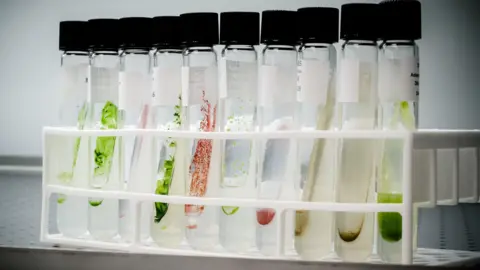
French agency Fermentalg has been all around the planet in its seek for helpful microalgae.
“Considered one of our fortunate scientists acquired to go and climb the volcanoes within the Caribbean for instance, and I’ve to restrain myself from amassing extra each time I am going residence to New Zealand,” says Hywel Griffiths, chief scientific officer at Fermentalg.
There are a whole bunch of 1000’s of species of microalgae – microscopic organisms, which largely stay in water. They’re important to the aquatic meals chain and in addition produce half the oxygen we breathe.
Some are already used commercially, to make food, animal feed and fertiliser.
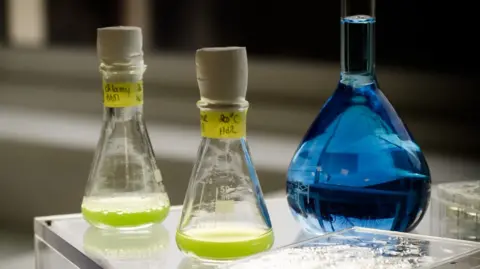
However for Fermantalg one specific kind, Galdieria sulphuraria, has a really helpful trait. It may be used to provide a pigment, appropriate to be used in meals, known as Galdieria blue.
“We develop the algae and make lots of it below circumstances which make lots of this specific molecule – the blue,” says Mr Griffiths.
The pigment can be utilized for any meals and drinks and Mr Griffiths expects the primary merchandise utilizing Galdieiria blue will probably be on store cabinets early subsequent yr.
Galdieria blue was approved by the US Meals and Drug Administration (FDA) in Could, together with Butterfly pea flower extract (additionally a blue color) and calcium phosphate (white).
The FDA also approved Gardenia blue earlier this month.

 Fermentalg
New sources of color for meals are wanted as synthetic meals dyes are on their means out.
In January, the FDA announced the banning of Pink Dye No. 3 in meals merchandise.
As well as, the FDA is seeking to part out petroleum-based artificial dyes akin to Yellow Dye 5 and 6 by the tip of subsequent yr as a part of the federal government’s mission to “Make America Wholesome Once more”.
“For the final 50 years, American youngsters have more and more been residing in a poisonous soup of artificial chemical substances,” FDA commissioner Marty Makary stated at a press convention in April.
Although not an outright ban, the FDA is hoping the meals trade voluntarily complies to remove synthetic meals dyes by 2026.
It comes after years of stress from mother and father and campaigners for the FDA to revoke approval for dyes or educate customers extra in regards to the dangers.
In latest occasions, many US states have made their very own strikes to go legal guidelines to take away synthetic meals colouring dyes.
Nations differ on the restrictions they’ve in place. Traditionally, the UK and the European Union have been stricter than the US.
The EU has been phasing out synthetic colourings over the past 20 years and in addition introducing warnings on meals with different colors.
 Sensient
So, these are good occasions for companies creating pure alternate options.
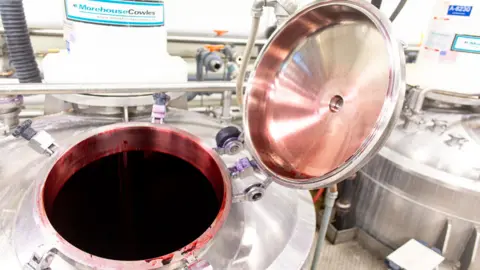
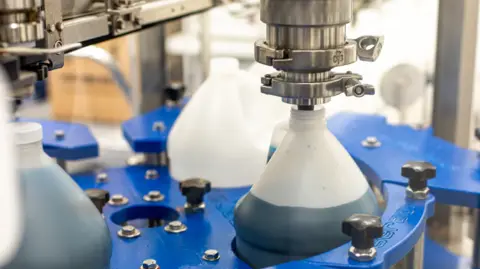
US-based Sensient creates pure colors by sourcing uncooked supplies which are grown particularly for his or her color content material. For instance, some crimson and purple colors are derived from carrots and potatoes.
“These crops are harvested, washed, processed right into a juice, and the color is extracted with water or different solvents,” says Paul Manning, chief government officer at Sensient.
“The ensuing color is additional processed to stabilise the focus and refine it to the precise shade desired by the client.”
However the arduous work will probably be attempting to match the artificial color. “It have to be equally vivid,” says Mr Manning.
“There are many examples of manufacturers changing to pure colors with much less vivid and vibrant shades the place the product does poorly out there and prospects complain about each the color and the flavour.”
Getting a steady, vivid color additionally concerned a lot work for Fermantalg.
“To our shock we discovered that the method of rising the algae and the method of extracting the color can even have a reasonably vital impression on the steadiness of the product on the finish, despite the fact that it is pretty closely purified,” says Griffiths.
“However one thing that we have achieved upstream is having an impression on how steady it’s on the finish.”
Will these new colors price extra?
“They’re costlier, however in precise contribution to the tip product, they don’t seem to be really that large an impression as a result of this stuff are used at a fraction of a share within the remaining product,” says Mr Griffiths.
“In the event you had a nosebleed and stood over the sink… you realize that just a little little bit of color goes a great distance.”
 Sensient
For the manufacturers which have lengthy relied on synthetic colourings, it is an upheaval.
“We’re reformulating our cereals served in colleges to not embrace FD&C colors by the 2026-27 college yr,” says a spokesperson for WK Kellogg, the corporate behind Kellogg’s.
FD&C refers to sure licensed artificial color components regulated by the FDA, and accepted by the Federal Meals, Drug, and Beauty Act.
Last year protesters gathered outdoors the corporate headquarters in Michigan, calling on it to take away synthetic dyes from cereals akin to Froot Loops.
“We is not going to be launching any new merchandise with FD&C colors, starting in January 2026,” the spokesperson stated.
This yr meals giants together with Nestle, Kraft Heinz, Common Mills and Conagra have all pledged to phase out artificial food colourings.
One of many challenges for meals manufacturers reliant on synthetic colouring is that many pure meals dyes do not essentially have a protracted shelf life, says Institute of Meals Technologists meals scientist Renee Leber.
“Whereas artificial dyes will outlive the shelf lifetime of just about any product.”
She additionally says that as many manufacturers rush to make the swap it will result in a “bottleneck” in manufacturing.
“We do not essentially have all these colors obtainable. However we now have 10 months to get that proper.”
Given this is not an outright ban, is it nonetheless anticipated to result in sweeping change within the US meals trade?
“If you’re a cereal firm and you’ve got a brightly colored cereal and your entire rivals swap from synthetics to pure colors, then you do not essentially need to be the final one,” says Ms Leber.
“It is a tight timeframe however corporations are doing their greatest to conform.”